Comparison
Babolat Pure Drive vs Yonex EZONE 100
These are the two frames club players most often end up choosing between, and on paper they are almost the same racket. Four differences do the separating, and only two of them are ones you will feel.
By Janet H.Updated
The short answer
Both are 100 sq in frames at 318 g strung, 4 points head light, in a 16x19 pattern. The Pure Drive 2025 runs two swingweight points higher, one RA point stiffer and a thinner 23 mm tip. The EZONE 100 2025 has a 24.5 mm upper hoop, an Isometric head and a far wider 45-60 lb tension range.
Disclosure — we earn a commission on qualifying purchases made through links on this page, at no extra cost to you. It never changes which product we rank first. How this site is funded.
Our picks
| # | Product | Best for | Score | Price |
|---|---|---|---|---|
| 1 | 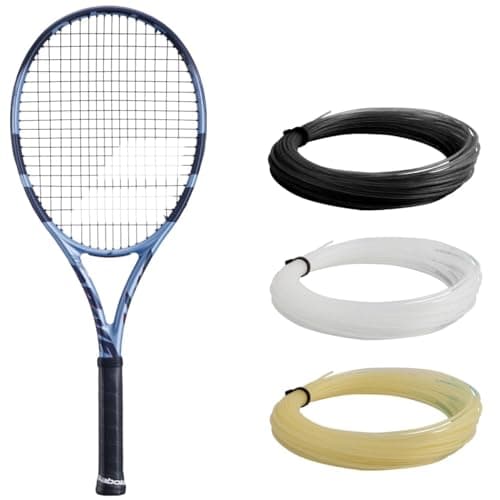 Babolat Pure Drive 2025Pick for pace | Baseliners who want the ball to leave the string bed faster | 8.75 criteria | |
| 2 | 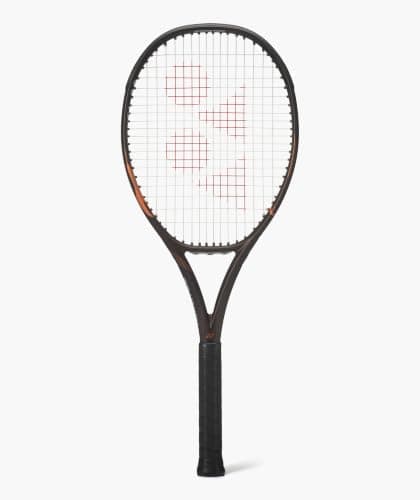 Yonex EZONE 100 (2025)Pick for feel | Players who want the same weight class with more setup room | 8.75 criteria |
The picks in detail
01Babolat Pure Drive 2025
Pick for paceBest for: Baseliners who want the ball to leave the string bed faster
Tennis Warehouse describe it as a lightning-fast racquet with easy access to power and spin, aimed at the baseliner who likes dictating action with heavy pace. That is the clearest statement of intent either of these frames makes, and it is the reason the Pure Drive has been the default club frame for twenty years.
The specification backs it where it matters: a 317 swingweight at 318 g strung with a 4-points-head-light balance, and the thinnest tip of the two at 23 mm. Babolat's HTR layup stiffens the hoop, which the retailer notes enhances power while also reducing frame wobble, and the 2025 generation adds an updated NF2 flax-fiber damper in the throat.
The honest cost is the tension window. Tennis Warehouse list a 46-55 lb range with an optimum of 51 — narrow, and low. If you like your strings tight, or you want a poly setup at 55-plus, this frame will not let you go where the EZONE will, and stringing above the listed range is at your own risk rather than the manufacturer's.
Our score
- Power
- 9.0
- Control
- 8.0
- Forgiveness
- 8.0
- Arm comfort
- 7.5
- Maneuverability
- 8.5
- Overall
- 8.7
Verified specs
- Head size
- 100 sq in
- Strung weight
- 11.2 oz / 318 g
- Balance
- 4 pts head light
- Swingweight
- 317
- Stiffness (RA)
- 69
- Beam
- 23 / 26 / 23 mm
- String pattern
- 16x19
- Length
- 27 in
Specs as published by Tennis Warehouse, checked September 2026.
Buy if
- Your complaint is that your shots land short
- You play from the baseline and want to dictate
- You want the most proven club frame of the two
Pass if
- You string tight or want a wide tension window
- You have had arm trouble and want the softer of the two
- You prefer a plush, muted response
02Yonex EZONE 100 (2025)
Pick for feelBest for: Players who want the same weight class with more setup room
Identical on the three numbers people shop by — 100 sq in, 318 g strung, 4 points head light — and then different in the places that are harder to read off a product page. The beam is 24.5 mm at the tip against the Babolat's 23, because Yonex thickened the upper hoop in this generation specifically to add power and stability there.
The practical advantage is the tension range: 45-60 lb, fifteen pounds wide against the Pure Drive's nine. That is the single most useful difference on this page, because it means one frame can be set up soft for comfort or tight for control without leaving the manufacturer's window. Yonex also put Minolon fibers in the shaft to damp vibration and cut a groove in the inner frame so the hoop bends more predictably through impact.
The costs are a slightly lower swingweight at 315 — marginally less plow-through — and the Isometric head shape, which is a squarer hoop that broadens the string-bed sweet spot and which some players simply do not like the look or the feel of. Tennis Warehouse customers rate it 4.5 out of 5 across 17 reviews, against 4.8 across 36 for the Pure Drive, so the crowd leans Babolat.
Our score
- Power
- 8.5
- Control
- 8.5
- Forgiveness
- 8.5
- Arm comfort
- 8.5
- Maneuverability
- 8.5
- Overall
- 8.7
Verified specs
- Head size
- 100 sq in
- Strung weight
- 11.2 oz / 318 g
- Balance
- 4 pts head light
- Swingweight
- 315
- Stiffness (RA)
- 68
- Beam
- 24.5 / 26.5 / 23 mm
- String pattern
- 16x19
- Length
- 27 in
Specs as published by Tennis Warehouse, checked September 2026.
Buy if
- You want one frame that can be strung soft or tight
- You want a broader sweet spot from the head shape
- Arm comfort is a factor in the decision
Pass if
- You want maximum plow-through
- You dislike a squared-off hoop
- You want the frame with the longer club-level track record
The specification sheets, side by side
Read this table before reading anything else about either frame, because it does most of the work. Nine of the thirteen lines are either identical or so close that no player would detect the difference.
| Specification | Babolat Pure Drive 2025 | Yonex EZONE 100 2025 | Does it matter? |
|---|---|---|---|
| Head size | 100 sq in | 100 sq in | Identical |
| Strung weight | 11.2 oz / 318 g | 11.2 oz / 318 g | Identical |
| Balance | 4 pts head light | 4 pts head light | Identical |
| Length | 27 in | 27 in | Identical |
| String pattern | 16x19 | 16x19 | Identical |
| Swingweight | 317 | 315 | No — two points is inside stringing variance |
| Stiffness (RA) | 69 | 68 | No — one point is not detectable |
| Beam width | 23 / 26 / 23 mm | 24.5 / 26.5 / 23 mm | Yes — see below |
| Tension range | 46-55 lb (optimum 51) | 45-60 lb | Yes — the biggest practical gap |
| Head shape | Conventional | Isometric | Yes — changes the sweet-spot shape |
| Damping | NF2 flax fibers in the throat | Minolon fibers in the shaft | Marginally |
| Composition | Graphite | Minolon / 2G NAMD Speed / HM Graphite | Not on its own |
| Price bracket | Premium | Premium | No — a few dollars apart at the same retailer |
Here is the part that most comparisons of these two frames leave out. Tennis Warehouse rate both at the same power level, Low-Medium; the same stroke style, Medium-Full; and the same swing speed, Medium-Fast. The retailer's own classification system cannot separate them. If you were hoping for a page that tells you one is the power racket and one is the control racket, the specification sheets do not support it.
Difference one: the beam, and where the thickness sits
Both frames use a tapered beam that is thickest in the middle. The Pure Drive runs 23 mm at the tip, 26 mm at the mid and 23 mm at the throat. The EZONE runs 24.5 mm at the tip, 26.5 mm at the mid and 23 mm at the throat.
The 1.5 mm at the tip is the meaningful number, and it points in a direction most people would not predict from the two frames' reputations. A thicker upper hoop resists bending more, which returns more energy on balls struck high in the string bed and holds its shape better on off-center contact up there. Yonex say so explicitly: they thickened the beam in the upper hoop to enhance power and stability.
So on the specification that governs how the top of the string bed behaves, the EZONE is the stiffer, more powerful frame of the two, while the Pure Drive is thinner and more flexible at the tip. That runs against the marketing of both rackets, which is exactly why reading the beam line is worth the thirty seconds. If the whole topic is new, tennis racket head size explains how hoop geometry and sweet-spot location interact.
Difference two: the tension range, and why it is the big one
If you only take one thing from this page, take this. The Pure Drive's recommended range is 46-55 lb with a listed optimum of 51. The EZONE's is 45-60 lb. That is a nine-pound window against a fifteen-pound window, and the EZONE's extends five pounds higher at the top.
String tension is the cheapest and most powerful adjustment you have. It changes power, control, comfort and spin potential more than most frame swaps do, and it costs the price of a restring rather than the price of a racket. A frame with a wider recommended window is a frame you can keep re-tuning as your game changes, without going outside what the manufacturer will stand behind.
This matters most if you are heading toward a polyester string. Poly is usually strung lower than synthetic gut or multifilament to keep it playable, and plenty of club players end up wanting a hybrid at the upper end of the range for control. The EZONE accommodates both ends; the Pure Drive accommodates the lower end and asks you to live with 55 as a ceiling. Tennis string tension covers how to pick a number inside whichever range you end up with.
Difference three: Isometric versus a conventional hoop
The EZONE's head is squarer than a traditional oval. Yonex's argument for Isometric is that squaring the hoop equalizes the lengths of the main and cross strings near the top of the string bed, which enlarges the area where the string bed deflects efficiently. Tennis Warehouse describe the resulting feel as undeniably more plush and responsive than conventionally shaped equivalents.
Treat that as a real design difference with an unquantified benefit. Neither we nor the retailer publishes a measured sweet-spot area for either frame, so the honest position is that the geometry is genuinely different and the size of the advantage is not something anyone has given us a number for.
What we can say is that it is visible, and some players dislike it on sight. If you have played a Yonex before and the hoop shape never bothered you, this is a non-issue. If you have not, it is worth seeing one in person before ordering.
Difference four: how each frame handles vibration
Both frames carry a damping system and both put it in a different place. Babolat's updated NF2 Tech uses flax fibers in the throat to smooth out harsh vibrations. Yonex use Minolon, which Tennis Warehouse describe as ultra-thin flexible fibers, in the shaft, alongside a groove in the inner frame intended to make the hoop bend optimally through impact.
On the stiffness number that correlates most strongly with transmitted shock, these two frames are a point apart: 69 against 68. One RA point is not a difference you can feel, and we are not going to tell you otherwise.
If arm comfort is the actual reason you are shopping, neither of these is the answer. Both sit in the stiff band where almost all modern 100 sq in power frames live. The frames built for that problem are a long way further down the stiffness scale — see best tennis rackets for tennis elbow, and the Wilson Clash 100 v3 review for the softest mainstream frame sold at 54 RA.
So which one should you buy?
When two frames are this close, the deciding factor is usually not the frame. It is whether you already own a stringing preference, whether you have a brand you get on with, and which one your local shop will let you demo. All three of those beat a two-point swingweight difference.
| If this is you | Buy | Because |
|---|---|---|
| Your shots land short | Pure Drive 2025 | The retailer's own framing: easy power, built for dictating pace |
| You want to experiment with tension | EZONE 100 2025 | 45-60 lb against 46-55 lb |
| You are moving to a polyester string | EZONE 100 2025 | Room at both ends of the range for a poly or hybrid setup |
| You want maximum plow-through | Pure Drive 2025 | 317 swingweight against 315, thinner tip |
| You mishit high in the string bed | EZONE 100 2025 | 24.5 mm upper hoop plus the Isometric head shape |
| You want the frame most club players own | Pure Drive 2025 | 4.8 out of 5 from 36 Tennis Warehouse customer reviews against 4.5 from 17 |
| You dislike squared-off hoops | Pure Drive 2025 | Conventional head shape |
| Arm trouble is the reason you are shopping | Neither | 69 and 68 RA — both stiff; look at a 54 RA frame instead |
Both are currently sold, with one caveat
Checked on 8 October 2026: Tennis Warehouse list both frames in stock, in the same premium price bracket and a few dollars apart. The EZONE's stock is quoted per grip size rather than as a single figure, so availability of the grip you want is worth confirming before you order. Neither frame is a discontinued or run-out model.
Grip size is worth settling before you order either one, because it is the one fitting decision you cannot adjust downward later — an overgrip adds roughly half a size, so buying at the top of your range leaves you nowhere to go. Tennis racket grip size explains how to measure your hand.
If neither of these is the frame
Both of these are premium 318 g frames for a developing-to-competitive club player. That is a specific buyer. If it is not you, these are the places to look instead.
| If you want | Consider | Why |
|---|---|---|
| Something softer on the arm | Wilson Clash 100 v3 | 54 RA, the softest mainstream frame sold |
| Something lighter | HEAD Speed MP UL 2026 | 278 g strung, 291 swingweight |
| More control, smaller head | Wilson Blade 98 16x19 v10 | 98 sq in, thin box beam, 61 RA |
| A spin-first frame | Babolat Pure Aero 98 2026 | 98 sq in aero frame built around spin |
| A first racket on a budget | Babolat Boost Drive | Entry price, arrives strung |
Full rankings live on best tennis rackets for intermediate players and best tennis rackets for power and spin. If you are not sure which band you belong in, racquet sports skill levels explained defines them by what happens in your rallies rather than by a rating.
And if you are reading this page while still on your first racket, it is probably too early. The frame most people start on is the HEAD Titanium Ti.S6 — 115 sq in and 244 g at an entry price — and the reason to leave it is a control ceiling rather than anything either of these two will fix sooner.
How this comparison was made
We have not hit with either frame. Racket & Rally does not run a test lab and nothing here is written as though we had one.
What this page is instead: both specification sheets read side by side from the retailer listings cited at the foot of the page, retrieved on 8 October 2026, plus an explanation of which differences change something you will notice and which are marketing. Where the two frames are genuinely indistinguishable on paper we say so rather than inventing a separation. Our full selection criteria set out the method.
Common questions
Is the Babolat Pure Drive or the Yonex EZONE 100 better?
Neither, on the specification sheets. Both are 100 sq in frames at 318 g strung, 4 points head light, in a 16x19 pattern, and Tennis Warehouse assign both the same power level, stroke style and swing speed. Choose on the four real differences: tension range, beam thickness at the tip, head shape and which brand you get on with.
What is the main difference between the Pure Drive 2025 and the EZONE 100 2025?
The recommended string tension range. The Pure Drive is 46-55 lb with an optimum of 51; the EZONE is 45-60 lb. Fifteen pounds of window against nine means the EZONE can be set up soft for comfort or tight for control without going outside what Yonex recommend.
Which has more power, the Pure Drive or the EZONE 100?
Tennis Warehouse rate both Low-Medium on their own power scale, so their classification does not separate them. On geometry the EZONE has the thicker upper hoop at 24.5 mm against 23 mm, which favors balls struck high in the string bed; the Pure Drive has two more swingweight points, which favors plow-through.
Is the Yonex EZONE 100 good for intermediate players?
Yes. At 318 g strung with a 315 swingweight and a 4-points-head-light balance it sits squarely in the intermediate-to-advanced bracket, and Tennis Warehouse market this update to exactly that group. A first-year player would be better served by something lighter.
Is either frame good for tennis elbow?
No, and we would not recommend either for that reason. They measure 69 and 68 RA, both in the stiff band where modern 100 sq in power frames sit. A frame chosen for arm comfort should be considerably softer — the Wilson Clash 100 v3 is 54 RA.
What does Isometric mean on a Yonex racket?
A squarer head shape rather than a traditional oval. Squaring the hoop equalizes main and cross string lengths near the top of the string bed, which Yonex say enlarges the efficient hitting area. Nobody publishes a measured sweet-spot area for it, so treat the benefit as real in direction and unquantified in size.
How much do the Pure Drive and EZONE 100 cost?
Both sit in the premium bracket and were within a few dollars of each other at the same retailer when we checked on 8 October 2026 — close enough that price should not decide it. Prices move, so take the current figure from the buy links above rather than from any number written into a page.
Read next
Sources
- 01Tennis Warehouse — Babolat Pure Drive 2025
- 02Tennis Warehouse — Yonex EZONE 100 2025
- 03Tennis Warehouse — Best Tennis Racquets gear guide
Every source above was retrieved while writing this page. Specifications are quoted from the listing or manufacturer page cited, not from memory.