Guide
Tennis string tension explained
Lower for power and comfort, higher for control. Simple to state, and the single most underused adjustment available to a club player.
By Janet H.Updated
The short answer
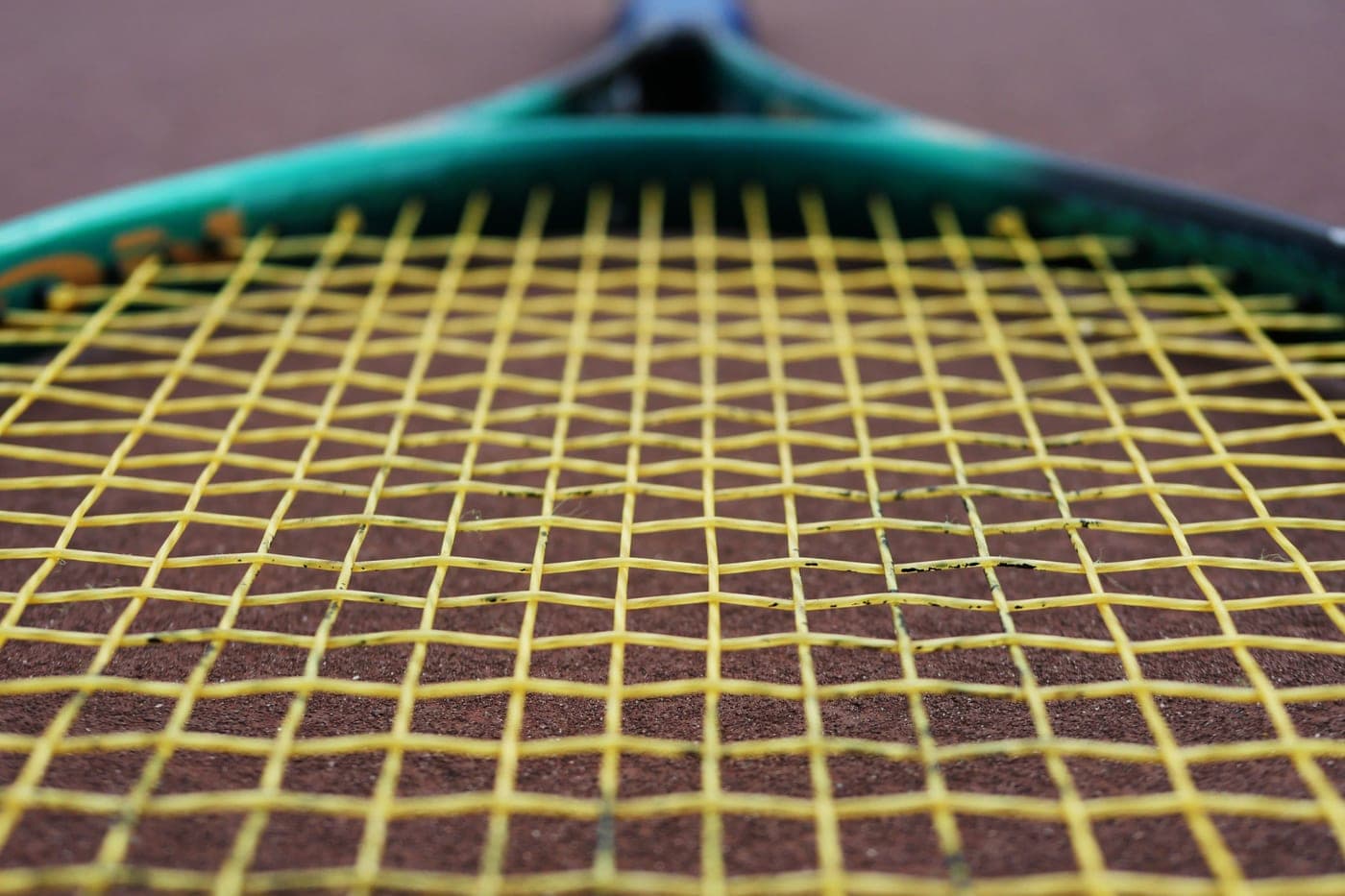
Start in the middle of the range printed inside your frame's hoop, then adjust in 2 lb steps. Lower tension gives more power, more comfort and a higher launch angle; higher tension gives more control and a lower launch angle. A change of 4-6 lb is clearly noticeable; 2 lb is subtle but real.
Disclosure — we earn a commission on qualifying purchases made through links on this page, at no extra cost to you. It never changes which product we rank first. How this site is funded.
What tension actually does
A string bed stores and returns energy when the ball deforms it. At lower tension the bed deforms further, holds the ball fractionally longer, and returns more energy — more power, higher launch, longer dwell, more comfort. At higher tension it deforms less and returns less, which reads as control.
| Lower tension | Higher tension | |
|---|---|---|
| Power | More | Less |
| Control | Less | More |
| Launch angle | Higher — balls travel further | Lower — balls travel shorter |
| Comfort | Better | Worse |
| Dwell time | Longer | Shorter |
| Spin potential | Slightly more | Slightly less |
The spin row surprises people. Lower tension lets the main strings move further sideways and snap back further, which is the mechanism behind topspin — so the old belief that tight strings produce spin has it backward.
Where to start
Every frame has a recommended range printed inside the hoop. The Wilson Clash 100 v3's, for instance, is 47 to 57 lb with an optimum of 55. Start in the middle of yours, play three or four sessions, then adjust.
- Balls landing long — go up 2-4 lb.
- Balls landing short — go down 2-4 lb.
- Arm discomfort — go down 4-6 lb, and consider changing string type.
- Bed feels dead and unresponsive — this is usually age, not tension. Restring.
String type changes the right tension
This is the part most club players do not know, and it causes more bad string jobs than anything else. Polyester is significantly stiffer than multifilament at the same tension, so it is normally strung several pounds lower.
A player who has been using multifilament at 55 lb and switches to polyester at 55 lb ends up with a bed that is both harsher and lower-powered than they expected — and frequently concludes that polyester is terrible, when what was terrible was the tension choice.
In a hybrid setup the mains and crosses are usually strung at different tensions too, with the polyester mains a few pounds below the softer crosses. Any competent stringer will do this by default; it is worth confirming.
Tension loss, which is the real story
Strings begin losing tension the moment they come off the machine, and they keep losing it whether or not you play. Polyester loses a substantial fraction within the first few hours of play and continues falling; multifilament and synthetic gut lose tension more gradually.
The practical consequence is that most club players spend most of their time on a bed several pounds below what they asked for, and adjust their swing to compensate without noticing. That is why restringing on a schedule rather than on breakage is the single most noticeable upgrade available to a regular player.
The rule of thumb: restring as many times a year as you play in a week. On polyester, every six to eight weeks regardless of breakage.
Things that do not work
- Stringing outside the recommended range. The range exists because the frame is designed for those loads. Going well above can damage the hoop; going well below produces an unstable bed.
- Chasing tension to fix technique. If your misses are long only when you go for it, that is timing, and no tension change will address it.
- Stringing tight for spin. It is backward — lower tension lets the mains move and snap back more.
- Ignoring the string type. Tension numbers are not comparable across types; 55 lb of poly and 55 lb of multifilament are different beds.
Now pick yours
The specs above are only useful once they resolve into something you can buy. These are the products that match what this page has just explained.
Our picks
| # | Product | Best for | Score | Price |
|---|---|---|---|---|
| 1 |  Wilson NXTBest comfort string | Comfort at any tension | 8.64 criteria | |
| 2 | Solinco Hyper-GBest control polyester | Lower tensions with control | 8.24 criteria | |
| 3 | Prince Synthetic Gut DuraflexBest for testing | Experimenting cheaply | 8.04 criteria |
01Wilson NXT
Best comfort stringBest for: Comfort at any tension
Tension interacts with string type, and a multifilament is the type that gives you the widest usable tension range. Tennis Warehouse name NXT their comfort winner — over a thousand ultra-flexible fibers bonded with polyurethane, at $23.95.
Because it stretches further than a monofilament, it stays comfortable at tensions where a polyester would feel boardy, which gives you room to raise tension for control without paying for it in shock.
It frays rather than snapping, so you will see it wearing before it breaks — restring when the fraying starts, because a frayed multifilament has already lost much of its stretch.
Our score
- Performance
- 8.5
- Comfort
- 10.0
- Durability
- 7.0
- Value
- 7.5
- Overall
- 8.6
Verified specs
- Type
- Multifilament
- Gauges
- 16, 17
- TW award
- Comfort
- Construction
- 1,000+ fibers bonded with polyurethane
- Listed price
- $23.95 per set
Specs as published by Tennis Warehouse, checked September 2026.
Buy if
- You want a wide usable tension range
- Comfort is a priority
- You do not break strings quickly
Pass if
- You break strings in under two weeks
- You need maximum control
- Budget is very tight
02Solinco Hyper-G
Best control polyesterBest for: Lower tensions with control
Polyester behaves very differently with tension than multifilament does, and understanding that is most of the practical value of this page. Tennis Warehouse award Hyper-G their control category at $13.99.
Poly is normally strung several pounds lower than a multifilament would be in the same frame, because it is stiffer to begin with. Stringing polyester at a multifilament's tension is the most common way club players end up with a harsh, low-powered bed.
Its wide gauge range — 15L through 20 — also matters once you start adjusting tension deliberately, because gauge and tension interact.
Our score
- Performance
- 9.0
- Comfort
- 5.5
- Durability
- 9.0
- Value
- 8.5
- Overall
- 8.2
Verified specs
- Type
- Polyester
- Gauges
- 15L to 20
- TW award
- Control
- Listed price
- $13.99 per set
Specs as published by Tennis Warehouse, checked September 2026.
Buy if
- You break softer strings quickly
- You want control and spin
- You will string it a few pounds lower
Pass if
- You have arm sensitivity
- Your strings last a month or more
- You want power from the bed
03Prince Synthetic Gut Duraflex
Best for testingBest for: Experimenting cheaply
Tennis Warehouse list this at $4.76 a set, which makes it the sensible string to experiment with. If you want to know what 4 lb does in your frame, do it twice in synthetic gut rather than twice in a $24 multifilament.
It is neutral — not especially powerful, not especially controlled — which is also useful for this purpose. You are measuring the tension change rather than the string.
It loses tension faster than a premium string, so treat any conclusions as directional rather than precise.
Our score
- Performance
- 7.5
- Comfort
- 7.5
- Durability
- 8.0
- Value
- 10.0
- Overall
- 8.0
Verified specs
- Type
- Synthetic gut
- Gauges
- 16, 17
- TW award
- All-Around Value
- Listed price
- $4.76 per set
Specs as published by Tennis Warehouse, checked September 2026.
Buy if
- You are testing tension changes
- You want the lowest cost per restring
- You want a neutral baseline
Pass if
- You want maximum comfort
- You want long tension life
- You break strings quickly
Common questions
What tension should I string my racket at?
Start in the middle of the range printed inside your frame's hoop, then adjust in 2 lb steps. Lower for power and comfort, higher for control. A 4-6 lb change is clearly noticeable.
Does lower string tension give more power?
Yes. A looser bed deforms further, holds the ball longer and returns more energy. It also raises your launch angle, so balls travel further — which is power and reduced control at the same time.
Do tight strings give more spin?
No, the opposite. Spin comes from the main strings sliding sideways and snapping back, and a looser bed lets them move further. Tight strings restrict that movement.
Should polyester be strung at a lower tension?
Yes, usually several pounds lower than a multifilament in the same frame, because polyester is considerably stiffer to begin with. Stringing poly at a multifilament's tension is the most common cause of a harsh, low-powered bed.
How quickly do strings lose tension?
Immediately and continuously, whether or not you play. Polyester loses a substantial fraction within the first few hours of play; multifilament and synthetic gut lose it more gradually. Most club players are playing several pounds below what they asked for.
Read next
Sources
- 01Tennis Warehouse — Best Tennis Strings gear guide
- 02Tennis Warehouse — Wilson Clash 100 v3 (tension range)
Every source above was retrieved while writing this page. Specifications are quoted from the listing or manufacturer page cited, not from memory.