Guide
How to choose a padel racket
Five decisions, and the first one — shape — determines most of the others. Get it right and the rest fall into place; get it wrong and no amount of carbon grade helps.
By Janet H.Updated

The short answer
Decide in this order: shape (round for beginners, teardrop for improvers, diamond for advanced attackers), core hardness (soft first), face material (fiberglass or soft carbon before high-modulus carbon), weight (350-360 g), and balance (head light to start). Shape determines where the sweet spot sits, which drives everything else.
Disclosure — we earn a commission on qualifying purchases made through links on this page, at no extra cost to you. It never changes which product we rank first. How this site is funded.
Decision 1 — shape
A padel racket's outline determines where its mass sits, and that determines where the sweet spot is. Everything else follows.
| Shape | Sweet spot | Natural balance | Suits |
|---|---|---|---|
| Round | Centered and large | Head light | Beginners, control players |
| Teardrop | Slightly high, medium | Medium | Improvers, all-rounders |
| Diamond | High and small | Head heavy | Advanced attackers |
Buying a diamond as a first racket is the most common expensive mistake in padel, and it happens because diamonds are what the advertising is built around. Padel racket shapes explained goes through it in detail.
Decision 2 — core hardness
The EVA foam core is the part that does the work. A soft core deforms further on impact, holds the ball fractionally longer, and returns it with less energy — which reads as control and comfort. A hard core deforms less and returns more, which reads as power and, at club level, as balls flying long.
Soft cores also transmit less shock, which matters because padel has a genuine incidence of lateral epicondylitis. Repeated short impacts with a stiff solid racket, a wrist-led technique on several shots, and long rallies are the combination that produces it.
Decision 3 — face material
- Fiberglass — soft, forgiving, generous sweet spot, less precise. The beginner default, and what Padel Market recommend for a first racket.
- Soft carbon or 3K carbon — firmer than fiberglass, more precise, still tolerant. The improver's material.
- 12K and high-modulus carbon — very stiff, very precise, small and unforgiving sweet spot. Advanced only.
The mistake here mirrors the shape mistake: paying for a carbon grade you cannot use. A 3K carbon face over a soft core — as on the Nox Nextgen Pro Hybrid — is the combination that suits most improving players, because it gives precision without harshness.
Decision 4 — weight
Padel Market's beginner guidance is 350 to 360 g, and competition frames typically sit at 360 to 370 g. That is a narrow band by tennis standards, and for good reason.
- Below about 350 g — unstable against hard shots. The racket gets pushed around on a return of smash.
- 350-360 g — the beginner and improver band. Enough mass to be stable, light enough not to fatigue.
- 360-370 g — competition. More weight behind a smash, more shoulder fatigue over a long match.
Weight fatigue is under-discussed in padel. Rallies are long and the racket is at shoulder height a great deal, so a frame that is 20 g too heavy stops being enjoyable in the third game.
Decision 5 — balance
Head light puts mass toward the handle, which makes the racket faster to reposition at the net. Head heavy puts it toward the tip, which adds weight behind a smash and slows the racket down.
Padel is decided at the net, and speed there is worth more than smash power at every level below competition. Start head light. Padel Market's beginner spec includes it for exactly this reason.
What to check before you buy
- 01Does the listing state the shape? Round, teardrop or diamond. If not, it is not a real racket listing.
- 02Does it state the core? EVA or FOAM, with a hardness indication. If not, assume the worst.
- 03Does it state the weight? A racket sold without a weight is a racket nobody weighed.
- 04Is a wrist tether included? Required by the rules — a non-elastic cord of no more than 35 cm.
- 05Is it sold in a pair with balls? That is a garden set, not equipment.
Now pick yours
The specs above are only useful once they resolve into something you can buy. These are the products that match what this page has just explained.
Our picks
| # | Product | Best for | Score | Price |
|---|---|---|---|---|
| 1 | 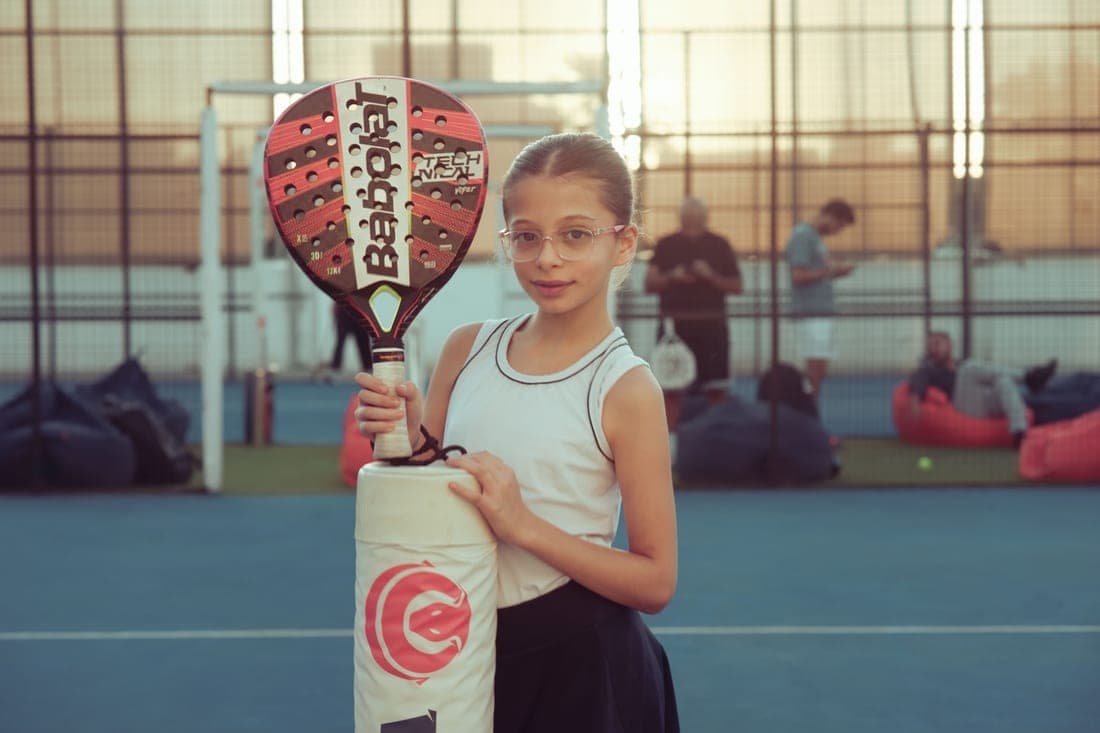 Babolat ContactBest beginner answer | A first racket | 8.65 criteria | |
| 2 | 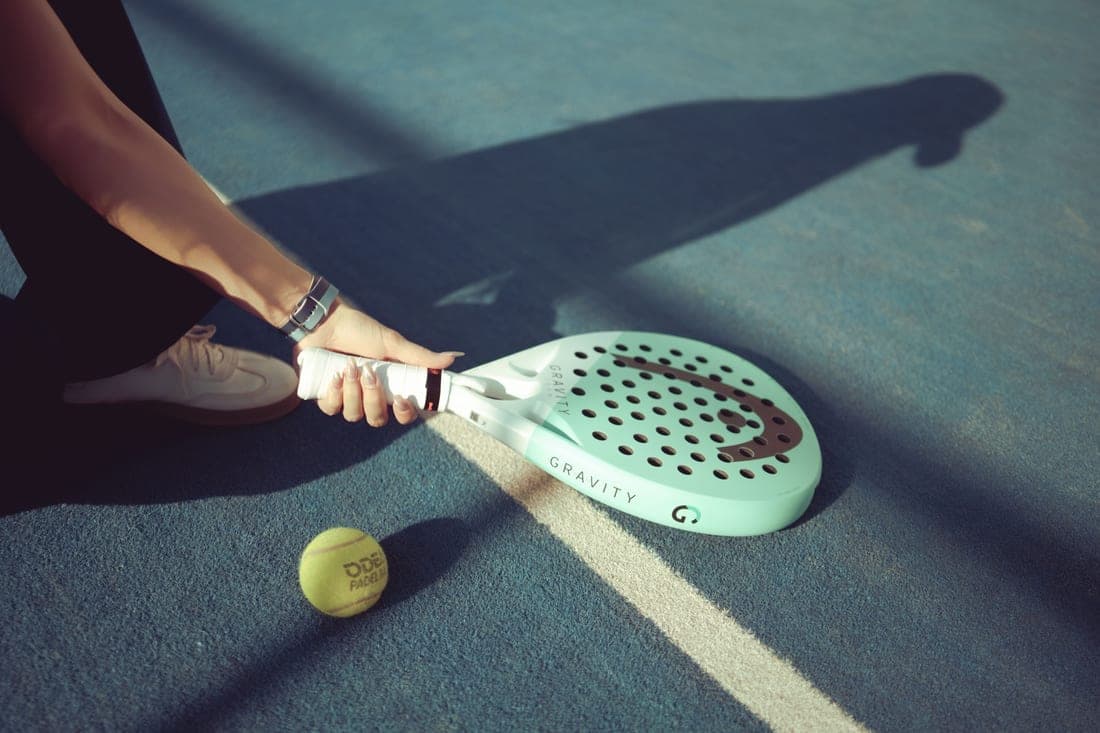 HEAD Evo SpeedBest step-up | Growing into | 8.45 criteria | |
| 3 | Babolat Technical Veron 3.0Best competition frame | Competitive play | 8.35 criteria |
01Babolat Contact
Best beginner answerBest for: A first racket
Every decision in this guide, set to the beginner setting: round shape, soft EVA core, composite face and frame, 340 g. Nothing on the spec sheet is trying to be clever.
That is the correct first racket. Padel's difficulty is front-loaded onto contact quality because the walls keep rallies alive, and you will hit far more off-center balls than you expect.
It is also cheap enough that if padel does not stick you have lost very little.
Our score
- Control
- 9.0
- Power
- 5.5
- Sweet spot
- 9.5
- Arm comfort
- 9.0
- Maneuverability
- 8.5
- Overall
- 8.6
Verified specs
- Shape
- Round
- Weight
- 340 g
- Core
- Soft EVA
- Face
- Composite
- Frame
- Composite
Specs as published by Padel Padel, checked September 2026.
Buy if
- This is your first padel racket
- You want the most forgiving option
- You want to spend under $100
Pass if
- You already play regularly
- You want power for smashing
- You want room to grow immediately
02HEAD Evo Speed
Best step-upBest for: Growing into
One notch along each dial rather than three: oversize teardrop instead of round, soft foam core rather than medium, fiberglass face, carbon frame, 38 mm profile and a 270 mm medium balance at 360 to 370 g.
That is the correct upgrade shape. Moving from a soft round frame straight to a firm diamond costs you sweet spot, comfort and control in a single purchase.
At $99.95 it is also the best value construction in the category — a carbon frame at a price that used to buy a molded beginner racket.
Our score
- Control
- 8.0
- Power
- 7.0
- Sweet spot
- 8.5
- Arm comfort
- 8.5
- Maneuverability
- 7.5
- Overall
- 8.4
Verified specs
- Shape
- Teardrop (oversize)
- Weight
- 360-370 g
- Balance
- 270 mm (medium)
- Core
- Soft foam
- Face
- Fiberglass
- Frame
- Carbon
- Profile
- 38 mm
Specs as published by Padel USA, checked September 2026.
Buy if
- You have outgrown a soft round frame
- You expect to improve quickly
- You want a carbon frame on a budget
Pass if
- You are in your first month
- You want the lightest racket
- You want a competition frame
03Babolat Technical Veron 3.0
Best competition frameBest for: Competitive play
Babolat position the Technical Veron 3.0 for the versatile competitor, at 360 g with a Carbonflex surface, describing it as softer and more tolerant than the rest of their technical range.
For a strong club player who is not a specialist attacker, that combination — real power available, still controllable on the defensive shots that make up most of a point — is the right end point of this guide.
It is a competition frame at a competition price. If your padel is social rather than league, the two rackets above will serve you better for less.
Our score
- Control
- 8.5
- Power
- 8.0
- Sweet spot
- 7.5
- Arm comfort
- 7.5
- Maneuverability
- 7.0
- Overall
- 8.3
Verified specs
- Weight
- 360 g
- Face
- Carbonflex
- Aimed at
- Versatile competitor
Specs as published by Babolat, checked September 2026.
Buy if
- You play league or competitive padel
- You want power without losing control
- You want a frame you will not outgrow
Pass if
- You play socially
- You want maximum forgiveness
- Budget is a constraint
Common questions
What padel racket should a beginner buy?
Round shape, soft EVA core, fiberglass or soft-carbon face, 350-360 g, head-light balance. Padel Market's beginner guidance is exactly that, and every variable in it is set to forgiving.
Is a carbon padel racket better?
Firmer and more precise, not better. A high-modulus carbon face has a small, unforgiving sweet spot. Soft carbon or 3K over a soft core is the combination that suits most improving players.
How heavy should a padel racket be?
350-360 g for beginners and improvers, 360-370 g for competition. Below about 350 g the racket gets pushed around by hard shots; above 370 g shoulder fatigue becomes the limiting factor.
Does padel racket shape really matter?
It is the most consequential single decision. Shape determines where the mass sits, which determines where the sweet spot is — round is centered and large, diamond is high and small.
How much should I spend on a padel racket?
$70 to $120 for a genuine branded frame with a soft EVA core and a stated shape and weight. Above that you are paying for carbon grade, core consistency and surface texture, none of which help a developing player.
Read next
Sources
- 01Padel Market — Best Padel Racket for Beginners 2026
- 02Wikipedia — Padel (racket and tether rules)
- 03Babolat — Padel Technical Collection 2026
- 04Padel USA — HEAD Evo Speed listing
Every source above was retrieved while writing this page. Specifications are quoted from the listing or manufacturer page cited, not from memory.