Guide
Tennis racket grip size guide
The cheapest thing to get right and the most expensive to get wrong. A grip half a size too small makes you squeeze, and squeezing is what loads the forearm.
By Janet H.Updated
The short answer
Measure from the tip of your ring finger to the second crease of your palm, along the lifeline. That distance in inches is your grip size. Most adult men land at 4 3/8 in, most adult women at 4 1/8 or 4 1/4 in. If you fall between sizes, buy the smaller one — an overgrip adds roughly half a size.
Disclosure — we earn a commission on qualifying purchases made through links on this page, at no extra cost to you. It never changes which product we rank first. How this site is funded.
Two ways to measure
The ruler method
Open your dominant hand flat with the fingers extended and together. Measure from the tip of your ring finger down to the second crease of your palm — the one that runs roughly parallel to your fingers, below the first. The distance in inches is your grip size.
The finger test
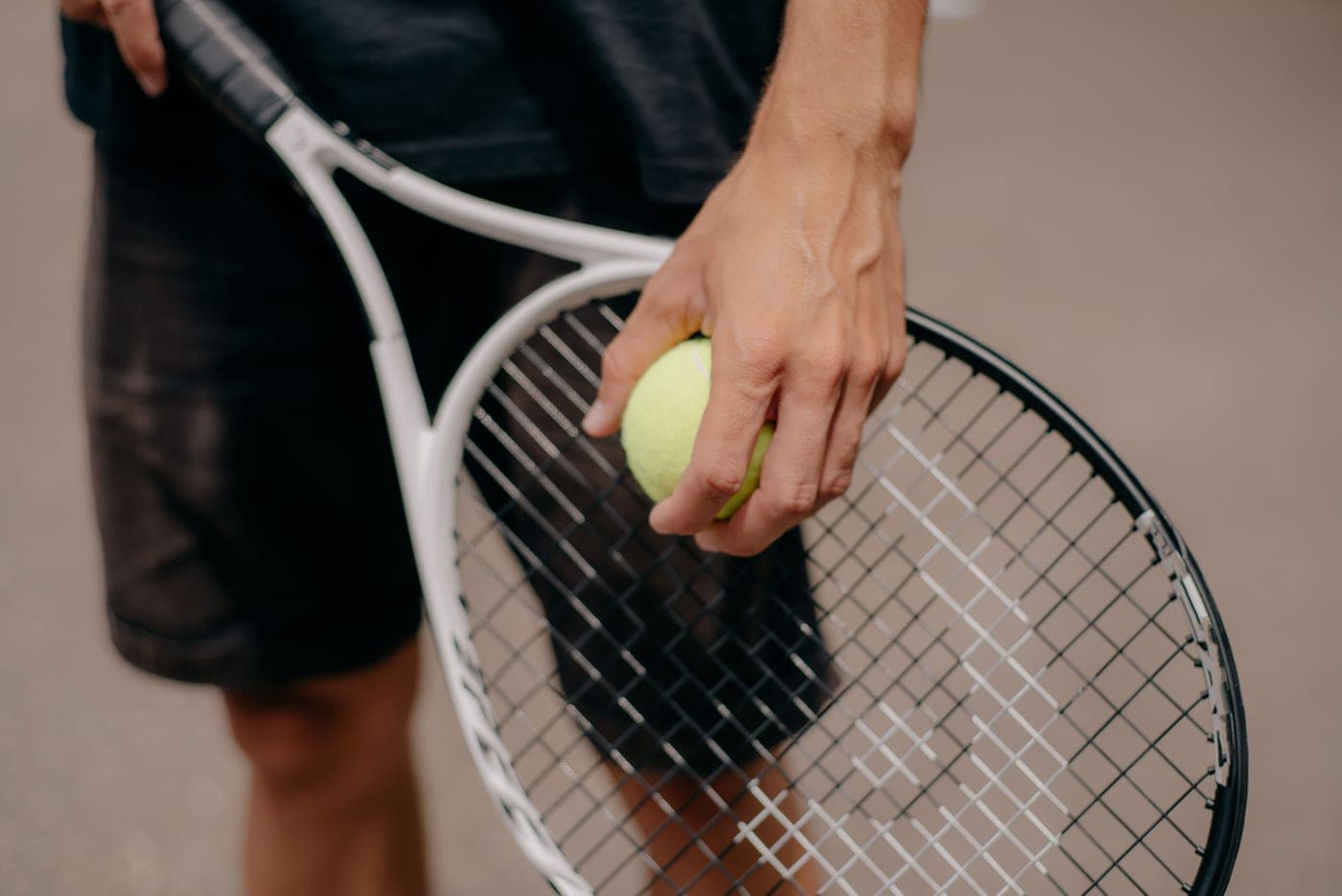
Hold a racket in an eastern forehand grip — palm on the same bevel as the string face. There should be room to slide the index finger of your other hand into the gap between your fingertips and the base of your thumb. No room means too small; a loose fit with space to spare means too large.
The size chart
| US size | European size | Circumference | Typical |
|---|---|---|---|
| 4 in | L0 | 4 in / 102 mm | Juniors, small hands |
| 4 1/8 in | L1 | 4.125 in / 105 mm | Many adult women |
| 4 1/4 in | L2 | 4.25 in / 108 mm | Many adult women, smaller men |
| 4 3/8 in | L3 | 4.375 in / 111 mm | Most adult men |
| 4 1/2 in | L4 | 4.5 in / 114 mm | Larger hands |
| 4 5/8 in | L5 | 4.625 in / 117 mm | Very large hands |
European listings use L numbers and US listings use fractions. They are the same measurement expressed differently — L3 and 4 3/8 in are identical.
When in doubt, go smaller
This is the single most useful rule in the guide, for a mechanical reason: you can add material to a handle and you cannot remove it.
- An overgrip adds roughly half a size, and most players use one anyway.
- A heat-shrink sleeve adds a full size and is fitted by any stringer.
- A thicker replacement grip adds a fraction of a size.
- Reducing a handle means removing the base grip and sanding the bevels, which is destructive and rarely done well.
What goes wrong at each extreme
| Too small | Too large | |
|---|---|---|
| What you do | Squeeze harder to stop it twisting | Cannot rotate the handle freely |
| Consequence | Sustained forearm extensor load | Restricted wrist on serve and slice |
| Injury risk | Tennis elbow | Wrist strain, less commonly |
| How it feels | The racket moves in your hand on mishits | Clumsy, hard to change grips |
Too small is the more common and the more damaging error. The grip force required to stop a twisting frame is a sustained isometric load on exactly the muscles that lateral epicondylitis affects — see best rackets for tennis elbow.
Grip size across sports
Padel rackets and pickleball paddles use similar handle diameters to tennis rackets, and the same overgrips fit all three. What differs is that padel and pickleball handles are usually supplied in one size, with grip adjustment done entirely by overgrip.
Pickleball handle *length* is the variable that matters more in that sport — a two-handed backhand needs about 5.5 inches. That is covered in how to choose a pickleball paddle.
Now pick yours
The specs above are only useful once they resolve into something you can buy. These are the products that match what this page has just explained.
Our picks
| # | Product | Best for | Score | Price |
|---|---|---|---|---|
| 1 |  Wilson Pro OvergripThinnest overgrip | Fine-tuning without adding bulk | 8.45 criteria | |
| 2 | Yonex Super GrapBest all-round grip | Most hands, most conditions | 8.65 criteria | |
| 3 |  Wilson Clash 100 v3Most arm-friendly frame | If the grip is not the problem | 8.55 criteria |
01Wilson Pro Overgrip
Thinnest overgripBest for: Fine-tuning without adding bulk
Tennis Warehouse describe the Wilson Pro Overgrip as thin and designed to keep grip size minimal, at $9.00 for three. That thinness is what makes it the right choice if your frame is already at the top of your comfortable size.
Every overgrip adds roughly half a size. That is the standard way to fine-tune between the half-inch steps handles come in — but it means a thick grip on a frame that is already slightly large pushes you over.
It is soft and rubbery, which suits dry hands in cool conditions. In heat it will go slick before a dry grip does.
Our score
- Power
- 7.0
- Control
- 8.5
- Forgiveness
- 7.5
- Arm comfort
- 9.0
- Maneuverability
- 8.5
- Overall
- 8.4
Verified specs
- Type
- Tacky
- TW status
- Best Seller
- Profile
- Thin — keeps grip size minimal
- Listed price
- $9.00 for 3
Specs as published by Tennis Warehouse, checked September 2026.
Buy if
- Your frame is already at the top of your size
- You want a soft, tacky feel
- You play indoors or in cool weather
Pass if
- Your hands sweat heavily
- You want a firmer grip with more feedback
- You want the best value per grip
02Yonex Super Grap
Best all-round gripBest for: Most hands, most conditions
A Tennis Warehouse best seller at $8.00 single and $23.00 for twelve, with a firmer feel than the Wilson that preserves more string-bed feedback.
If your grip size is correct and you simply need a grip, this is the default. It is also the best value tacky grip in their set at roughly $1.90 per grip in a twelve-pack.
It sits slightly thicker than the Wilson Pro, so if you are borderline on size, that is the one consideration that might send you the other way.
Our score
- Power
- 7.5
- Control
- 9.0
- Forgiveness
- 7.5
- Arm comfort
- 8.5
- Maneuverability
- 8.5
- Overall
- 8.6
Verified specs
- Type
- Tacky
- TW status
- Best Seller
- Listed price
- $8.00 single, $23.00 for 12
Specs as published by Tennis Warehouse, checked September 2026.
Buy if
- Your grip size is correct and you need a grip
- You want feedback from the string bed
- You regrip frequently
Pass if
- You are at the top of your grip size
- Your hands sweat heavily
- You want the softest possible feel
03Wilson Clash 100 v3
Most arm-friendly frameBest for: If the grip is not the problem
If you have corrected your grip size and your arm still complains, the next variable is frame stiffness, and the Clash's 54 RA is the softest in the mainstream market.
The order matters: grip size and string are cheap to change and frames are not, so work through them first. This is the frame to consider once you have.
It is also a legitimately good racket rather than a comfort compromise — 100 sq in, 312 g strung, 308 swingweight — which is why it appears on so many of our lists.
Our score
- Power
- 7.5
- Control
- 8.0
- Forgiveness
- 8.0
- Arm comfort
- 9.5
- Maneuverability
- 8.0
- Overall
- 8.5
Verified specs
- Head size
- 100 sq in
- Strung weight
- 11 oz / 312 g
- Balance
- 7 pts head light
- Swingweight
- 308
- Stiffness (RA)
- 54
- Beam
- 24.5 mm uniform
- String pattern
- 16x19
- Length
- 27 in
Specs as published by Tennis Warehouse, checked September 2026.
Buy if
- Grip and string changes have not resolved arm pain
- You want the softest mainstream frame
- You want a racket that spans levels
Pass if
- You have not tried a softer string yet
- You want maximum power
- Budget is tight
Common questions
How do I measure my tennis grip size?
Measure from the tip of your ring finger to the second crease of your palm along the lifeline. That distance in inches is your grip size. Check it against the finger test: there should be room for an index finger between your fingertips and the base of your thumb.
What grip size do most people use?
Most adult men land at 4 3/8 in (L3) and most adult women at 4 1/8 or 4 1/4 in (L1 or L2). Hand length varies more than that generalization suggests, so measure rather than assume.
Should I buy a bigger or smaller grip if I am between sizes?
Smaller. An overgrip adds roughly half a size and a heat-shrink sleeve adds a full size, so you can always build up. Reducing a handle means sanding the bevels, which is destructive.
Can the wrong grip size cause tennis elbow?
A grip that is too small contributes to it. You squeeze harder to stop the frame twisting, and that sustained grip force loads the same forearm extensors that lateral epicondylitis affects.
Does an overgrip change grip size?
Yes, by roughly half a size. That is how most players fine-tune between the half-inch steps handles come in. Tennis Warehouse note the Wilson Pro Overgrip as the thin option if you need to add minimum bulk.
Do padel and pickleball use the same grip sizes?
Handle diameters are similar and the same overgrips fit all three sports. The difference is that padel rackets and pickleball paddles usually come in a single handle size, with adjustment done entirely by overgrip.
Read next
Sources
- 01Tennis Warehouse — Best Tennis Overgrips gear guide
- 02Tennis Warehouse — Wilson Clash 100 v3
- 03Tennis Warehouse — Best Tennis Racquets gear guide
- 04Tennis Warehouse — Best Tennis Racquets for Beginners
Every source above was retrieved while writing this page. Specifications are quoted from the listing or manufacturer page cited, not from memory.