Guide
How to choose tennis shoes for your court surface
Surface decides the outsole, the outsole decides the shoe, and fit decides whether you will actually wear it. In that order.
By Janet H.Updated

The short answer
Match the outsole to your surface first: dense modified herringbone for hard court, full herringbone for clay, hybrid for mixed play. Then check the structure — RunRepeat rate torsional rigidity and heel counter stiffness out of 5, and the flagship court shoes score 5/5. Fit last, and fit late in the day.
Disclosure — we earn a commission on qualifying purchases made through links on this page, at no extra cost to you. It never changes which product we rank first. How this site is funded.
Step 1 — surface decides the outsole
| Surface | Pattern | What it must do | Failure mode |
|---|---|---|---|
| Hard court | Dense modified herringbone or hex | Resist abrasion | Outsole goes smooth in weeks |
| Clay / Har-Tru | Full herringbone | Grip, then shed clay | Clay packs in, unpredictable sliding |
| All-court | Modified herringbone, harder compound | Compromise | Neither perfect, both acceptable |
| Indoor carpet | Non-marking, smoother | Grip without marking | Facility refuses entry |
The rule to remember is that hard-court and clay outsoles are specific in both directions. Hard-court tread on clay does not have the bite and clogs; clay tread on hard court wears away fast and grips unevenly. An all-court shoe is a genuine compromise, and a reasonable one if you split your time.
Step 2 — check the structure numbers
Court shoes are one of the few categories with independent lab data. RunRepeat cut shoes in half and measure the properties that actually matter for lateral sport, which means you can compare rather than guess.
- Torsional rigidity (out of 5) — resistance to the shoe twisting along its length. A twisting shoe lets the forefoot invert while the heel stays planted, which is the ankle-sprain mechanism. Look for 5/5.
- Heel counter stiffness (out of 5) — how firmly the heel is held. Look for 4/5 or better.
- Outsole hardness (HC) and wear depth — abrasion resistance. The ASICS GEL-Resolution X measures 90.4 HC with 0.6 mm wear.
- Shock absorption (SA) — impact absorbed at the heel and forefoot. Figures range from 89 SA to 116 SA across the shoes we cover.
Step 3 — fit, and fit properly
- 01Try them late in the day. Feet swell; a shoe fitted first thing will be tight by the end of a match.
- 02Leave a thumb's width at the toe. Your foot slides forward on every hard stop, and a shoe fitted snug at the toe costs you toenails within a month.
- 03Wear your playing socks. A thicker sport sock changes fit by roughly half a size.
- 04Check the heel does not lift. Heel slip is a blister factory and a sign the counter is not doing its job.
- 05Do not size up for width. A longer shoe in the same width adds heel slip. Buy a genuinely wide model — see best tennis shoes for wide feet.
Toebox width is measured, not guessed: RunRepeat report both the widest point and the big-toe width, and they differ. The GEL-Resolution X is roomy across the ball of the foot and only 66.6 mm at the big toe.
The outsole guarantee
Several major brands offer a six-month outsole durability guarantee on flagship models. It is a genuine consumer protection and it is also a signal — a brand that guarantees an outsole has confidence in the compound.
It is not universal. RunRepeat call it out specifically on the Court FF 3, their highest-scoring shoe, which has no such guarantee. If you are hard on outsoles, check the warranty before the reviews, and keep the receipt.
When to replace them
When the midsole has compressed flat, not when the tread looks worn. A bottomed-out midsole transmits impact straight to your joints while the outsole can still look serviceable from above.
The other replacement trigger is grip that has become unpredictable. An outsole worn smooth in patches grabs and releases inconsistently, and an unplanned slide is how ankles go.
Playing four or more times a week, two pairs alternated will outlast two pairs used consecutively — midsole foam recovers between sessions.
Padel and pickleball, briefly
Pickleball is played on hard courts with the same movement pattern, so tennis shoes are the correct answer — see tennis shoes vs pickleball shoes.
Padel is not. Most padel is on sand-dressed artificial turf, which needs a clay-pattern or hybrid sole; hard-court tread rides on top of the sand. See padel shoes vs tennis shoes and best padel shoes.
Now pick yours
The specs above are only useful once they resolve into something you can buy. These are the products that match what this page has just explained.
Our picks
| # | Product | Best for | Score | Price |
|---|---|---|---|---|
| 1 | 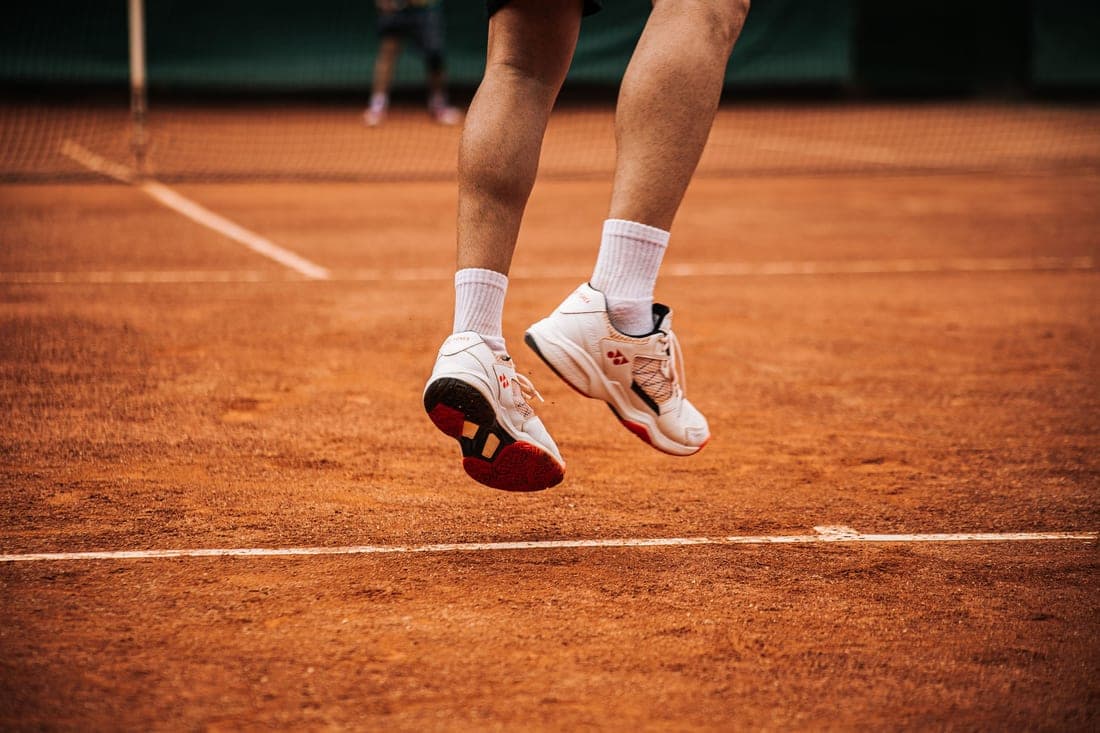 ASICS Court FF 3Best all-round | Hard court and mixed play | 8.85 criteria | |
| 2 | 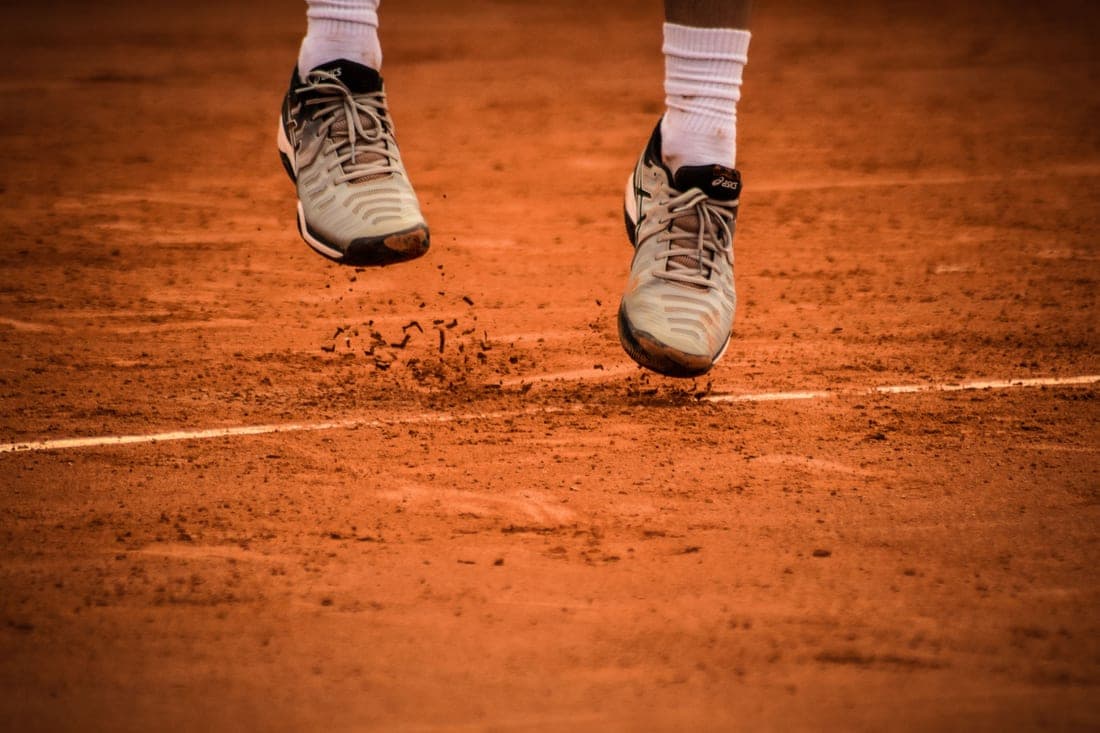 ASICS GEL-Resolution 9 ClayBest clay option | Clay and Har-Tru | 8.75 criteria | |
| 3 | K-Swiss Hypercourt Express 2Best value | A first court shoe | 8.35 criteria |
01ASICS Court FF 3
Best all-roundBest for: Hard court and mixed play
RunRepeat's highest-scoring hard-court shoe at 93, with an 85.3 HC outsole that took only a 0.4 mm cavity in their abrasion test and a 28.8 mm heel against a 20.6 mm forefoot.
Its 101.8 mm forefoot is the widest they have measured in a tennis shoe, which makes it the easiest shoe here to actually fit.
It does not carry an outsole durability guarantee, which RunRepeat flag specifically. If you wear soles out quickly, that is a real consideration.
Our score
- Lateral stability
- 8.5
- Cushioning
- 8.0
- Outsole durability
- 8.5
- Fit accommodation
- 9.5
- Lightness
- 6.5
- Overall
- 8.8
Verified specs
- RunRepeat score
- 93 — Best Overall, hard court
- Heel stack
- 28.8 mm
- Forefoot stack
- 20.6 mm
- Toebox width (widest)
- 101.8 mm
- Outsole hardness
- 85.3 HC
- Dremel wear
- 0.4 mm cavity
Specs as published by RunRepeat, checked September 2026.
Buy if
- You play mostly hard court
- You have a wider forefoot
- You want the best-measured all-rounder
Pass if
- You want an outsole warranty
- You play mostly clay
- You want the lightest shoe
02ASICS GEL-Resolution 9 Clay
Best clay optionBest for: Clay and Har-Tru
RunRepeat score it 89 and measure a 0.82 traction coefficient on clay, which they describe as amazingly grippy, with 5/5 torsional rigidity from the TPU shank.
The outsole is 88.5 HC and 4.6 mm thick, wearing only 0.8 mm in their abrasion test, which supports the six-month durability guarantee the model carries.
RunRepeat flag the non-breathable PU upper as a problem for heat-sensitive players — and clay season is summer season in most of the country.
Our score
- Lateral stability
- 9.5
- Cushioning
- 8.5
- Outsole durability
- 9.5
- Fit accommodation
- 7.5
- Lightness
- 5.5
- Overall
- 8.7
Verified specs
- RunRepeat score
- 89
- Weight
- 13.0 oz / 369 g
- Heel / forefoot stack
- 31.7 mm / 21.5 mm
- Drop
- 10.2 mm
- Traction
- 0.82 coefficient on clay
- Torsional rigidity
- 5/5
- Heel counter stiffness
- 4/5
- Outsole
- 88.5 HC, 0.8 mm wear, 4.6 mm thick
- Toebox at big toe
- 68.4 mm
Specs as published by RunRepeat, checked September 2026.
Buy if
- You play clay regularly
- You want maximum stability when sliding
- You want an outsole guarantee
Pass if
- You overheat easily
- You play clay occasionally
- You want a light shoe
03K-Swiss Hypercourt Express 2
Best valueBest for: A first court shoe
RunRepeat score it 86 at $110 — about 13% below their category average price — and list it in their wide-feet catalog.
It is the shoe that answers the most common objection to buying court-specific footwear, which is cost. An 86-rated court shoe at mid-range running shoe money is not a compromise.
It will not match a flagship on outsole hardness or structural scores. At once or twice a week, that does not matter.
Our score
- Lateral stability
- 7.5
- Cushioning
- 7.0
- Outsole durability
- 7.5
- Fit accommodation
- 9.0
- Lightness
- 8.0
- Overall
- 8.3
Verified specs
- RunRepeat score
- 86 — Best Budget, hard court
- Price
- $110, 13% below category typical
- Weight
- Lighter than average
- Width fit
- Listed in RunRepeat's wide-feet catalog
Specs as published by RunRepeat, checked September 2026.
Buy if
- This is your first court shoe
- You play once or twice a week
- You have wider feet
Pass if
- You play four or more times a week
- You need flagship stability
- You play mostly clay
Common questions
Do I need different tennis shoes for different surfaces?
If you play one surface predominantly, yes — outsole patterns are specific in both directions. If you split your time, an all-court shoe is a genuine compromise and a reasonable one.
What should I look for in a tennis shoe?
The right outsole for your surface, then structure — RunRepeat rate torsional rigidity and heel counter stiffness out of 5, and the flagship court shoes score 5/5 — then fit, measured late in the day with your playing socks on.
How long should tennis shoes last?
On abrasive hard courts the outsole usually gives out first, and the six-month guarantee several brands offer on flagship models is a reasonable expectation for regular play. Replace when the midsole compresses flat, not when the tread looks worn.
What is the six-month outsole guarantee?
A warranty several major brands offer on flagship court shoes covering outsole wear. It is not universal — RunRepeat note the ASICS Court FF 3 does not carry one despite being their highest-scoring model.
Can I use tennis shoes for padel?
Occasionally and on dry courts, yes. Regularly on sanded artificial turf, no — hard-court tread rides on top of the sand and produces grip that holds and then releases without warning.
Read next
Sources
- 01RunRepeat — Best Hard Court Tennis Shoes
- 02RunRepeat — Best Tennis Shoes
- 03RunRepeat — ASICS GEL-Resolution 9 Clay lab review
- 04RunRepeat — ASICS GEL-Resolution X lab review
Every source above was retrieved while writing this page. Specifications are quoted from the listing or manufacturer page cited, not from memory.