Comparison
Padel racket vs pickleball paddle: closer cousins, still not the same
Both are stringless slabs, so they look like variations on one idea. They are not: a padel racket weighs roughly 340 to 370 g and a pickleball paddle about 7 to 8.5 oz, which is less than half as much.
By Janet H.Updated
The short answer
A padel racket is a thick perforated composite face over a foam core, capped at 45.5 cm long and usually 340 to 370 g. A pickleball paddle is a thin honeycomb-core panel with no holes, around 7 to 8.5 oz - roughly 200 to 240 g - and governed by a combined length-plus-width limit. Neither is legal in the other sport.
Disclosure — we earn a commission on qualifying purchases made through links on this page, at no extra cost to you. It never changes which product we rank first. How this site is funded.
Our picks
| # | Product | Best for | Score | Price |
|---|---|---|---|---|
| 1 | 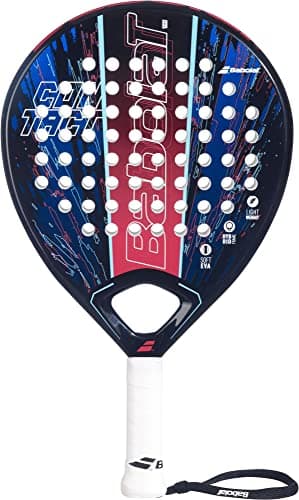 Babolat ContactBest padel pick | If padel is the sport | 8.74 criteria | |
| 2 | 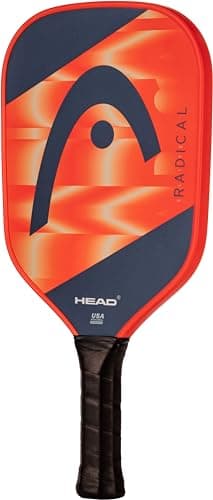 HEAD Radical EliteBest paddle for converts | Pickleball for a racket-sport player | 8.04 criteria | |
| 3 | 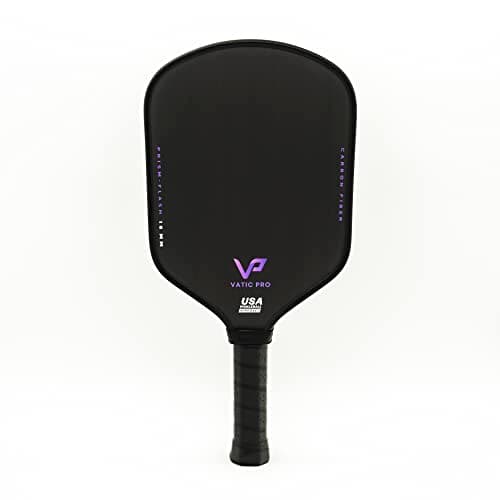 Vatic Pro Prism FlashBest value paddle | A forgiving first paddle | 8.34 criteria |
The picks in detail
01Babolat Contact
Best padel pickBest for: If padel is the sport
On the padel side of the comparison this is the frame we recommend most often: a round head, a soft EVA core and 340 g, which puts every variable at the forgiving end at the same time.
It also illustrates the difference the table below records. 340 g is the light end of padel and it is still about half again as heavy as the heaviest pickleball paddle on this page - the foam core and the thick profile are where that mass goes.
The soft EVA core is what keeps it comfortable, and it is the direct equivalent of core thickness in a paddle: it is the only shock-absorbing element in a stringless frame, and it is chosen once at purchase.
Our score
- Control
- 9.0
- Power
- 7.0
- Sweet spot
- 9.5
- Value
- 9.0
- Overall
- 8.7
Verified specs
- Shape
- Round
- Weight
- 340 g
- Core
- Soft EVA
- Face
- Composite
- Frame
- Composite
Specs as published by Padel Padel, checked September 2026.
Buy if
- Padel is the sport you are buying for
- You want the most forgiving shape
- Arm comfort matters to you
Pass if
- You are buying for pickleball
- You want to attack from the net
- You already play padel at club level
02HEAD Radical Elite
Best paddle for convertsBest for: Pickleball for a racket-sport player
PickleballUS name this paddle specifically for tennis players converting, and the same logic holds for a padel player: a 13 mm core with a graphite face rewards a full swing rather than absorbing it.
At 7.8 oz on a standard shape it is also the clearest demonstration of the weight gap. A padel player picking this up for the first time will find it almost weightless, and the first adjustment is learning that the paddle supplies far less of the shot than they are used to.
What you give up is the soft game. A thin core gives you very little help on a dink or a reset, and in pickleball the kitchen line decides most points. It is a fine first paddle and not a destination one.
Our score
- Control
- 6.5
- Power
- 9.5
- Sweet spot
- 7.0
- Value
- 9.0
- Overall
- 8.0
Verified specs
- PickleballUS award
- Best for Tennis Players Converting
- Weight
- 7.8 oz
- Core
- 13 mm
- Face
- Graphite
- Shape
- Standard
Specs as published by PickleballUS, checked September 2026.
Buy if
- You are arriving from tennis or padel
- You win points by driving the ball
- You want an inexpensive first paddle
Pass if
- You play a patient soft game
- You want help resetting a hard drive
- You want maximum spin
03Vatic Pro Prism Flash
Best value paddleBest for: A forgiving first paddle
PickleballUS list the Prism Flash as their best value all-rounder: a raw carbon fiber face on a 16 mm core, standard shape, 7.8 to 8.2 oz. That is the modern default specification for a pickleball paddle.
It is the better first paddle for most people than the thin-core option above it, because the 16 mm core gives you a reset shot and the raw carbon face generates real spin. A standard shape also keeps the sweet spot as wide as the rules allow.
It is the standard-shape sibling of the elongated V-SOL, so if you later decide you want reach and leverage there is an obvious next step rather than a brand change. Our [best pickleball paddles for intermediate players](/pickleball/best-paddles-for-intermediate) page covers that move.
Our score
- Control
- 8.0
- Power
- 7.5
- Sweet spot
- 9.0
- Value
- 9.5
- Overall
- 8.3
Verified specs
- PickleballUS award
- Best Value All-Rounder
- Weight
- 7.8-8.2 oz
- Core
- 16 mm
- Face
- Raw carbon fiber
- Shape
- Standard
Specs as published by PickleballUS, checked September 2026.
Buy if
- Pickleball is the sport you are buying for
- You want a thick core and a raw carbon face
- You want the widest forgiving face
Pass if
- You want maximum drive power
- You want an elongated shape
- You are buying for padel
Side by side
| Padel racket | Pickleball paddle | |
|---|---|---|
| Typical weight | 340-370 g | 7.2-8.5 oz (about 204-241 g) |
| Core | Solid EVA or foam, graded soft to hard | Polymer honeycomb |
| Thickness | Up to about 38 mm profile | 13-16 mm |
| Face | Perforated with holes | Solid, no holes |
| Size rule | Maximum 45.5 cm length | Combined length plus width limit |
| Shape vocabulary | Round, teardrop, diamond | Standard, elongated |
| Ball | Pressurized felt, tennis-like | Hollow perforated plastic, under 30 g |
| Spin source | Face friction | Face friction |
The two bottom rows are the honest common ground: both sports generate spin from surface friction alone, because neither has strings to displace and snap back. That is why face material is the first thing to read on either spec sheet.
Which should you buy?
The answer is set by which court you have access to, not by which implement you prefer. These are not substitutes, and neither one is legal in the other sport's competition.
- You have a padel court nearby. Buy a round, soft, 340 g padel racket. Best padel rackets for beginners covers the shortlist.
- You have pickleball courts nearby. Buy a 16 mm standard-shape paddle with a raw carbon face. Best pickleball paddles for beginners covers it.
- You play both. Expect the transition to feel like a weight change more than a technique change, in both directions. The padel racket will feel dead in your hand after a paddle; the paddle will feel like nothing at all after a racket.
If the question you are actually asking is which sport to take up, padel vs pickleball compares the courts, the rules and the gear cost rather than the implements.
How we compared them
Everything above is read from published specification sheets, retailer listings and the rules of each sport, all cited at the foot of the page. We do not run a test lab and nothing here is written as though we had played with anything ourselves.
The three products listed are existing registry entries with cited sources. Our selection criteria set out the method and the editorial policy covers corrections. No price is written into this page - the figure on each buy button is the live one.
Common questions
Is a padel racket the same as a pickleball paddle?
No. Both are solid and stringless, but a padel racket is roughly 340 to 370 g with a thick perforated foam core, while a pickleball paddle is about 7 to 8.5 oz with a thin solid honeycomb core. Neither is legal in the other sport.
Can you use a padel racket for pickleball?
No. Pickleball regulates the combined length and width of a paddle and a padel racket's dimensions and perforated face do not comply. It would also play badly - a 340 g implement is far too heavy for the hand speed the kitchen line demands.
Can you use a pickleball paddle for padel?
No. A pickleball paddle is too light to resist a pressurized padel ball and too thin to absorb the impact, so you would feel every shot in your arm and lose depth on all of them. It is also not a legal padel racket.
Why is a padel racket so much heavier than a pickleball paddle?
Because of the ball. A padel ball is a pressurized felt ball close to a tennis ball in mass, so the frame needs weight to stand up to it. A pickleball is a hollow plastic ball under 30 g, so the paddle does not.
Why does a padel racket have holes and a pickleball paddle not?
The padel perforations cut air resistance and remove weight from the center of the face without weakening the edges, both of which matter on a 340 g frame. An 8 oz paddle needs neither, and drilling a honeycomb core would weaken it.
Which is cheaper to get into, padel or pickleball?
Pickleball, on equipment: a competent 16 mm paddle costs well under $100 at the listed prices we cite, while padel rackets start higher. Court access usually dominates the total either way - we do not publish court fees because they vary by club.
Read next
Sources
- 01Wikipedia - Padel
- 02Wikipedia - Pickleball
- 03Pickleheads - Padel vs pickleball
- 04PickleballUS - Paddles for beginners
- 05Padel Padel - Babolat Contact padel racket
Every source above was retrieved while writing this page. Specifications are quoted from the listing or manufacturer page cited, not from memory.