Guide
How to put on a tennis overgrip
It takes two minutes once you know the sequence, and the whole job comes down to three things: which end you start from, how much you overlap, and how much tension you pull.
By Janet H.Updated
The short answer
Start at the butt cap with the tapered end, wrap upward toward the throat with the sticky-side finishing tape saved for last, overlap each turn by about a sixteenth of an inch, keep light steady tension throughout, trim at the top and secure with the supplied tape. The whole job takes two minutes.
Disclosure — we earn a commission on qualifying purchases made through links on this page, at no extra cost to you. It never changes which product we rank first. How this site is funded.
What you need, and what you do not
You need the overgrip, which comes with a small piece of finishing tape in the packet, and scissors. That is the whole list. You do not need to remove the replacement grip underneath - an overgrip goes over it, which is the entire point of the product. If you are not sure which layer is which, our overgrip vs replacement grip guide sorts it out in a paragraph.
If there is an old overgrip on the racket, peel it off first. It has no adhesive except at the finishing end, so it comes away in one piece. Wrapping a new overgrip over an old one adds a full grip size and produces a lumpy, uneven handle.
The seven steps
- 01Unroll and identify the ends. One end is tapered to a point or a diagonal; the other is square and comes with the separate finishing tape. The tapered end starts at the butt cap.
- 02Start at the butt cap. Lay the tapered end flat against the handle at the very bottom, with roughly half of it overhanging the butt. Hold it in place with your thumb.
- 03Make the first turn around the butt. Wrap once around the bottom of the handle, folding the overhang down over the butt cap edge. This first turn anchors everything, so pull it snug.
- 04Wrap upward with a consistent overlap. Rotate the racket with one hand and feed the grip with the other, overlapping each turn onto the previous one by about a sixteenth of an inch. Consistency matters more than the exact figure.
- 05Keep light, steady tension. Pull just hard enough that the grip conforms to the bevels of the handle without stretching thin. If you can see the material narrowing, you are pulling too hard.
- 06Stop below the throat and trim. Wrap until you are about an inch below where the handle meets the frame, then cut the grip at an angle so the end sits flush rather than leaving a step.
- 07Secure with the finishing tape. Wrap the supplied tape over the cut edge, one full turn, and press it down. That tape is the only adhesive in the whole product.
Wrapping upward from the butt cap is not arbitrary. It means each turn overlaps in the direction your hand slides under load, so the edges tuck away from your palm rather than catching against it. Wrapping downward from the throat produces a grip that peels at the edges within a session.
The three mistakes that undo the job
Pulling too hard
This is the most common error and the least obvious. Overgrip material stretches, and a stretched grip is thinner, less cushioned and under permanent tension, which is why it starts unravelling at the butt within a couple of sessions. Firm enough to conform to the handle bevels is the whole requirement.
Inconsistent overlap
If some turns overlap heavily and others barely meet, you get a handle with thick and thin bands. Your hand reads those bands as bevels that are not there, and it makes finding the right grip by feel harder - which matters, because that is how every player locates a continental or an eastern grip without looking.
Starting at the wrong end
Starting at the throat and wrapping down to the butt reverses the overlap direction. The grip will feel fine for ten minutes and then the edges will start lifting under your palm. It is an easy mistake to make because the square end with the tape looks like the natural starting point - it is not, it is the finish.
When to do it again
An overgrip is a consumable and the replacement signal depends on which type you are using.
- Tacky grips go shiny and smooth as the tack transfers to your hand and the surface compresses. Visible shine means the grip is done.
- Dry grips darken as they saturate and stop absorbing. Once they are uniformly dark they have nothing left to take up.
- Either type should be replaced if the edges have started lifting, because a lifting edge will roll under your palm mid-rally.
For a player on court three or four times a week, that is realistically every few sessions, which is why overgrips are sold in packs of ten and twelve. For a once-a-week club player, every few weeks is normal.
The three grips below are the ones we would wrap. They cover the two categories - tacky and dry - and the thin option for anyone who does not want the handle growing.
How this guide was put together
We do not run a test lab and nothing here is written as though we did. This guide is built from the published specification sheets and retailer listings cited at the foot of the page, plus the physical reasoning that connects them. Where a figure is not published we say so rather than estimating it.
The picks below are drawn from our product registry, so every one carries a cited source and a verified listing. Our full selection criteria set out the method and the editorial policy covers corrections. No price is written into this page as a recommendation - the figure on each buy button is the live one.
Now pick yours
The specs above are only useful once they resolve into something you can buy. These are the products that match what this page has just explained.
Our picks
| # | Product | Best for | Score | Price |
|---|---|---|---|---|
| 1 | 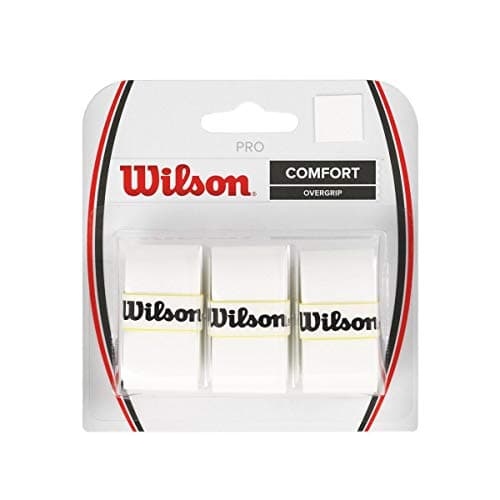 Wilson Pro OvergripTop pick | A clean, thin wrap | 8.54 criteria | |
| 2 | 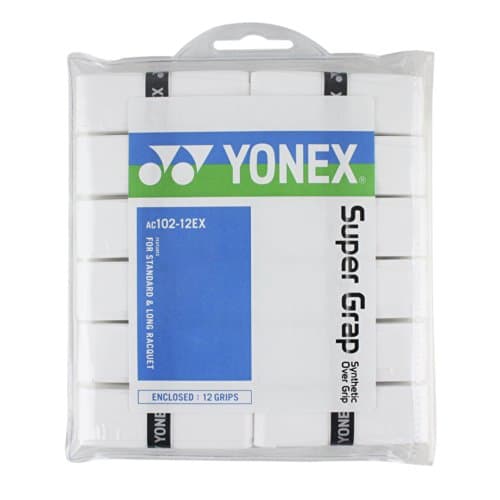 Yonex Super GrapBest value | Buying in bulk and not thinking about it | 8.84 criteria | |
| 3 | 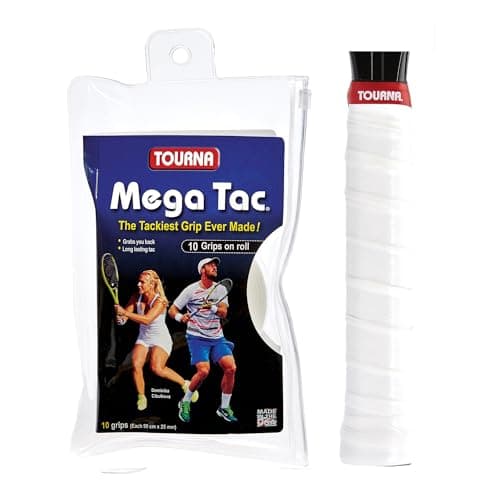 Tourna Mega TacTackiest option | Players who regrip mid-match | 8.24 criteria | $18.95 · View on Amazon Price as of October 11, 2026 · was $19.95, 5% off |
01Wilson Pro Overgrip
Top pickBest for: A clean, thin wrap
The Wilson Pro is the thinnest mainstream tacky grip and a Tennis Warehouse best seller, listed at $9.00 for three. Thin material is also the most forgiving to wrap, because a thinner grip conforms to the handle bevels with less tension.
If you are learning the technique, that matters. The commonest beginner error is pulling too hard, and a thin grip gives you less material to stretch and therefore less to get wrong.
It will not add cushioning and it wears through sooner than a standard-thickness wrap. At roughly $3 a grip, that is the deal, and it is a fair one.
Our score
- Performance
- 8.5
- Comfort
- 8.0
- Durability
- 7.5
- Value
- 9.0
- Overall
- 8.5
Verified specs
- Type
- Tacky
- TW status
- Best Seller
- Profile
- Thin — keeps grip size minimal
- Listed price
- $9.00 for 3
Specs as published by Tennis Warehouse, checked September 2026.
Buy if
- You do not want your grip size creeping up
- You are learning to wrap
- You want maximum feel through the handle
Pass if
- You want cushioning from the overgrip
- You want the longest life per wrap
- Your hands sweat heavily
02Yonex Super Grap
Best valueBest for: Buying in bulk and not thinking about it
Super Grap is listed at $8.00 single and $23.00 for twelve at Tennis Warehouse, which makes it the obvious buy once you accept that overgrips are a consumable. Twelve wraps is most of a season for a club player.
It is firm rather than spongy, so it holds its shape through a wrap without bunching, and it keeps the feedback coming up the handle from the string bed - something a soft, thick grip muffles.
It is tacky, so it is at its best with a dry hand. In real humidity it will get slick no matter how well you wrapped it, and that is a category problem rather than a technique problem.
Our score
- Performance
- 9.0
- Comfort
- 9.0
- Durability
- 8.0
- Value
- 9.5
- Overall
- 8.8
Verified specs
- Type
- Tacky
- TW status
- Best Seller
- Listed price
- $8.00 single, $23.00 for 12
Specs as published by Tennis Warehouse, checked September 2026.
Buy if
- You change grips often
- You want the best tack per dollar
- You play mostly in moderate conditions
Pass if
- Your hands sweat heavily
- You want the thinnest possible wrap
- You only need one grip
03Tourna Mega Tac
Tackiest optionBest for: Players who regrip mid-match
Tennis Warehouse describe Mega Tac as the tackiest grip they sell, listed at $7.50 single and $18.50 for ten. If you choke up on the handle, change grips between shots or play a lot of two-handed backhands, high tack is doing real work.
The practical benefit when wrapping is that a very tacky grip stays where you put it. It is harder to get a clean overlap wrong because the material does not slide once it has touched down.
Very tacky grips also pick up court dust and transfer tack onto your hand faster, so they go shiny sooner than a moderate grip. Expect a shorter life per wrap.
Our score
- Performance
- 8.5
- Comfort
- 7.5
- Durability
- 7.0
- Value
- 8.5
- Overall
- 8.2
Verified specs
- Type
- Tacky
- TW note
- The tackiest grip offered
- Listed price
- $7.50 single, $18.50 for 10
Specs as published by Tennis Warehouse, checked September 2026.
Buy if
- You want maximum tack
- You change grip position between shots
- You play a two-handed backhand
Pass if
- Your hands sweat heavily
- You want the longest life per wrap
- You dislike a sticky feel
Price as of October 11, 2026 · was $19.95, 5% off
Common questions
Which end of an overgrip do you start with?
The tapered end, at the butt cap, wrapping upward toward the throat. The square end with the separate finishing tape is where you finish. Starting at the throat reverses the overlap and the edges will lift under your palm.
How much should you overlap an overgrip?
About a sixteenth of an inch per turn. The exact figure matters less than keeping it consistent - uneven overlap produces thick and thin bands that your hand reads as phantom bevels.
How tight should you pull an overgrip?
Firm enough to conform to the handle bevels, no tighter. If you can see the material narrowing as you pull, you are stretching it, and a stretched grip is thinner, less cushioned and will start unravelling at the butt within a couple of sessions.
Do you remove the old grip before putting on a new overgrip?
Remove the old overgrip, yes - it peels off in one piece because it has no adhesive. Leave the replacement grip underneath alone; the overgrip is designed to go over it.
Can you put an overgrip over an overgrip?
You can, and you should not. It adds a full grip size, produces an uneven handle and the layer underneath is already saturated. Peel the old one off - it takes five seconds.
Where do you stop wrapping an overgrip?
About an inch below where the handle meets the frame. Cut the grip at an angle so the end lies flush rather than leaving a step, then secure it with the finishing tape supplied in the packet.
Read next
Sources
Every source above was retrieved while writing this page. Specifications are quoted from the listing or manufacturer page cited, not from memory.