Guide
Overgrip vs replacement grip
Two different products, two different jobs, two completely different replacement schedules - and buying the wrong one is the most common mistake in the grip aisle.
By Janet H.Updated
The short answer
A replacement grip is the thick, cushioned, adhesive-backed base layer bonded to the bare handle - it sets the racket's grip size and lasts months. An overgrip is a thin non-adhesive wrap applied on top, which you change every few sessions and which adds roughly half a grip size. Nearly everyone buying a grip wants an overgrip.
Disclosure — we earn a commission on qualifying purchases made through links on this page, at no extra cost to you. It never changes which product we rank first. How this site is funded.
The two layers, from the handle outward
Pick up any racket and there are two things between your hand and the pallet. Understanding which is which takes thirty seconds and saves most people from a wasted purchase.
Replacement grip - the base layer
The replacement grip is what the manufacturer fits at the factory. It is roughly 1.5 to 1.8 mm thick, it is cushioned, and it has an adhesive backing so it bonds directly to the bare handle. It is also what the stated grip size on the racket refers to: when a frame is sold as a 4 3/8, that circumference is measured with the factory replacement grip in place.
Because it is adhesive-backed, fitting a new one means peeling the old one off, cleaning any residue from the handle and wrapping the new one under tension from the butt cap upward. It is the fiddlier of the two jobs and you do it rarely - typically once a year or less, or when the cushioning has gone flat and you can feel the pallet edges through it.
Overgrip - the wear layer
An overgrip is thin, usually around 0.5 to 0.6 mm, and it has no adhesive except a small finishing tape at the end. It goes on over the replacement grip, it takes all the sweat and all the wear, and it comes off in seconds when it is finished. That is the entire design intent: a disposable surface that protects the expensive layer underneath.
This is what nearly everyone is actually looking for when they search for a tennis grip, and it is the one you buy in packs of three, ten or twelve because you will go through them.
Side by side
| Replacement grip | Overgrip | |
|---|---|---|
| Position | Bonded to the bare handle | Wrapped over the replacement grip |
| Adhesive | Full-length adhesive backing | None, except a finishing tape |
| Typical thickness | About 1.5-1.8 mm | About 0.5-0.6 mm |
| Effect on grip size | Sets the stated size | Adds roughly half a size |
| Replacement interval | Months to a year | Every few sessions to a few weeks |
| Sold in | Singles | Packs of 3, 10 or 12 |
| Job it does | Cushioning and grip size | Traction, sweat handling, wear |
| Difficulty to fit | Moderate - stripping and cleaning first | Easy - two minutes |
The grip size consequence nobody mentions
An overgrip adds roughly half a grip size. That one fact has a decision hiding inside it, and it is the reason we tell people to size down when they are between two sizes.
If you buy a racket in a 4 3/8 and you intend to run an overgrip permanently - which most players do - you are effectively playing a 4 7/16. Going the other way is much harder: taking a size off means stripping the replacement grip and fitting a thinner one, which is a limited and fiddly adjustment. Adding half a size costs you eight dollars and two minutes.
So the order of operations is: measure your hand, buy at or just below the measured size, then use overgrips to fine-tune upward. Our tennis racket grip size guide covers the ruler measurement and the finger test.
Tacky or dry: the only other choice that matters
Once you know you want an overgrip, the remaining decision is one axis, and it is about your hands rather than your game.
- Tacky grips feel slightly sticky when dry and that is where they perform best. As your hand gets wetter, a tacky grip gets more slippery. Most overgrips sold are tacky, and for most players in most conditions they are correct.
- Dry grips feel slightly rough and absorbent when new and improve as your hand gets wetter. They are the right answer in humidity, in summer heat, or for anyone whose hands sweat heavily, and they feel unimpressive in a cool indoor hall.
If sweat is the reason you are reading this, best overgrips for sweaty hands goes into the dry-grip category properly. For the general case, best tennis overgrips covers both sides.
The three picks below are the shortlist for the common decision: one default tacky grip, one thin tacky grip for players who do not want their grip size creeping up, and one dry grip for sweaty hands.
How this guide was put together
We do not run a test lab and nothing here is written as though we did. This guide is built from the published specification sheets and retailer listings cited at the foot of the page, plus the physical reasoning that connects them. Where a figure is not published we say so rather than estimating it.
The picks below are drawn from our product registry, so every one carries a cited source and a verified listing. Our full selection criteria set out the method and the editorial policy covers corrections. No price is written into this page as a recommendation - the figure on each buy button is the live one.
Now pick yours
The specs above are only useful once they resolve into something you can buy. These are the products that match what this page has just explained.
Our picks
| # | Product | Best for | Score | Price |
|---|---|---|---|---|
| 1 | 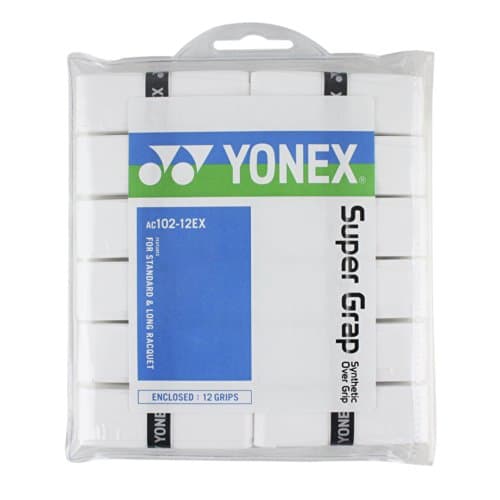 Yonex Super GrapTop pick | The default overgrip | 8.94 criteria | |
| 2 | 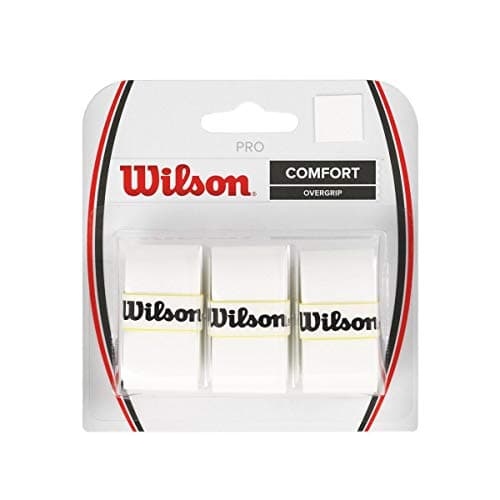 Wilson Pro OvergripThinnest option | Keeping grip size where it is | 8.44 criteria | |
| 3 | 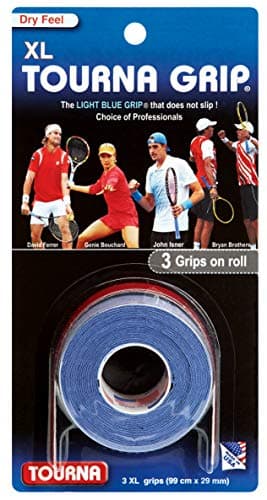 Tourna Grip OriginalBest dry grip | Hands that sweat | 8.34 criteria |
01Yonex Super Grap
Top pickBest for: The default overgrip
Super Grap is a Tennis Warehouse best seller and it is the overgrip we would hand to someone who has never bought one. It is listed at $8.00 single and $23.00 for twelve, which is the best tack-per-dollar in the tacky category.
It is firm rather than spongy, which matters more than it sounds. A soft overgrip muffles the feedback coming up the handle from the string bed, and that feedback is how you know where on the face you made contact.
It is a tacky grip, so it is at its best when your hand is dry. In genuine humidity it will get slick, and that is when you want the Tourna below instead.
Our score
- Performance
- 9.0
- Comfort
- 9.0
- Durability
- 8.0
- Value
- 9.5
- Overall
- 8.9
Verified specs
- Type
- Tacky
- TW status
- Best Seller
- Listed price
- $8.00 single, $23.00 for 12
Specs as published by Tennis Warehouse, checked September 2026.
Buy if
- You want one overgrip that works for most players
- You want to buy in a twelve-pack and stop thinking about it
- You want to keep string feedback through the handle
Pass if
- Your hands sweat heavily
- You want the thinnest possible wrap
- You play mostly in high humidity
02Wilson Pro Overgrip
Thinnest optionBest for: Keeping grip size where it is
The Wilson Pro is the thinnest mainstream tacky grip and another Tennis Warehouse best seller, listed at $9.00 for three. Thin is the specific reason to choose it: it will not push your grip size up half a step the way a thicker wrap does.
That makes it the right pick for anyone who measured into the top of a size band, or who already has large hands and does not want the handle growing further. If your racket is a 4 1/2 and it already feels full, this is the overgrip to use.
The trade is durability. Less material wears through sooner, so expect to change it more often than a standard-thickness grip. At $3 a wrap that is a reasonable cost of doing business.
Our score
- Performance
- 8.5
- Comfort
- 8.0
- Durability
- 7.5
- Value
- 9.0
- Overall
- 8.4
Verified specs
- Type
- Tacky
- TW status
- Best Seller
- Profile
- Thin — keeps grip size minimal
- Listed price
- $9.00 for 3
Specs as published by Tennis Warehouse, checked September 2026.
Buy if
- Your grip already feels full in the hand
- You measured at the top of a size band
- You want maximum feel through the handle
Pass if
- You want the grip to add cushioning
- You want the longest life per wrap
- Your hands sweat heavily
03Tourna Grip Original
Best dry gripBest for: Hands that sweat
Tourna Grip is the dry grip, listed from $6.75, and it works on the opposite principle from everything else here: it starts slightly rough and gets better as your hand gets wetter, because it absorbs rather than sticks.
That makes it the only correct answer for a specific player. If you lose grip in the second set of a hot match, no tacky grip will fix it - tackiness is precisely what water defeats. Switching category is the fix, not switching brand.
It feels unimpressive in a cool indoor hall, where a dry grip has nothing to absorb and a tacky grip is at its best. If humidity is not your problem, the Yonex above is the better buy.
Our score
- Performance
- 8.5
- Comfort
- 7.0
- Durability
- 7.5
- Value
- 9.0
- Overall
- 8.3
Verified specs
- Type
- Dry / absorbent
- Strength
- Sweat absorption
- Listed price
- From $6.75
Specs as published by Tennis Warehouse, checked September 2026.
Buy if
- Your hands sweat heavily
- You play in heat or humidity
- You have tried tacky grips and lost grip anyway
Pass if
- You play mostly indoors in cool conditions
- You like a tacky feel
- You want a cushioned handle
Common questions
What is the difference between an overgrip and a replacement grip?
A replacement grip is the thick, cushioned, adhesive-backed base layer bonded to the bare handle, and it sets the racket's grip size. An overgrip is a thin non-adhesive wrap applied over it that takes the wear and sweat, and it adds roughly half a grip size.
Do I need both an overgrip and a replacement grip?
You need a replacement grip, and your racket came with one from the factory. The overgrip is optional but almost universal, because it is much cheaper and quicker to change than the layer underneath.
Can I put an overgrip straight onto the bare handle?
You can, and it will feel thin and hard. An overgrip is about 0.5 mm thick and provides almost no cushioning on its own, and the handle's pallet edges will be obvious through it. Fit a replacement grip first.
How often should I change an overgrip?
When it stops gripping - for a frequent player that is every few sessions, for a casual player every few weeks. Visible shine on a tacky grip or darkened saturation on a dry one are both signals.
How often should I change a replacement grip?
Far less often, typically once a year or less. The trigger is cushioning rather than traction: if you can feel the hard edges of the pallet through it, or the handle has started to feel thin, replace it.
Does an overgrip change grip size?
Yes, by roughly half a size. That is why we recommend sizing down when you are between two sizes - adding half a size with an overgrip is trivial, and taking half a size off a handle is not.
Read next
Sources
Every source above was retrieved while writing this page. Specifications are quoted from the listing or manufacturer page cited, not from memory.