Guide
Tennis racket stiffness explained
RA is the one specification that correlates with what your arm feels. It is also the one most often read in the wrong direction and the one where small differences mean nothing.
By Janet H.Updated
The short answer
RA is a flex measurement: a higher number means a stiffer frame that bends less at impact, returns more energy as power, and transmits more shock to your arm. Current frames run from about 54 RA to about 71. A 10-point difference is clearly felt; one or two points is inside manufacturing variance and means nothing.
Disclosure — we earn a commission on qualifying purchases made through links on this page, at no extra cost to you. It never changes which product we rank first. How this site is funded.
What the number is
RA stands for Racquet Analysis and it is a stiffness measurement: a frame is clamped and deflected, and the number describes how much it resists bending. A higher RA is a stiffer frame. Current mainstream rackets occupy a band from roughly 54 to roughly 71, and the frames in our registry cover almost all of it.
What stiffness does is decide where the energy of the impact goes. A flexible frame bends, absorbs some of the impact in that bending, and returns less of it to the ball. A stiff frame barely bends, so more energy goes back into the ball as power — and more of what is left travels back up the handle into your hand, wrist and elbow.
That is the whole trade, and it is why RA is the specification people with arm trouble care about most. It is also why the marketing rarely leads with it: stiff frames are easier to sell on power, and the cost of that power is not a selling point.
| RA band | What it means | Registry example |
|---|---|---|
| 54-58 | Genuinely flexible, comfort-first | Wilson Clash 100 v3 at 54 |
| 59-63 | Soft for a modern frame | HEAD Speed MP UL 2026 at 61 |
| 64-67 | Middle of the market | Babolat Boost Drive at 65 |
| 68-70 | Stiff — where most power frames sit | Babolat Pure Drive 2025 at 69 |
| 71 and over | Very stiff, usually very light | HEAD Titanium Ti.S6 at 71 |
One RA point is not a difference
This is where most stiffness comparisons go wrong, and it goes wrong in a specific way: someone compares two frames a point or two apart and concludes one is the comfortable choice. It is not. A one-point RA difference is inside manufacturing variance and is not something a human being can feel.
Our own head-to-head of the Babolat Pure Drive vs Yonex EZONE 100 is a worked example: 69 against 68. Those are two frames with reputations that differ far more than their stiffness does, and on this specification they are the same racket. Anyone telling you otherwise is reading marketing rather than numbers.
The rough threshold worth working with is five points. Below five, treat two frames as equivalent on stiffness and decide on something else. At ten points and above, you are comparing genuinely different rackets — the 54 RA Clash and the 69 RA Pure Drive feel nothing alike, and that 15-point gap is the reason.
Why light and stiff is the combination to watch
If you take one practical warning from this page, take this one. Two properties reduce the shock reaching your arm: mass, which absorbs impact, and flex, which absorbs impact. A frame that has neither gives you the least protection available, and light stiff frames are extremely common because both properties sell well.
Light sells because the racket feels easy to swing in a shop. Stiff sells because the ball comes off faster. Put them together and you have a racket that is pleasant to pick up, flattering on the first few balls, and the most demanding thing on the shelf for an arm that is not already conditioned.
The combination to look for instead, if arm comfort is a factor, is light and soft — which exists and is rarer than it should be. The HEAD Speed MP UL 2026 at 278 g and 61 RA is the clearest example in our registry, and that pairing is the reason it appears on so many of our pages.
The other direction worth knowing: a heavier soft frame protects you best of all, which is why older, heavier, flexible rackets rarely caused the arm problems modern light stiff ones do. That is not nostalgia, it is physics. How much should a tennis racket weigh covers the mass side.
String choice can undo a frame choice
Stiffness is not only a frame property. The string bed has its own stiffness and the two add up, which means a soft frame with a stiff string can transmit more shock than a stiffer frame with a soft string. People buy a comfort racket, put polyester in it and wonder why their elbow is no better.
Polyester is far stiffer than multifilament before any tension is applied, and tension raises effective stiffness further. So the comfort stack has three layers, and all three have to point the same way: a lower-RA frame, a multifilament or natural gut string, and a tension toward the lower end of the frame's printed range.
| If your arm hurts | Change | Direction |
|---|---|---|
| First and cheapest | String type | Polyester to multifilament |
| Second and cheapest | String tension | Down, in 2 lb steps |
| Third | Grip size | Measure it — too small means squeezing harder |
| Fourth and most expensive | Frame stiffness | Down 10 or more RA points |
The ordering matters because a restring costs a fraction of a frame. Best tennis strings for tennis elbow sorts the string category by stiffness, and best tennis rackets for tennis elbow handles the frame end if the cheap changes have not worked.
How this guide was put together
We do not run a test lab and nothing here is written as though we did. This guide is built from the published specification sheets and third-party lab measurements cited at the foot of the page, plus the physical reasoning that connects them. Where a figure is not published we say so rather than estimating it.
The picks below are drawn from our product registry, so every one carries a cited source and a verified listing. Our full selection criteria set out the method and the editorial policy covers corrections. No price is written into this page — the figure on each buy button is the live one.
Now pick yours
The specs above are only useful once they resolve into something you can buy. These are the products that match what this page has just explained.
Our picks
| # | Product | Best for | Score | Price |
|---|---|---|---|---|
| 1 | 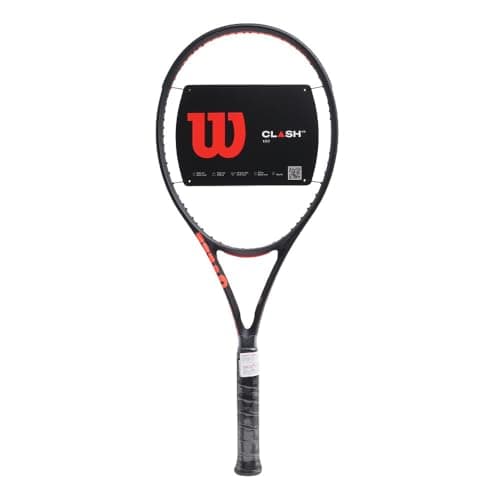 Wilson Clash 100 v3Lowest RA here | The softest mainstream frame | 8.75 criteria | |
| 2 | 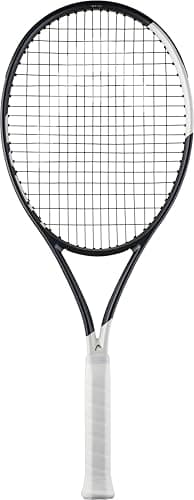 HEAD Speed MP UL 2026Best light-and-soft | Light and soft at the same time | 8.65 criteria | |
| 3 | 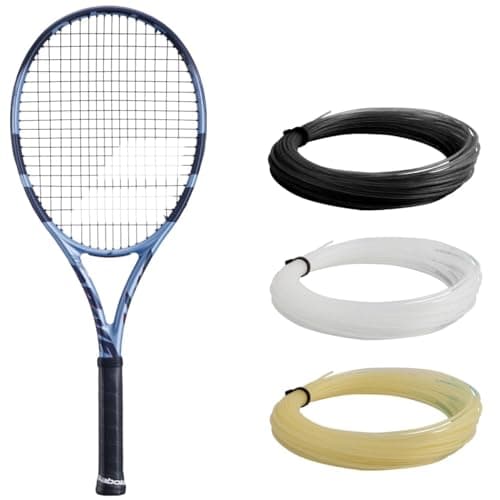 Babolat Pure Drive 2025The stiff reference | Understanding what stiff feels like | 8.75 criteria |
01Wilson Clash 100 v3
Lowest RA hereBest for: The softest mainstream frame
54 RA on a 100 square inch head at 312 g strung, 7 points head light, with a 308 swingweight and a 24.5 mm uniform beam. That stiffness figure is the lowest in our registry by a clear margin and the lowest on any mainstream 100 square inch frame we are aware of.
It is the reference point for this whole page. When a 69 RA frame is described as comfortable, 54 is what actual flex looks like — fifteen points, which is three times the threshold at which a difference becomes perceptible.
The cost of flex is power, and it is real: a frame that bends returns less energy to the ball. If your complaint is that your shots land short, a soft frame makes that worse rather than better. Our [Wilson Clash 100 v3 review](/reviews/wilson-clash-100-v3) covers the whole trade.
Our score
- Power
- 7.0
- Control
- 8.5
- Forgiveness
- 8.5
- Arm comfort
- 10.0
- Maneuverability
- 8.0
- Overall
- 8.7
Verified specs
- Head size
- 100 sq in
- Strung weight
- 11 oz / 312 g
- Balance
- 7 pts head light
- Swingweight
- 308
- Stiffness (RA)
- 54
- Beam
- 24.5 mm uniform
- String pattern
- 16x19
- Length
- 27 in
Specs as published by Tennis Warehouse, checked September 2026.
Buy if
- Arm comfort is the reason you are shopping
- You want the softest frame available
- You generate your own pace
Pass if
- Your shots land short
- You want free power
- You want a light frame
02HEAD Speed MP UL 2026
Best light-and-softBest for: Light and soft at the same time
278 g strung at 61 RA with a 291 swingweight, 100 square inches, on a 23 mm uniform beam. Light and soft together, which is the combination this page argues for and the one the market supplies least of.
The 291 swingweight is the number that makes it usable. A soft frame asks you to generate your own pace, and you cannot do that if the racket is slow through the contact zone. At 291 it is genuinely quick, so the flex is an asset rather than a handicap.
61 RA is soft for a modern frame but it is not 54. If you have an active arm problem rather than a precaution, the Clash above is seven points softer and that is a real gap.
Our score
- Power
- 7.5
- Control
- 8.5
- Forgiveness
- 8.0
- Arm comfort
- 9.5
- Maneuverability
- 9.5
- Overall
- 8.6
Verified specs
- Head size
- 100 sq in
- Strung weight
- 9.8 oz / 278 g
- Balance
- 2 pts head light
- Swingweight
- 291
- Stiffness (RA)
- 61
- Beam
- 23 mm uniform
- String pattern
- 16x19
- Length
- 27 in
Specs as published by Tennis Warehouse, checked September 2026.
Buy if
- You want light without going stiff
- You are coming back from arm trouble
- You want a quick frame through contact
Pass if
- You want maximum flex
- You want a heavier, more stable frame
- You want maximum power
03Babolat Pure Drive 2025
The stiff referenceBest for: Understanding what stiff feels like
69 RA at 318 g strung, 100 square inches, 4 points head light, with a 317 swingweight. It is the frame most club players either own or have hit with, and it is a useful anchor: when a racket is described as stiff, this is what that means in practice.
It is on this page as the reference point rather than as a comfort recommendation. At 318 g it has real mass to absorb impact, which is why a stiff frame at this weight is far more forgiving on the arm than a stiff frame at 244 g.
If you have had arm trouble, this is not the frame and we would not recommend it for that reason. 69 sits squarely in the stiff band where almost all modern power frames live.
Our score
- Power
- 9.0
- Control
- 8.0
- Forgiveness
- 8.0
- Arm comfort
- 7.5
- Maneuverability
- 8.5
- Overall
- 8.7
Verified specs
- Head size
- 100 sq in
- Strung weight
- 11.2 oz / 318 g
- Balance
- 4 pts head light
- Swingweight
- 317
- Stiffness (RA)
- 69
- Beam
- 23 / 26 / 23 mm
- String pattern
- 16x19
- Length
- 27 in
Specs as published by Tennis Warehouse, checked September 2026.
Buy if
- You want easy power from the frame
- You play from the baseline and want to dictate
- Your arm has never given you trouble
Pass if
- You have had tennis elbow
- You want a flexible frame
- You want a lighter racket
Common questions
What does RA mean on a tennis racket?
It is a stiffness measurement — the frame is clamped and deflected, and the number describes how much it resists bending. Higher is stiffer. Current frames run from about 54 to about 71, and stiffer frames return more power to the ball and more shock to your arm.
Is a stiffer tennis racket better?
It is more powerful and less comfortable. A stiff frame bends less, so more energy goes into the ball and more of the remaining shock travels into your hand and arm. Whether that is better depends entirely on whether power or comfort is your constraint.
What is a good stiffness rating for tennis elbow?
As low as you can live with. The Wilson Clash 100 v3 at 54 RA is the softest mainstream frame we carry. More important: change your string and tension first, because a soft frame strung with polyester at high tension is not a comfortable racket.
How much RA difference can you actually feel?
About five points is the rough threshold. One or two points is inside manufacturing variance and is not detectable — our Pure Drive versus EZONE comparison is 69 against 68, which is the same racket on this specification. Ten points and above is a genuinely different frame.
Does a light racket mean a soft racket?
No, and confusing the two is a common and consequential mistake. The HEAD Titanium Ti.S6 is both the lightest frame in our registry at 244 g and one of the stiffest at 71 RA. Light and stiff together is the combination most associated with arm trouble.
Do strings affect how stiff a racket feels?
Substantially. The string bed has its own stiffness and the two add together. A soft frame with polyester at high tension can transmit more shock than a stiffer frame with a loose multifilament, which is why string is the first thing to change rather than the last.
Read next
Sources
- 01Tennis Warehouse — Wilson Clash 100 v3
- 02Tennis Warehouse — HEAD Speed MP UL 2026
- 03Tennis Warehouse — Babolat Pure Drive 2025
- 04Tennis Warehouse — HEAD Titanium Ti.S6
Every source above was retrieved while writing this page. Specifications are quoted from the listing or manufacturer page cited, not from memory.