Guide
Are court shoes different than running shoes?
They are different in a way that matters more than any spec on the box: a running shoe is engineered to roll you forward and a court shoe is engineered to stop you going sideways. Here is what that actually changes.
By Janet H.Updated
The short answer
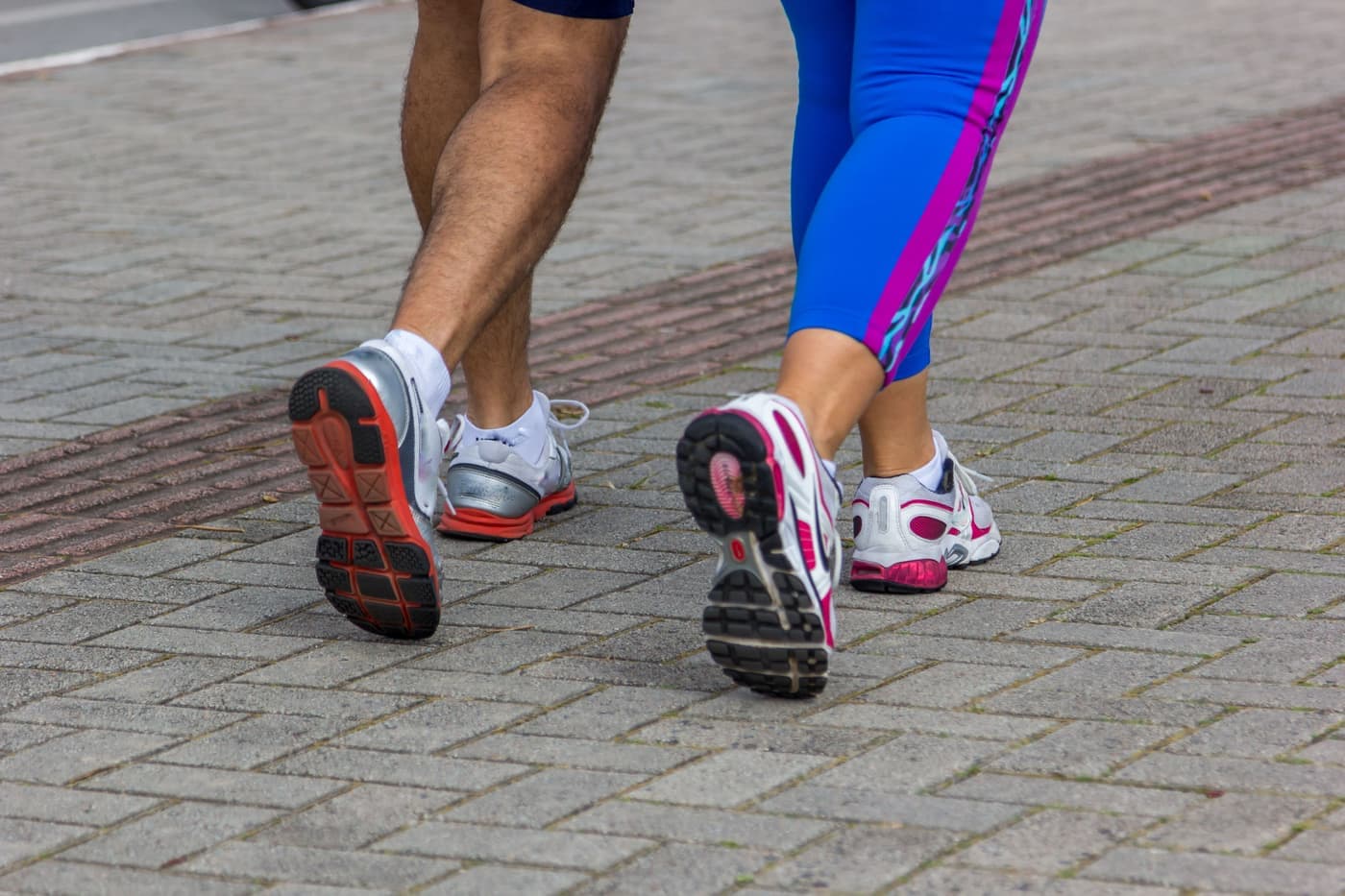
Yes, and the difference is structural rather than cosmetic. A running shoe has a tall, soft, narrow heel built to absorb a straight-line landing and roll you forward; a court shoe has a flat, wide, low outsole, a reinforced upper and a stiff heel counter built to hold your foot still when your momentum goes sideways. Running shoes fold over their own edge under lateral load, which is why ankles turn in them on court.
Disclosure — we earn a commission on qualifying purchases made through links on this page, at no extra cost to you. It never changes which product we rank first. How this site is funded.
What a court shoe is
A court shoe is footwear built for a game played inside a box, where almost all the force goes across the foot rather than along it. That covers tennis, padel, pickleball, squash, badminton, racquetball and volleyball, and the shoes for all of them share the same basic architecture even when the outsole patterns differ. In American English the term collides awkwardly with "tennis shoes", which is often just the word for sneakers - so "court shoe" is the more precise label and the one we use throughout this site.
The defining feature is a flat, wide, low sole with a non-marking rubber compound and a dense tread cut for multidirectional grip and controlled sliding. Above that sits a reinforced upper, usually with TPU or synthetic overlays through the forefoot and the medial wall, and a stiff heel counter. Nearly every court shoe also has a toe guard across the front, because dragging the front foot on a push-off is what destroys the toe of a normal sneaker in a month.
A running shoe is engineered for the opposite case. It has a tall, soft, often narrow heel designed to absorb a repeated straight-line impact, a rocker geometry that helps you roll forward, a light mesh upper with minimal lateral reinforcement, and a sole deliberately built to compress. Every one of those choices is correct for running and wrong for a court.
The five differences that matter
| Feature | Court shoe | Running shoe | Why it matters on court |
|---|---|---|---|
| Outsole shape | Flat, wide, low to the ground | Narrow, tall, often flared only at the heel | A wide low base resists tipping; a tall narrow one folds over its edge under sideways load |
| Outsole compound | Dense non-marking rubber, dense tread | Soft blown rubber or exposed foam | Court rubber survives abrasion and does not mark a gym floor; running outsoles shred on concrete |
| Upper | TPU or synthetic overlays, medial wall | Light engineered mesh | Overlays keep the foot above the midsole when you load an edge |
| Heel counter | Stiff, often rated 4/5 or 5/5 | Soft or minimal | A stiff counter stops the heel lifting out on a hard change of direction |
| Stack height | Low, often under 30 mm at the heel | Frequently 35-40 mm or more | Less height means less lever arm between your ankle and the court |
Read the stack row twice, because it is the one people underrate. Every millimeter of foam between your foot and the ground is a millimeter of lever arm: the higher you stand, the more torque a sideways force applies to your ankle. Running shoes have grown taller every year for a decade, and the modern maximal running shoe is close to the worst possible platform for a lateral sport.
Why running shoes roll ankles on court
Picture one shuffle step to a wide ball. Your outside foot plants, your momentum keeps going sideways, and all of that load arrives through the outer edge of the shoe. A court shoe answers with a wide flat base, a dense outsole that grips and then releases in a controlled slide, and an upper that holds your foot above the midsole.
A running shoe answers by deforming, because deforming is its job. The soft midsole compresses on the outer edge, the shoe tips, and the top of the shoe keeps moving while the sole stays on the floor - and your ankle is the hinge in the middle. That is the mechanism behind the standard clubhouse observation that ankles turn in running shoes and almost never in court shoes. It is not brand snobbery; it is geometry and foam density.
The second failure is cheaper and more certain: you will destroy the shoes. A running outsole has soft rubber in a sparse pattern optimized for rolling contact. Drag it through a push-off on abrasive concrete a few hundred times and the forefoot wears through, often before the midsole has done any mileage at all. We go through the tennis-specific version of this comparison in detail on tennis shoes vs running shoes.
How to tell a court shoe from a lifestyle sneaker
A lot of shoes look like court shoes. Four checks separate the real thing from a sneaker with a retro tennis silhouette, and you can run all four in a store in under a minute.
- 01Turn it over. A court outsole has a dense herringbone, modified herringbone or multidirectional pattern covering the whole sole, and it is flat. If the tread is sparse, deeply lugged, or the sole curves up sharply at the toe, it is not a court shoe.
- 02Twist it. Hold the heel in one hand and the forefoot in the other and twist. A court shoe resists - the better ones barely move, which is what reviewers score as torsional rigidity. A running or lifestyle shoe twists easily.
- 03Squeeze the heel. The heel counter should feel like a cup you cannot collapse. If the back of the shoe folds inward between your fingers, it will fold on court too.
- 04Look for the toe guard. A reinforced panel across the outer toe is near-universal on court shoes and near-absent on sneakers. Its presence is a reliable signal that the shoe was designed for someone who drags their front foot.
- 05Then check the surface claim. A proper court shoe will say which surface it is for - hard court, clay, indoor, all-court - because the outsole pattern differs. A shoe that does not mention a surface was probably not built for one.
Do you need a different court shoe for each sport?
No, with one asymmetry worth knowing. A tennis shoe is built for the biggest court in the group, so it carries the most outsole rubber, the most lateral wall and often the stiffest chassis. Nothing in pickleball, padel or recreational badminton asks more of a shoe than tennis does, which is why a hard-court tennis shoe is a perfectly good pickleball or indoor shoe.
The reverse is a compromise. A pickleball shoe is usually lighter and lower with a smaller outsole, which is right for a game played in a 20-foot box and thin for a full tennis court where you cover more ground and slide further. A padel shoe has a clay-style herringbone or omni pattern cut for sanded artificial turf, which is the wrong pattern on a hard court - too soft, too open, and it will wear quickly. We cover each pairing in full on tennis shoes vs pickleball shoes and padel shoes vs tennis shoes.
So if you play two court sports and want one pair of shoes, buy the tennis shoe and buy it for the harder, more abrasive surface. If you only play one, buy the sport-specific shoe - it will be lighter and better fitted to the movement pattern.
How this guide was put together
We do not run a test lab and nothing here is written as though we did. This page is built from published specification sheets, from the independent measurements and governing-body rules cited at the foot of the article, and from the physical reasoning that connects them. Where a figure is not published anywhere we can cite, the page says so rather than filling the gap.
The picks are existing products from our own registry, so each one carries a source you can check. Our full selection criteria set out the method, and the editorial policy covers corrections and how often pages are revisited. We earn a commission if you buy through our links, which is disclosed on every page and never changes a ranking.
Now pick yours
The specs above are only useful once they resolve into something you can buy. These are the products that match what this page has just explained.
Our picks
| # | Product | Best for | Score | Price |
|---|---|---|---|---|
| 1 | 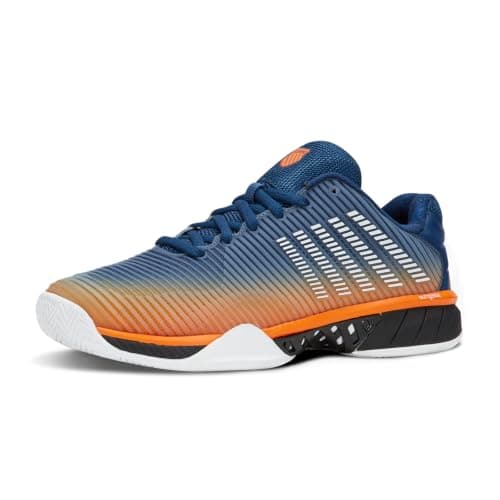 K-Swiss Hypercourt Express 2Best starting point | A first real court shoe for any sport | 8.35 criteria | |
| 2 | 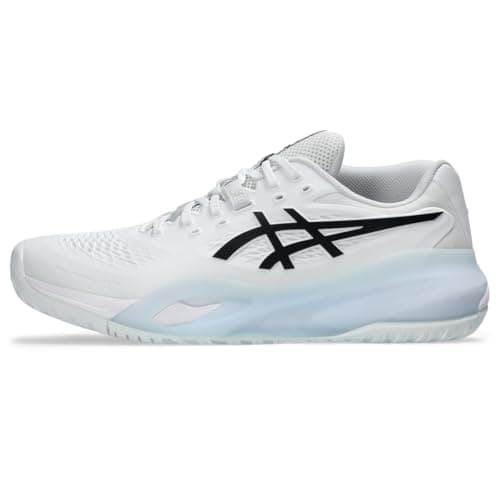 ASICS GEL-Resolution XMost structure | Players who want the structure a running shoe cannot give | 8.65 criteria | $139.95 · View on Amazon Price as of October 17, 2026 · was $164.95, 15% off |
| 3 | 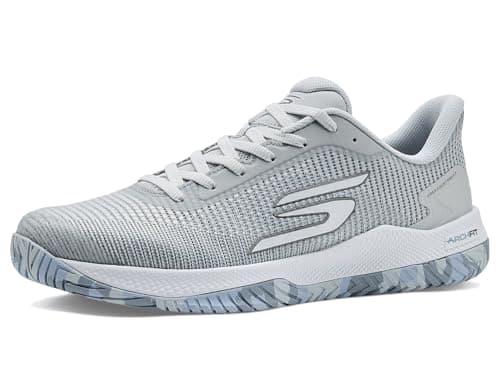 Skechers Viper Court Pro 2.0Best for pickleball | Pickleball and a roomier forefoot | 8.65 criteria | $89.99 · View on Amazon Price as of October 17, 2026 · was $120.00, 25% off |
01K-Swiss Hypercourt Express 2
Best starting pointBest for: A first real court shoe for any sport
RunRepeat score it 86 and name it their budget hard-court pick at a listed $110, 13 percent below what they consider typical for the category. For somebody who has just worked out that their running shoes are the problem, this is the cheapest honest fix: a real court outsole, a real heel counter, a real toe guard.
It is also the most versatile shoe on this page. Tennis Warehouse carry it in their pickleball shoe catalog as well as their tennis range, so the crossover is a retail fact rather than our inference, and RunRepeat list it in their wide-feet catalog, which makes it accommodating for a tennis last.
The honest cost is that it is a budget shoe in a premium category. You do not get the measured stability of a GEL-Resolution or the cushioning of a New Balance CT-Rally, and a heavy player who plays four times a week will wear it out faster than a premium shoe. It is the right first court shoe, not the last one.
Our score
- Lateral stability
- 8.0
- Cushioning
- 7.5
- Outsole durability
- 8.5
- Fit accommodation
- 8.5
- Lightness
- 8.0
- Overall
- 8.3
Verified specs
- RunRepeat score
- 86 — Best Budget, hard court
- Price
- $110, 13% below category typical
- Weight
- Lighter than average
- Width fit
- Listed in RunRepeat's wide-feet catalog
Specs as published by RunRepeat, checked September 2026.
Buy if
- You are moving off running shoes for the first time
- You play more than one court sport
- You want a court shoe without premium pricing
Pass if
- You play four or more times a week
- You want measured maximum stability
- You want the most cushioning available
02ASICS GEL-Resolution X
Most structureBest for: Players who want the structure a running shoe cannot give
If you want to understand what a court shoe is by holding one, hold this. RunRepeat scored both its torsional rigidity and its heel counter stiffness at 5/5 - the two measurements that define the category - alongside a 90.4 HC outsole that lost only 0.6 mm in their Dremel test.
The numbers that matter for the comparison on this page are the stack and the drop: 30.8 mm at the heel, 21.9 mm at the forefoot, an 8.9 mm drop. That is low and flat next to a modern cushioned running shoe, and it is deliberately so - less height, less lever, less chance of tipping.
The cost is 14.7 oz / 417 g, which is heavy, and a price at the top of the category. This is the shoe for somebody who has already decided they are a court player rather than somebody deciding whether to be one. Our [hard court roundup](/tennis-shoes/best-for-hard-court) has the lighter alternatives.
Our score
- Lateral stability
- 9.5
- Cushioning
- 8.5
- Outsole durability
- 9.5
- Fit accommodation
- 8.0
- Lightness
- 6.5
- Overall
- 8.6
Verified specs
- RunRepeat score
- 90 — Best Stability
- Weight
- 14.7 oz / 417 g (men's 9)
- Heel / forefoot stack
- 30.8 mm / 21.9 mm
- Drop
- 8.9 mm
- Torsional rigidity
- 5/5
- Heel counter stiffness
- 5/5
- Heel shock absorption
- 98 SA
- Outsole wear
- 0.6 mm depth, 90.4 HC
Specs as published by RunRepeat, checked September 2026.
Buy if
- You play several times a week on hard court
- You have rolled an ankle and want maximum structure
- You want an outsole that survives outdoor concrete
Pass if
- You want a light shoe
- You are still deciding how often you will play
- You want a soft, flexible ride
Price as of October 17, 2026 · was $164.95, 15% off
03Skechers Viper Court Pro 2.0
Best for pickleballBest for: Pickleball and a roomier forefoot
The sport-specific answer if the court sport you play is pickleball. A Goodyear Gold rubber outsole built for the quick stop rather than for rolling forward, an ULTRA GO foam midsole, a removable Arch Fit insole, and a Relaxed Fit last that gives the forefoot genuine room - which matters in a game that pushes off the inside edge of the forefoot over and over.
It also sits well below premium court-shoe money, which makes it the sensible answer for a player whose alternative was a pair of trainers. A rubber toe guard covers the drag point and the published heel height is 1 1/4 inches.
The honest cost is upper support at the top end. A mesh upper with a toe guard is not a TPU cage, so a heavy, aggressive mover who covers a lot of ground will feel the upper give before the outsole wears out - and the relaxed last works against a narrow foot. Skechers publish no weight for this model, so we are not going to state one.
Our score
- Lateral stability
- 8.0
- Cushioning
- 8.5
- Outsole durability
- 8.5
- Fit accommodation
- 9.0
- Lightness
- 8.0
- Overall
- 8.6
Verified specs
- Outsole
- Goodyear Gold rubber
- Midsole
- ULTRA GO foam
- Insole
- Arch Fit, removable EVA
- Upper
- Mesh with rubber toe guard
- Fit
- Relaxed Fit — roomy toe and forefoot
- Heel height
- 1 1/4 in
- Brand list price
- $115 at Skechers
Specs as published by Skechers, checked September 2026.
Buy if
- Pickleball is your main court sport
- You want a roomy forefoot rather than a snug tennis last
- You want a court outsole without premium pricing
Pass if
- You play tennis as well and want one pair for both
- You have a narrow foot
- You want a caged, structured upper
Price as of October 17, 2026 · was $120.00, 25% off
Common questions
Are court shoes different than running shoes?
Yes, structurally. Court shoes have a flat, wide, low outsole in dense non-marking rubber, a reinforced upper with lateral overlays, a stiff heel counter and a toe guard. Running shoes have a tall, soft, often narrow midsole, a light mesh upper and a sole built to compress and roll forward. The two are engineered for opposite forces.
Can I play tennis in running shoes?
You can, and plenty of people do for a few sessions. The risks are an ankle rolling when the soft tall midsole folds over its outer edge under lateral load, and the forefoot outsole wearing through quickly because running rubber is not built for abrasion from a push-off drag.
Can I wear court shoes for running?
For short distances, yes, but you will not enjoy it. A court shoe is heavy, firm and torsionally rigid by design, with much less cushioning than a running shoe at the heel. It is not dangerous - just the wrong tool, and your knees will tell you about it.
Is a tennis shoe the same as a court shoe?
A tennis shoe is one type of court shoe. The category also covers padel, pickleball, squash, badminton, racquetball and volleyball shoes, which share the same architecture but differ in outsole pattern and weight. In American English "tennis shoes" is also just a word for sneakers, which is why we use "court shoe" when we mean the real thing.
How can I tell if a shoe is a real court shoe?
Four checks. Turn it over - the tread should be dense, flat and multidirectional. Twist it - a court shoe resists. Squeeze the heel - the counter should not collapse. And look for a toe guard across the outer forefoot. A shoe that passes all four and names a surface is a court shoe.
Do I need different court shoes for indoor and outdoor?
The compound matters more than the category. Outdoor concrete is abrasive and rewards a hard, durable outsole; indoor wood rewards grip and a non-marking compound, and many clubs post a non-marking rule at the door. If you play on both, buy for the abrasive surface - it is the one that destroys shoes.
Read next
Sources
- 01RunRepeat - best tennis shoes
- 02RunRepeat - best hard court tennis shoes
- 03RunRepeat - ASICS GEL-Resolution X
- 04Skechers - Viper Court Pro 2.0 Pickleball
- 05Tennis Warehouse - men's pickleball shoes
Every source above was retrieved while writing this page. Specifications are quoted from the listing or manufacturer page cited, not from memory.