Guide
High-top vs low-top tennis shoes
Almost nobody makes an ankle-high tennis shoe, and players keep searching for one anyway. The support you are looking for is real - it just comes from three other parts of the shoe.
By Janet H.Updated
The short answer
True high-top tennis shoes are almost nonexistent, because a tall collar restricts the ankle flexion a tennis player needs and does little to stop the rolling motion that actually causes injuries. Ankle support in a court shoe comes from three measurable things instead: a stiff heel counter, high torsional rigidity, and a low stack height. Buy for those, not for collar height.
Disclosure — we earn a commission on qualifying purchases made through links on this page, at no extra cost to you. It never changes which product we rank first. How this site is funded.
Why ankle-high tennis shoes barely exist
If you search for ankle-high or high-top tennis shoes you will mostly find basketball shoes, retro lifestyle sneakers and a handful of mid-cut models that are marketed on looks rather than on support. There is no meaningful high-top segment in current court footwear, and that is a design decision rather than an oversight.
Tennis needs ankle mobility. A split step, a low volley, a slide into a wide forehand and a recovery step all require the ankle to flex and roll through a real range of motion, and they require it hundreds of times an hour. A collar that physically limits dorsiflexion costs you depth in the split step and speed out of it. Basketball tolerates a high collar because the sport's loading pattern is dominated by jumping and landing; tennis is dominated by low, wide, fast changes of direction.
The second reason is that a collar sits above the joint that actually fails. The classic court ankle injury is an inversion sprain: the foot rolls outward underneath you while the leg keeps going. The structures that resist that are at and below the ankle - the heel counter wrapping the calcaneus, the midsole's resistance to twisting, and the height of the platform your foot stands on. Fabric above the joint has very little leverage on any of it.
The three things that actually resist an ankle roll
All three of these are measured by independent reviewers, which means you can shop on them rather than guessing.
- Heel counter stiffness. The counter is the structure that cups the back of your heel. A rigid one keeps the heel bone seated and aligned under the leg when the foot loads an edge; a soft one lets the heel tilt first, and the rest of the foot follows. RunRepeat score this 1 to 5, and the ASICS GEL-Resolution X and GEL-Challenger 15 both take a full 5/5.
- Torsional rigidity. How much the shoe resists being twisted along its length. A rigid chassis keeps the forefoot and the heel in the same plane, so a force applied at the forefoot does not twist the rest of the shoe out from under you. RunRepeat score this 1 to 5 and also publish it in newton meters - their category average is 18.1 Nm.
- Stack height. The lower you stand, the shorter the lever arm between the court and your ankle, and the less torque a sideways force applies. This is why court shoes have stayed low while running shoes have grown tall. The adidas Barricade 14's 14.4 mm forefoot is the lowest figure we track.
Notice that collar height appears on none of these lists, and that two of the three are structural rather than cosmetic. It is also why we rank these three on our ankle support roundup instead of ranking shoes by how far up the leg they come.
The numbers side by side
| Shoe | Heel counter | Torsional rigidity | Forefoot stack | Collar |
|---|---|---|---|---|
| ASICS GEL-Resolution X | 5/5 | 5/5 | 21.9 mm | Standard low |
| ASICS GEL-Challenger 15 | 5/5 | Midsole stiffness 5/5 | Not published | Standard low |
| New Balance Fresh Foam X CT-Rally v2 | Not published | 5/5 | 20.2 mm | Standard low |
| Nike Zoom GP Challenge 1 | 4/5 | 5/5 | Not published | Standard low |
| adidas Barricade 14 | Not published | Not published | 14.4 mm | Standard low |
The table also shows how patchy the published data is. Heel counter stiffness exists for three of the five; torsional rigidity for four. That is still far more than you get for collar height, which no brand publishes as a measurement at all because no brand treats it as a feature.
If your ankle has gone over before
A previous sprain is the strongest predictor of the next one, and it changes the shopping list in two places rather than sending you looking for a taller shoe.
- 01Buy for the two structural scores. A 5/5 heel counter and a 5/5 torsional rigidity figure is the combination, and the ASICS GEL-Resolution X is the only shoe we track that has both.
- 02Go low rather than cushioned. A tall soft heel is a tall soft lever. If you have to choose between shock absorption and a low platform, a previously injured ankle argues for the low platform.
- 03Consider a brace rather than a shoe. A lace-up or stirrup ankle brace does what a high collar is imagined to do, and does it at the joint, under the shoe's upper where it has leverage. It is also a medical decision rather than a gear one - which is a reason to raise it with a clinician instead of solving it at checkout.
- 04Check the shoes you own. A compressed midsole has lost the stack geometry you bought and an outsole polished smooth will not release in a controlled slide. Our five replacement checks take two minutes.
- 05Lace to the top eyelet with a heel lock. It pulls the collar down onto the heel rather than squeezing the instep, which improves the seat of the heel in the counter you paid for.
What about basketball shoes, then?
The obvious thought is that if high-tops exist in basketball and basketball players change direction too, a basketball shoe should work. It is the right question and the answer is no - for reasons that have nothing to do with the collar. A basketball shoe carries a much taller stack, a softer and more compliant midsole built around jumping and landing, and an outsole pattern and compound cut for a clean indoor wood floor.
On a hard court that combination gives you a high, soft platform with a sole that does not slide in a controlled way, which is more ankle risk rather than less, plus an outsole that will wear quickly on abrasive outdoor surfaces. We work through that trade in full on basketball shoes for tennis.
How this guide was put together
We do not run a test lab and nothing here is written as though we did. This page is built from published specification sheets, from the independent measurements and governing-body rules cited at the foot of the article, and from the physical reasoning that connects them. Where a figure is not published anywhere we can cite, the page says so rather than filling the gap.
The picks are existing products from our own registry, so each one carries a source you can check. Our full selection criteria set out the method, and the editorial policy covers corrections and how often pages are revisited. We earn a commission if you buy through our links, which is disclosed on every page and never changes a ranking.
Now pick yours
The specs above are only useful once they resolve into something you can buy. These are the products that match what this page has just explained.
Our picks
| # | Product | Best for | Score | Price |
|---|---|---|---|---|
| 1 | 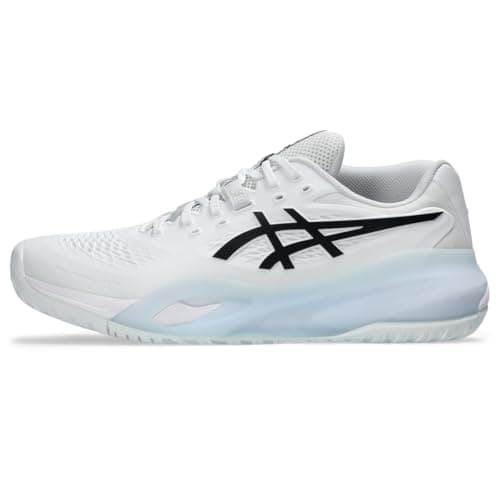 ASICS GEL-Resolution XTop pick | Maximum measured ankle structure | 8.75 criteria | $139.95 · View on Amazon Price as of October 17, 2026 · was $164.95, 15% off |
| 2 | 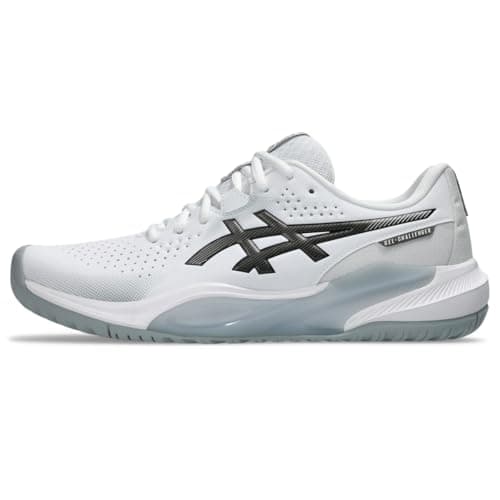 ASICS GEL-Challenger 15Best value | Structure at a beginner price | 7.95 criteria | |
| 3 | 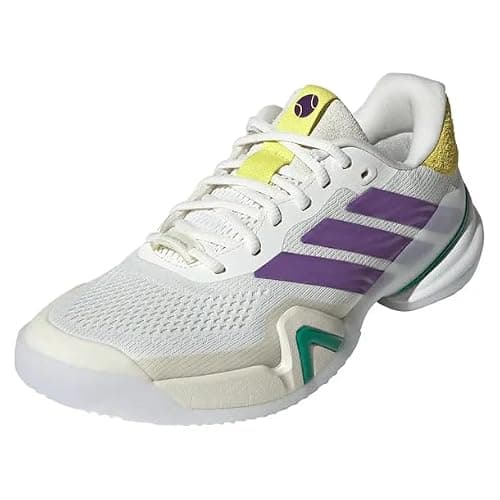 adidas Barricade 14Lowest platform | Standing as low as possible | 8.05 criteria |
01ASICS GEL-Resolution X
Top pickBest for: Maximum measured ankle structure
The only shoe we track that scores a full 5/5 on both of the measurements that matter here - heel counter stiffness and torsional rigidity. If you came looking for an ankle-high tennis shoe because your ankle has gone over, this is the shoe that answers the actual problem.
The rest of its figures support the case: a 30.8 mm heel and 21.9 mm forefoot on an 8.9 mm drop, 98 SA of heel shock absorption, and the hardest outsole we have a figure for at 90.4 HC with 0.6 mm of Dremel wear. Low, rigid and durable is the profile you want.
The cost is 14.7 oz / 417 g - the heaviest shoe in our registry - and premium pricing. A rigid shoe is also less comfortable in the first week than a flexible one. Those are real trade-offs, and they are the ones worth making if your ankle is the limiting factor.
Our score
- Lateral stability
- 9.5
- Cushioning
- 8.5
- Outsole durability
- 9.5
- Fit accommodation
- 8.0
- Lightness
- 6.5
- Overall
- 8.7
Verified specs
- RunRepeat score
- 90 — Best Stability
- Weight
- 14.7 oz / 417 g (men's 9)
- Heel / forefoot stack
- 30.8 mm / 21.9 mm
- Drop
- 8.9 mm
- Torsional rigidity
- 5/5
- Heel counter stiffness
- 5/5
- Heel shock absorption
- 98 SA
- Outsole wear
- 0.6 mm depth, 90.4 HC
Specs as published by RunRepeat, checked September 2026.
Buy if
- You have rolled an ankle on court before
- You want the two structural scores maxed out
- You play several times a week on hard court
Pass if
- You want a light shoe
- You want a soft, flexible ride out of the box
- Price is the deciding factor
Price as of October 17, 2026 · was $164.95, 15% off
02ASICS GEL-Challenger 15
Best valueBest for: Structure at a beginner price
RunRepeat's Best for Beginners pick at an 83, and it takes 5/5 for both midsole stiffness and heel counter stiffness - the same maximum heel-counter score as the GEL-Resolution X, at a fraction of the price. For a new player whose ankles are the reason they are reading this page, that is the single best value on offer.
It is also listed in RunRepeat's wide-feet catalog, so it accommodates a broader foot than most structured court shoes, and a shoe that fits is a shoe whose heel counter can actually do its job.
The honest costs: RunRepeat describe it as notably heavier than average, ASICS publish no stack or drop figure for it, and it sits at the entry tier of the range - so the outsole and midsole will not last like a premium shoe's. Buy it as the sensible first structured court shoe.
Our score
- Lateral stability
- 8.5
- Cushioning
- 7.5
- Outsole durability
- 7.5
- Fit accommodation
- 8.5
- Lightness
- 6.0
- Overall
- 7.9
Verified specs
- RunRepeat score
- 83 — Best for Beginners
- Midsole stiffness
- 5/5
- Heel counter stiffness
- 5/5
- Weight
- Notably heavier than average
- Width fit
- Listed in RunRepeat's wide-feet catalog
Specs as published by RunRepeat, checked September 2026.
Buy if
- You are new to court sports and want structure
- You have a wide foot
- You want the cheapest 5/5 heel counter available
Pass if
- You play four or more times a week
- You want published stack and drop figures
- You want a light shoe
03adidas Barricade 14
Lowest platformBest for: Standing as low as possible
A 14.4 mm forefoot stack and a 26.3 mm heel - the lowest pair of figures we track, and RunRepeat's Best Court Feel award. If you accept the argument that stack height is a lever arm, this is the shoe that shortens it most.
Low also means informative. You feel where your weight is, which is its own kind of ankle protection: proprioception is how you correct a foot that is starting to roll, and a tall soft platform mutes the signal you need.
The cost is printed in the shock-absorption numbers: 89 SA at the heel and 47 SA at the forefoot, against 116 and 78 for the CT-Rally v2. That is a large real difference underfoot, and anybody with heel or forefoot pain should read it as a reason to look elsewhere.
Our score
- Lateral stability
- 8.5
- Cushioning
- 6.5
- Outsole durability
- 8.5
- Fit accommodation
- 8.0
- Lightness
- 7.5
- Overall
- 8.0
Verified specs
- RunRepeat award
- Best Court Feel
- Heel stack
- 26.3 mm
- Forefoot stack
- 14.4 mm
- Heel shock absorption
- 89 SA
- Forefoot shock absorption
- 47 SA
Specs as published by RunRepeat, checked September 2026.
Buy if
- You want the lowest platform available
- You correct your own balance and want feedback from the court
- You trust the Barricade chassis
Pass if
- You need real cushioning
- You have heel or forefoot pain
- You play long sessions on concrete
Common questions
Are there high-top tennis shoes?
Essentially no. Current court footwear is a low-collar category, and the high-tops you find when searching are basketball shoes or lifestyle sneakers. A tall collar restricts the ankle flexion tennis needs and has little leverage on the inversion motion that causes most court ankle injuries.
Do high-top shoes prevent ankle sprains?
Not in the way players expect on a tennis court. The classic court injury is the foot rolling outward beneath the leg, and the structures that resist it sit at or below the joint - the heel counter, the shoe's torsional rigidity and the stack height. Material above the ankle has very little mechanical advantage over that motion.
What gives a tennis shoe ankle support, then?
Three measurable things: heel counter stiffness, torsional rigidity and a low stack height. RunRepeat publish scores for the first two and measurements for the third, so you can shop on them. The ASICS GEL-Resolution X is the only shoe we track that scores 5/5 on both of the first two.
Should I wear an ankle brace for tennis instead?
A lace-up or stirrup brace acts at the joint, under the shoe's upper, which is where a high collar is imagined to act and does not. Whether you should wear one after an injury is a clinical question rather than a gear question, so it belongs with the person examining your ankle.
Are mid-cut court shoes worth it?
If you like the containment, there is no harm in it - the proprioceptive feeling of being held is real. Just do not trade away a stiff heel counter or a low stack to get it, because those are the parts doing the measurable work.
Can I wear basketball shoes for tennis to get ankle support?
It is a poor trade. A basketball shoe has a taller, softer stack and an outsole cut for indoor wood, so on a hard court you get more lever arm, less controlled sliding and faster outsole wear. We cover it in full on basketball shoes for tennis.
Read next
Sources
- 01RunRepeat - ASICS GEL-Resolution X
- 02RunRepeat - best hard court tennis shoes
- 03RunRepeat - best tennis shoes
- 04RunRepeat - New Balance Fresh Foam X CT-Rally v2
Every source above was retrieved while writing this page. Specifications are quoted from the listing or manufacturer page cited, not from memory.