Guide
When to replace tennis shoes
A court shoe fails from the inside out. By the time the upper looks worn, the structure that was protecting your ankle has usually been gone for months.
By Janet H.Updated
The short answer
Replace court shoes when the outsole tread is smooth at the pivot points, when the midsole creases permanently, when the heel counter can be squeezed flat, or when the upper has stretched enough that your foot slides. None of those depends on how the shoe looks, and all of them precede visible damage to the upper.
Disclosure — we earn a commission on qualifying purchases made through links on this page, at no extra cost to you. It never changes which product we rank first. How this site is funded.
Why mileage is the wrong unit for a court shoe
Running shoes get replaced on distance, usually quoted somewhere between 300 and 500 miles, and the number works because running is a repetitive forward-loading activity that wears a shoe in a predictable way. Tennis, padel and pickleball are not that.
Court sport loads the shoe sideways, in bursts, at unpredictable angles, and the wear concentrates in a few small areas rather than spreading evenly. Two players with the same court hours can destroy a pair at very different rates depending on how they move, how heavy they are, and what surface they play on. There is no mileage equivalent, which is why the checks below are physical rather than numerical.
One figure is worth knowing though, because it is the manufacturers' own: several shoes in our registry carry a six-month outsole warranty, including the ASICS GEL-Resolution 9 Clay, the New Balance Coco CG2 and the Mizuno Wave Exceed Tour 7. A six-month guarantee against outsole wear tells you what the brands expect a hard-played outsole to survive, and it is a shorter period than most people assume.
The five checks
- 01Outsole tread at the pivot points. Not overall tread — the specific patches under the ball of the foot and the outside edge of the forefoot, where you push off and pivot. When those go smooth, your grip is gone in the exact places you need it most.
- 02Permanent midsole creasing. Press the midsole and look at the sidewall. Deep creases that stay when the shoe is unloaded mean the foam has compressed and is no longer returning energy or absorbing shock.
- 03Heel counter collapse. Squeeze the back of the shoe between thumb and fingers. A healthy heel counter resists firmly. If it folds easily, the structure holding your heel has gone, and that is the property that stops your foot rolling inward.
- 04Upper stretch. Lace the shoe normally and move your foot side to side. If it slides inside the shoe, the upper has stretched past the point where lacing can hold you, and no amount of tightening fixes it.
- 05Torsional give. Hold the shoe at heel and toe and twist. New court shoes resist this noticeably. A shoe that twists easily has lost the torsional rigidity that is the single most protective property a court shoe has.
Any one of those is a replacement signal on its own. Two together and the shoe has been finished for a while. All five can be true on a shoe whose upper still looks presentable, which is the trap.
What a dead shoe actually costs you
The reason to care is not the shoe, it is the ankle. RunRepeat's lab teardowns score torsional rigidity and heel counter stiffness out of five, and on their measurements those two properties are what separate a protective court shoe from an unprotective one — the ASICS GEL-Resolution X earns 5 out of 5 on both, which is why it leads so many stability lists.
Those are structural properties, and structure degrades. A shoe that measured 5 out of 5 when new does not hold that score indefinitely; the foam compresses, the heel counter softens, and the adhesives and stitching that make the chassis rigid loosen. Nobody publishes a decay curve for this, so we are not going to invent one, but the direction is one-way.
What that means in practice is that the shoe stops doing the job you bought it for before it stops looking like a shoe. If you chose a shoe specifically for stability — for flat feet, for ankle support, for plantar fasciitis — then letting it run until it looks worn out means spending most of its life without the property you paid for.
The pages where this matters most are best tennis shoes for flat feet, best tennis shoes for ankle support and best tennis shoes for plantar fasciitis. If you are on any of those lists for a reason, replace earlier rather than later.
Surface changes the arithmetic
Where you play changes how fast the shoe dies, and by more than most people expect. Hard court is abrasive and attacks the outsole directly. Clay is gentler on rubber but packs the tread with material. Padel's sanded artificial turf is the harshest of the three on outsoles, because the sand acts as a grinding medium under the sole.
- Hard court — outsole wear dominates. RunRepeat measure outsole hardness in HC and Dremel wear depth in millimetres, and a harder compound lasts longer. The ASICS GEL-Resolution X measured 90.4 HC with 0.6 mm of wear, which is at the durable end.
- Clay — less outsole abrasion but the midsole and upper still age normally, so the structural checks matter more than the tread check.
- Padel and sanded turf — the fastest outsole wear of the three. This is why a Vibram-soled padel shoe exists as a category answer; see best padel shoes for men.
- Indoor and carpet — gentlest on the outsole, so the structural checks will almost always reach the threshold before the tread does.
The practical consequence is that a hard-court player should check the outsole and a clay or indoor player should check the heel counter and the torsion, because those are the properties their surface will finish first. How to choose tennis shoes for your court surface covers the sole patterns themselves.
How this guide was put together
We do not run a test lab and nothing here is written as though we did. This guide is built from the published specification sheets and third-party lab measurements cited at the foot of the page, plus the physical reasoning that connects them. Where a figure is not published we say so rather than estimating it.
The picks below are drawn from our product registry, so every one carries a cited source and a verified listing. Our full selection criteria set out the method and the editorial policy covers corrections. No price is written into this page — the figure on each buy button is the live one.
Now pick yours
The specs above are only useful once they resolve into something you can buy. These are the products that match what this page has just explained.
Our picks
| # | Product | Best for | Score | Price |
|---|---|---|---|---|
| 1 | 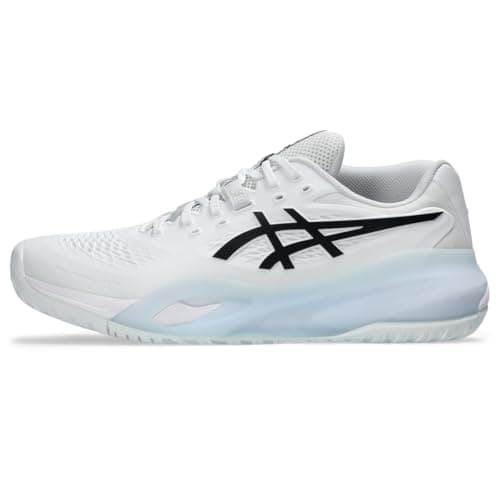 ASICS GEL-Resolution XMost durable structure | Replacing a dead stability shoe | 8.95 criteria | $139.95 · View on Amazon Price as of October 10, 2026 · was $164.95, 15% off |
| 2 | 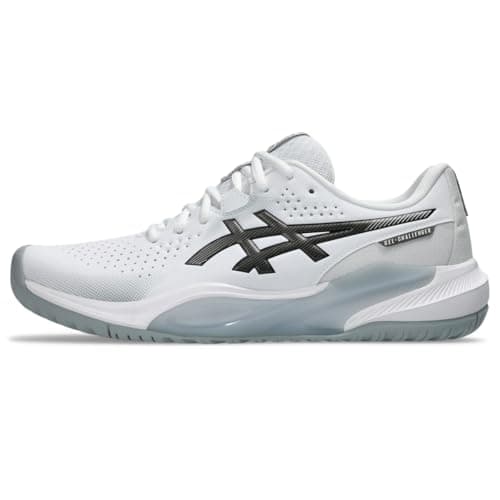 ASICS GEL-Challenger 15Best value replacement | Replacing shoes often on a budget | 8.15 criteria | |
| 3 | 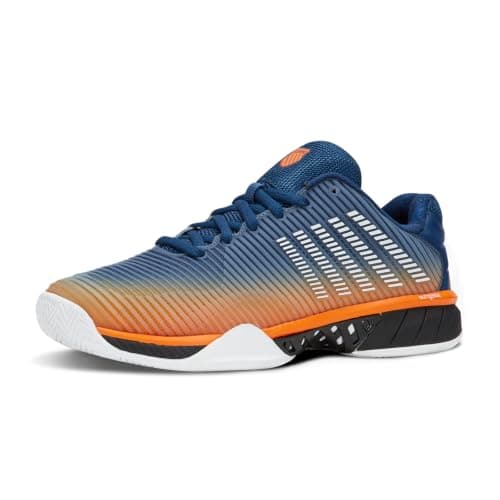 K-Swiss Hypercourt Express 2Best lightweight option | A lighter replacement that still scores well | 8.15 criteria |
01ASICS GEL-Resolution X
Most durable structureBest for: Replacing a dead stability shoe
RunRepeat score it 90 overall with 5 out of 5 for both torsional rigidity and heel counter stiffness — the two properties this page is about — and measured its outsole at 90.4 HC with only 0.6 mm of Dremel wear, which is the hardest and most wear-resistant in their hard-court set.
That combination is what you want if you have just worn out a shoe faster than you expected. The hardest outsole they measured delays the tread check, and the maximum structural scores give you the longest useful life before the heel counter and torsion checks catch up.
It weighs 14.7 oz or 417 g in a men's 9, which is at the top of the category, and there is no way around that — the structure that lasts is made of material, and material weighs something.
Our score
- Lateral stability
- 10.0
- Cushioning
- 8.5
- Outsole durability
- 9.5
- Fit accommodation
- 7.5
- Lightness
- 4.0
- Overall
- 8.9
Verified specs
- RunRepeat score
- 90 — Best Stability
- Weight
- 14.7 oz / 417 g (men's 9)
- Heel / forefoot stack
- 30.8 mm / 21.9 mm
- Drop
- 8.9 mm
- Torsional rigidity
- 5/5
- Heel counter stiffness
- 5/5
- Heel shock absorption
- 98 SA
- Outsole wear
- 0.6 mm depth, 90.4 HC
Specs as published by RunRepeat, checked September 2026.
Buy if
- Your last pair wore out faster than expected
- You want the hardest outsole measured
- Stability is why you buy court shoes
Pass if
- You want a light shoe
- You want maximum court feel
- You play once a fortnight
Price as of October 10, 2026 · was $164.95, 15% off
02ASICS GEL-Challenger 15
Best value replacementBest for: Replacing shoes often on a budget
RunRepeat score this 83 and give it 5 out of 5 for both midsole stiffness and heel counter stiffness. Those are the same two maximum structural scores a premium shoe earns, at a beginner price — which is the right answer if the thing stopping you replacing shoes on time is cost.
That is a genuine strategy rather than a compromise. A fresh mid-price shoe with intact structure protects you better than a worn premium one, and replacing two of these over the period you would have kept one expensive pair is the better outcome for your ankles.
RunRepeat note it is notably heavier than average, and it does not match the GEL-Resolution X on torsional rigidity or outsole hardness. It is also in their wide-feet catalog, which is useful if fit has been a problem.
Our score
- Lateral stability
- 9.0
- Cushioning
- 7.5
- Outsole durability
- 8.0
- Fit accommodation
- 9.0
- Lightness
- 4.5
- Overall
- 8.1
Verified specs
- RunRepeat score
- 83 — Best for Beginners
- Midsole stiffness
- 5/5
- Heel counter stiffness
- 5/5
- Weight
- Notably heavier than average
- Width fit
- Listed in RunRepeat's wide-feet catalog
Specs as published by RunRepeat, checked September 2026.
Buy if
- Cost is what delays your replacements
- You want measured structure at a lower price
- Your feet are wide
Pass if
- You want the longest-lasting outsole
- You play five times a week
- Weight is a concern
03K-Swiss Hypercourt Express 2
Best lightweight optionBest for: A lighter replacement that still scores well
RunRepeat score this 86 and name it their best budget hard-court shoe at $110, which they note is 13% below the category typical, and they record it as lighter than average. It is also listed in their wide-feet catalog.
It is here because the honest objection to the two ASICS above is weight, and a shoe you find too heavy to wear is a shoe that protects nothing. An 86 at a lighter weight is a reasonable trade if the structural checks are ones you intend to run regularly.
Lighter means less material, and less material means the structural checks will reach the threshold sooner than on the GEL-Resolution X. Plan on a shorter replacement cycle rather than assuming equivalence.
Our score
- Lateral stability
- 8.0
- Cushioning
- 8.0
- Outsole durability
- 7.5
- Fit accommodation
- 9.0
- Lightness
- 8.0
- Overall
- 8.1
Verified specs
- RunRepeat score
- 86 — Best Budget, hard court
- Price
- $110, 13% below category typical
- Weight
- Lighter than average
- Width fit
- Listed in RunRepeat's wide-feet catalog
Specs as published by RunRepeat, checked September 2026.
Buy if
- The heavier stability shoes are too much shoe
- You want a strong score at a lower price
- Your feet are wide
Pass if
- You need maximum structure
- You want the longest replacement cycle
- You play on sanded padel turf
Common questions
When should you replace tennis shoes?
When the outsole has gone smooth at the pivot points, the midsole creases permanently, the heel counter squeezes flat, the upper has stretched enough that your foot slides, or the shoe twists easily end to end. Any one of those is enough, and none of them depends on how the upper looks.
How many hours do tennis shoes last?
There is no reliable hours figure, because court sport wears shoes unevenly and at rates that depend on your movement, your weight and your surface. The closest thing to a manufacturer's answer is the six-month outsole warranty several models carry, which is shorter than most people assume.
Can I use mileage like running shoes?
No. Running wear is repetitive and forward-loaded, so distance predicts it. Court movement is lateral, bursty and concentrated in small patches of the outsole, so the same hours can produce very different wear on two pairs.
Do tennis shoes lose support before they look worn?
Yes, and that is the central problem. Torsional rigidity and heel counter stiffness are the properties that protect your ankle, and both degrade as foam compresses and the chassis loosens — well before the upper looks finished.
Does playing on padel courts wear shoes faster?
The outsoles, yes. Sanded artificial turf puts a grinding medium between the rubber and the base, so outsole wear is faster than on hard court. It is the reason a Vibram-soled padel shoe exists as a category answer.
Is it worth buying expensive court shoes if they wear out?
It depends on how often you play. A harder outsole and a more rigid chassis genuinely last longer, which is what the premium buys. But a fresh mid-price shoe protects you better than a worn premium one, so if cost is what delays your replacements, buy cheaper and replace sooner.
Read next
Sources
- 01RunRepeat — ASICS GEL-Resolution X lab teardown
- 02RunRepeat — Best Hard Court Tennis Shoes
- 03RunRepeat — ASICS GEL-Resolution 9 Clay
- 04RunRepeat — Mizuno Wave Exceed Tour 7
Every source above was retrieved while writing this page. Specifications are quoted from the listing or manufacturer page cited, not from memory.