Buying guide
Best pickleball paddles for spin in 2026
Spin on a pickleball paddle is a surface property. Once you know that, the whole category sorts itself — and a $100 paddle can out-spin a $200 one.
By Janet H.Updated
The short answer
The Vatic Pro V-SOL Pro is the best spin paddle for most players: a raw T700 carbon face on a 16 mm core at $99.99, which is the face material that grips the ball longest at contact. The JOOLA Hyperion CFS 16 adds elongated leverage, and the Engage Pursuit MX 6.0 takes the textured fiberglass route.
Disclosure — we earn a commission on qualifying purchases made through links on this page, at no extra cost to you. It never changes which product we rank first. How this site is funded.
Our picks
| # | Product | Best for | Score | Price |
|---|---|---|---|---|
| 1 | 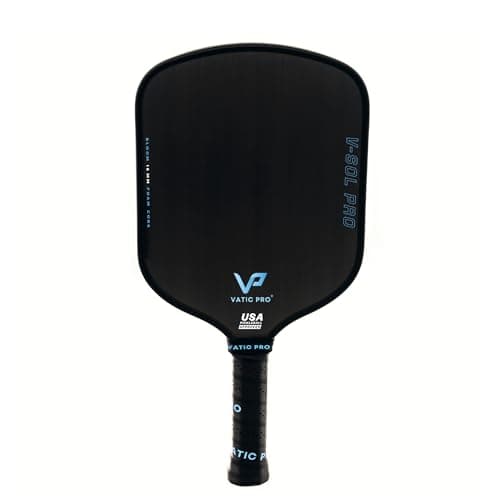 Vatic Pro V-SOL ProTop pick | Raw carbon spin at a mid-tier price | 8.65 criteria | |
| 2 |  JOOLA Ben Johns Hyperion CFS 16Best elongated | Spin with reach behind it | 8.65 criteria | |
| 3 | Engage Pursuit MX 6.0Best textured face | Texture instead of raw carbon | 8.45 criteria | |
| 4 | 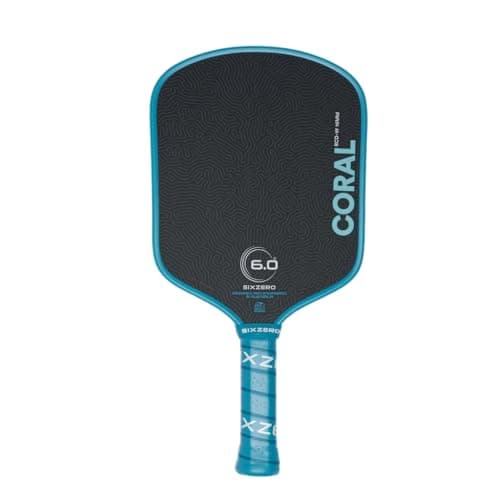 Six Zero CoralBest for the soft game | Spin without giving up control | 8.55 criteria |
The picks in detail
01Vatic Pro V-SOL Pro
Top pickBest for: Raw carbon spin at a mid-tier price
A raw T700 carbon face on a 16 mm core, 8 to 8.5 oz, with a 5.3 to 5.6 inch handle, at $99.99 as listed by Pickleheads — who give it their best budget award. Raw carbon means the weave is left unfinished rather than painted or clear-coated.
That is the whole mechanism. An unfinished carbon surface is microscopically rough, so it holds the ball a fraction longer at contact and lets the paddle face drag across it rather than skid off. Spin is produced in that fraction, which is why the face matters and the core does not.
Raw faces wear smoother with use, and that is the honest cost of every paddle on this page. The texture is a consumable in the same sense a tyre tread is. Expect a measurable drop in bite over a heavy season, and treat any claim of permanent grit as marketing.
Our score
- Control
- 8.5
- Power
- 8.0
- Spin
- 9.0
- Sweet spot
- 8.0
- Value
- 9.5
- Overall
- 8.6
Verified specs
- Pickleheads award
- Best Budget
- Weight
- 8-8.5 oz
- Core
- 16 mm
- Face
- T700 raw carbon
- Handle
- 5.3-5.6 in
- Price
- $99.99 as listed by Pickleheads
Specs as published by Pickleheads, checked September 2026.
Buy if
- You want the most spin per dollar
- You are working on topspin dinks and roll volleys
- You want a 16 mm core as well as a grippy face
Pass if
- You want the longest-lasting face texture
- You want a two-handed-backhand handle at any cost
- You want maximum damping for resets
02JOOLA Ben Johns Hyperion CFS 16
Best elongatedBest for: Spin with reach behind it
An elongated 16 mm paddle with a Carbon Friction face and a 5.5 inch handle at 8.0 to 8.4 oz, which PickleballUS name their best overall for players moving up. The face name is literal — it is a carbon surface specified for friction rather than for stiffness.
Elongated shapes amplify spin for a reason that is purely mechanical: the contact point sits further from your wrist, so the same wrist rotation produces more face speed across the ball. More face speed across the ball, on a grippy surface, is more spin.
The costs are the usual elongated ones — a narrower sweet spot, and less forgiveness on hits toward the edges. If your contact is not consistent yet, the extra leverage will not show up because you will not be using the same part of the face twice.
Our score
- Control
- 8.5
- Power
- 9.0
- Spin
- 9.0
- Sweet spot
- 7.5
- Value
- 7.5
- Overall
- 8.6
Verified specs
- PickleballUS award
- Best Overall for beginners moving up
- Weight
- 8.0-8.4 oz
- Core
- 16 mm
- Face
- Carbon Friction
- Handle
- 5.5 in
- Shape
- Elongated
Specs as published by PickleballUS, checked September 2026.
Buy if
- You want the most spin available here
- You hit a two-handed backhand
- Your contact point is already consistent
Pass if
- You mishit toward the edges
- You want the widest sweet spot
- You want a published price before you shop
03Engage Pursuit MX 6.0
Best textured faceBest for: Texture instead of raw carbon
PickleballUS name this specifically for players chasing spin: a skin-textured fiberglass face on an Engage ControlPro core, 7.6 to 8.1 oz. Textured fiberglass is the other route to the same destination — the grip comes from a moulded surface pattern rather than from an unfinished weave.
There is a practical advantage to that. A moulded texture is part of the face rather than a property of its finish, so it tends to hold up better over a season than a raw carbon weave that polishes smooth. If you play four times a week, that is worth something.
Fiberglass has more pop than carbon, which cuts both ways. You get free depth on a drive and slightly less help absorbing pace on a reset. The 4.0 to 4.125 inch handle also rules out a two-handed backhand.
Our score
- Control
- 8.5
- Power
- 7.5
- Spin
- 9.0
- Sweet spot
- 8.0
- Value
- 9.0
- Overall
- 8.4
Verified specs
- PickleballUS award
- Best for Beginners Chasing Spin
- Weight
- 7.6-8.1 oz
- Core
- Engage ControlPro
- Face
- Fiberglass with skin texture
- Handle
- 4.0-4.125 in
Specs as published by PickleballUS, checked September 2026.
Buy if
- You want a texture that lasts
- You play often and wear faces out
- You hit one-handed on both sides
Pass if
- You hit a two-handed backhand
- You want raw carbon specifically
- You want maximum damping
04Six Zero Coral
Best for the soft gameBest for: Spin without giving up control
Pickleheads' control pick at $180: 8 to 8.3 oz, a 16 mm core and a Diamond Tough carbon face, with 5.5 and 5.75 inch handle options. It is on a spin page because the shot most people actually want spin for is a soft one.
A topspin dink and a roll volley are both soft shots that need the ball to grip and then drop. A paddle with pop makes them harder, because the ball leaves faster than the spin can bend it down. The combination that works is a grippy face on a damped core, which is what this is.
It is not the highest-spin paddle here and we are not going to claim it is — the raw-carbon and textured-fiberglass faces above bite harder. It is the paddle that gives you the most spin you can actually use at the kitchen line.
Our score
- Control
- 9.5
- Power
- 7.5
- Spin
- 8.5
- Sweet spot
- 8.5
- Value
- 7.0
- Overall
- 8.5
Verified specs
- Pickleheads award
- Best Control
- Weight
- 8-8.3 oz
- Core
- 16 mm
- Face
- Diamond Tough carbon
- Handle
- 5.5 / 5.75 in
- Price
- $180 as listed by Pickleheads
Specs as published by Pickleheads, checked September 2026.
Buy if
- Your spin shots are soft shots
- You want damping and grip together
- You want a 5.75 inch handle
Pass if
- You want maximum raw spin
- You want to spend under $100
- Power on drives is your priority
Spin is a face property, and that changes how you shop
In tennis, spin comes from the string bed — from the main strings sliding sideways under load and snapping back. A pickleball paddle has no strings. The face is a solid composite surface, so the entire spin mechanism is surface friction, and the only question that matters is how rough that surface is at a microscopic level.
That single fact resolves most of the confusion in the category. Core thickness does not generate spin. Weight does not generate spin. Paddle shape affects it only indirectly, by changing how fast the face travels across the ball. What generates spin is the face, and faces come in three kinds.
- Raw carbon — the weave left unfinished, so the surface is inherently rough. The highest initial grip, and it polishes smoother with use.
- Textured or moulded faces — usually fiberglass with a surface pattern pressed into it. Slightly less initial bite, better longevity, because the texture is structural rather than a finish.
- Painted or clear-coated faces — smooth. These generate the least spin regardless of what is underneath the paint, which is why an expensive paddle with a glossy face can be out-spun by a cheap rough one.
| Paddle | Face | Core | Shape | Listed price |
|---|---|---|---|---|
| Vatic Pro V-SOL Pro | T700 raw carbon | 16 mm | Standard | $99.99 |
| JOOLA Hyperion CFS 16 | Carbon Friction | 16 mm | Elongated | Not published |
| Engage Pursuit MX 6.0 | Textured fiberglass | ControlPro | Standard | Not published |
| Six Zero Coral | Diamond Tough carbon | 16 mm | Standard | $180 |
Face texture is a consumable
This is the thing paddle marketing does not want to discuss and that anyone buying for spin should know. A rough face works by being rough, and playing with it makes it less rough. Raw carbon in particular polishes with use, and the spin a new paddle generates is not the spin it will generate in a year.
Nobody publishes a wear curve for this, so we are not going to invent a number of hours. What we can say is that the direction is one-way, that it is faster on raw carbon than on a moulded texture, and that cleaning a face with anything abrasive accelerates it rather than restoring it.
The practical consequence is a buying decision. If you play twice a week, a raw carbon face gives you the most spin and the wear will not bother you for a long time. If you play four or five times a week, a moulded texture is likely to hold more of its bite over the same calendar period, which is why the Engage is on this page.
How these picks were made
Racket & Rally does not run a test lab. Nothing on this page is written as though we had hit with, worn or measured anything ourselves, because we have not. What we do instead is read the published specification sheets and the third-party lab measurements cited at the foot of the page, set them against each other, and say which differences change something you will notice.
Every product here is already in our registry, which means it carries a cited retailer or review source and a verified listing. Our full selection criteria set out the method, and the editorial policy covers corrections and how often pages are revisited. Prices are never written into the page — the number on each buy button is the live one.
Common questions
What is the best pickleball paddle for spin?
The Vatic Pro V-SOL Pro: a raw T700 carbon face on a 16 mm core at $99.99 as listed by Pickleheads. Raw carbon is the face material that grips the ball longest at contact, and spin on a paddle is entirely a surface-friction effect.
Does core thickness affect spin?
No. Spin on a pickleball paddle is generated by the face surface, not by the core. A thicker core changes how much pace the paddle absorbs and how wide the usable hitting area is, which are both worth having, but it does not make the ball rotate faster.
Is raw carbon better than textured fiberglass for spin?
It grips harder when new. Textured fiberglass tends to hold its bite longer, because the texture is moulded into the face rather than being a property of an unfinished weave. If you play very often, the longevity can matter more than the peak.
Do pickleball paddles lose their spin over time?
Yes. Rough faces work by being rough and playing with them polishes them smooth. Raw carbon goes first. Nobody publishes a wear curve, so we will not quote hours, but the direction is one-way and abrasive cleaning makes it worse rather than better.
Does an elongated paddle give more spin?
Indirectly, yes. The contact point sits further from your wrist, so the same wrist rotation moves the face faster across the ball. That only helps if your contact point is consistent, because an elongated face has a narrower sweet spot.
Read next
Sources
Every source above was retrieved while writing this page. Specifications are quoted from the listing or manufacturer page cited, not from memory.