Buying guide
Best tennis shoes for men in 2026
Men's court shoes are where the published lab data is strongest, because the industry's reference test pair is a men's US 9. Here is what those numbers say, and what the word 'men's' does and does not change.
By Janet H.Updated
The short answer
The ASICS Court FF 3 is our pick for most men: RunRepeat score it 93, their highest in the men's set, with 5/5 torsional rigidity and top-rated abrasion resistance. If your feet are wide, the GEL-Resolution X at 90 is the better fit; if your joints ache the day after, the New Balance CT-Rally v2 at 92.
Disclosure — we earn a commission on qualifying purchases made through links on this page, at no extra cost to you. It never changes which product we rank first. How this site is funded.
Our picks
| # | Product | Best for | Score | Price |
|---|---|---|---|---|
| 1 | 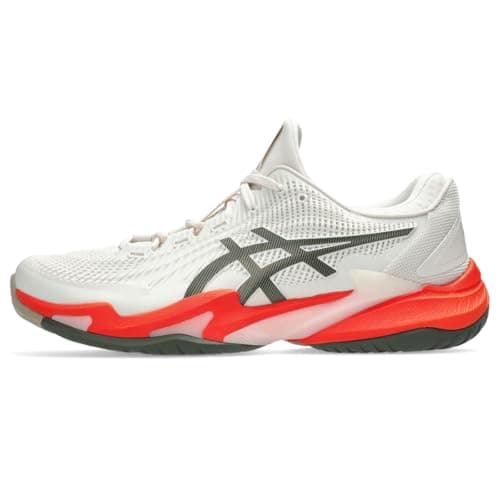 ASICS Court FF 3Top pick | Most men, most courts | 9.05 criteria | $149.95 · View on Amazon Price as of October 8, 2026 · was $179.95, 17% off |
| 2 | 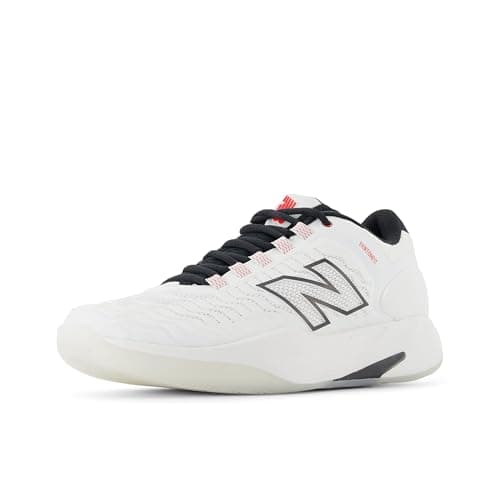 New Balance Fresh Foam X CT-Rally v2Best cushioning | Knees, hips and backs that complain the next morning | 8.85 criteria | |
| 3 | 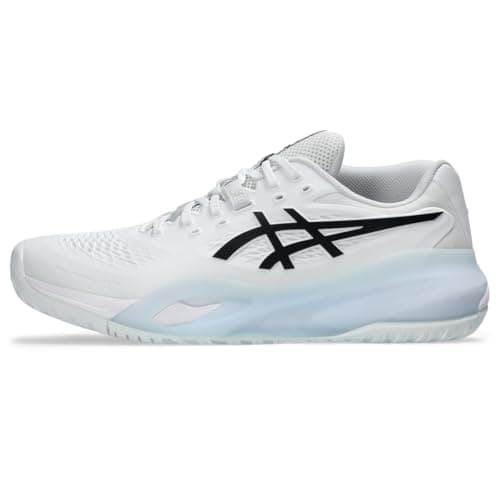 ASICS GEL-Resolution XMost stable | Wide feet, ankle history, and players who destroy outsoles | 8.75 criteria | |
| 4 | 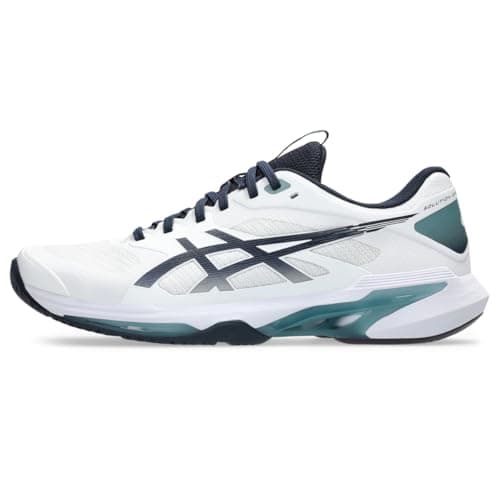 ASICS Solution Speed FF 4Best for speed | Men whose problem is arriving late, not landing hard | 8.65 criteria | $134.95 · View on Amazon Price as of October 8, 2026 · was $159.95, 16% off |
| 5 | 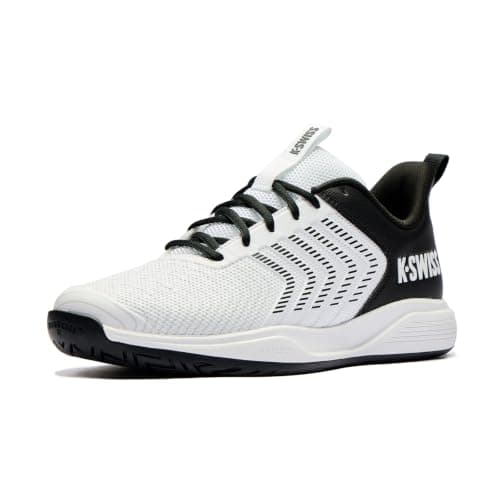 K-Swiss Ultrashot LightBest value | A first or second pair on a budget | 8.35 criteria | |
| 6 | 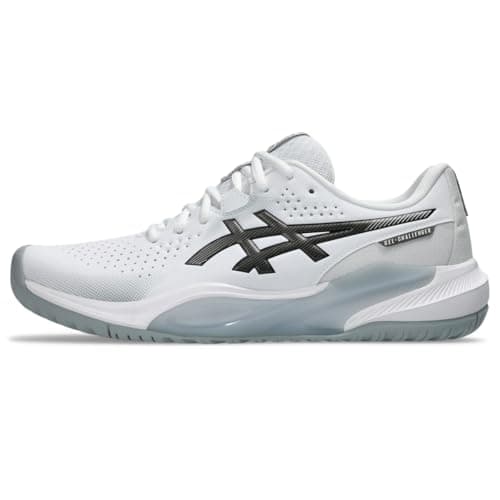 ASICS GEL-Challenger 15Best for beginners | Men new to the sport who want structure for not much money | 8.25 criteria | |
| 7 | 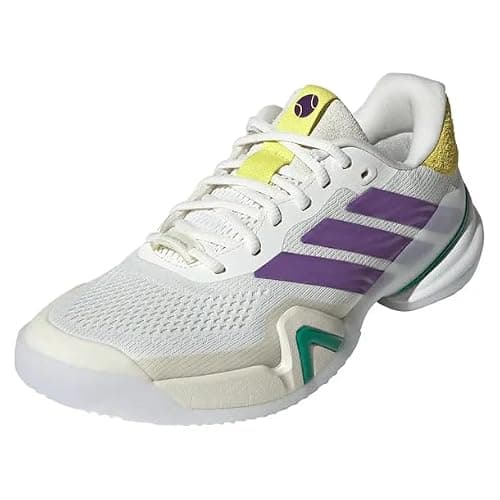 adidas Barricade 14Best court feel | Players who want to feel the court through the shoe | 7.35 criteria |
The picks in detail
01ASICS Court FF 3
Top pickBest for: Most men, most courts
This is RunRepeat's Best Overall in their men's guide and their highest score in the set at 93. The reasons they give are the two that decide whether a court shoe is any good: 5/5 torsional rigidity, meaning the chassis refuses to twist when you plant and change direction, and abrasion resistance they rate top-notch.
The stack is 32.1 mm at the heel and 21.8 mm at the forefoot, which is a lot of foam for a shoe this stable — RunRepeat describe the platform as exceptionally stable and the foot containment as unmatched, which is the combination most men are actually shopping for and rarely get in one shoe.
Two honest costs, both from RunRepeat's own cons list. It is not for wide feet, and it is heavier than their category average. If you have ever bought a D-width shoe and still felt your foot spill over the footbed, start with the GEL-Resolution X below instead — this is the one shoe here RunRepeat explicitly rule out for wide feet.
Our score
- Lateral stability
- 9.0
- Cushioning
- 8.5
- Outsole durability
- 9.0
- Fit accommodation
- 7.5
- Lightness
- 5.5
- Overall
- 9.0
Verified specs
- RunRepeat score
- 93 — Best Overall, hard court
- Heel stack
- 28.8 mm
- Forefoot stack
- 20.6 mm
- Toebox width (widest)
- 101.8 mm
- Outsole hardness
- 85.3 HC
- Dremel wear
- 0.4 mm cavity
Specs as published by RunRepeat, checked September 2026.
Buy if
- You want the highest-scoring men's court shoe in the set
- You want stability and cushioning without choosing between them
- You play two or more times a week on hard court
Pass if
- Your feet are wide
- You feel shoe weight late in a match
- You want an outsole durability guarantee in writing
Price as of October 8, 2026 · was $179.95, 17% off
02New Balance Fresh Foam X CT-Rally v2
Best cushioningBest for: Knees, hips and backs that complain the next morning
RunRepeat's Best Shock Absorption pick in the men's guide, at 92, and the numbers are not close: 116 SA at the heel and 78 SA at the forefoot, on a 33.3 mm heel and 20.2 mm forefoot stack. If what limits how often you play is how you feel the following day rather than how fast your outsoles disappear, this is the shoe.
Tall, soft shoes usually pay for it in stability, and this one does not. RunRepeat measure 5/5 torsional rigidity and call out fantastic lateral support, excellent lockdown and a balanced grip. It is also sold in genuine wide widths rather than just a roomy standard fit.
The costs are weight and toebox height. RunRepeat put it above their average weight and flag a low toebox, which is a different problem from a narrow one: if your feet are deep rather than broad, the upper will press on the top of your toes. Outsole wear measured 0.8 mm, which is average rather than class-leading.
Our score
- Lateral stability
- 9.0
- Cushioning
- 10.0
- Outsole durability
- 7.5
- Fit accommodation
- 8.5
- Lightness
- 3.5
- Overall
- 8.8
Verified specs
- RunRepeat score
- 92 — Best Shock Absorption
- Heel stack
- 33.3 mm
- Forefoot stack
- 20.2 mm
- Heel shock absorption
- 116 SA
- Forefoot shock absorption
- 78 SA
- Torsional rigidity
- 5/5
Specs as published by RunRepeat, checked September 2026.
Buy if
- You get joint soreness after matches
- You play on concrete-base hard courts
- You need a wide width without losing lateral support
Pass if
- You have high-volume feet and need toebox height
- You want a light, connected shoe
- Outsole life is your main running cost
03ASICS GEL-Resolution X
Most stableBest for: Wide feet, ankle history, and players who destroy outsoles
RunRepeat's Best Stability pick in the men's guide at 90, and the one shoe in this group they describe as perfect for wide feet. For a man who has spent years sizing up to get width, that single line is worth more than any score.
It is also the hardest-wearing shoe here. RunRepeat measured 0.6 mm of wear in their abrasion test against a 0.8 mm category average, with traction at 0.89, a 30.8 mm / 21.9 mm stack and 70 SA at the forefoot. Dynalacing lets you adjust the hold across the instep, which is the other half of fitting a broad foot properly.
The cons are real and RunRepeat list them plainly: unusual fit and sizing, a long break-in period, a raised collar they call a mixed bag, and a weight well above average — the men's pair they weighed came in at 417 g. This is a shoe you commit to, not one you slip on.
Our score
- Lateral stability
- 10.0
- Cushioning
- 8.5
- Outsole durability
- 9.5
- Fit accommodation
- 8.5
- Lightness
- 3.0
- Overall
- 8.7
Verified specs
- RunRepeat score
- 90 — Best Stability
- Weight
- 14.7 oz / 417 g (men's 9)
- Heel / forefoot stack
- 30.8 mm / 21.9 mm
- Drop
- 8.9 mm
- Torsional rigidity
- 5/5
- Heel counter stiffness
- 5/5
- Heel shock absorption
- 98 SA
- Outsole wear
- 0.6 mm depth, 90.4 HC
Specs as published by RunRepeat, checked September 2026.
Buy if
- Your feet are genuinely wide
- You have rolled an ankle before
- You wear outsoles out faster than everyone at your club
Pass if
- You want a shoe that works out of the box
- You notice weight in the third set
- You have long toes rather than a broad forefoot
04ASICS Solution Speed FF 4
Best for speedBest for: Men whose problem is arriving late, not landing hard
RunRepeat score it 90 and make it their Best for Speed pick. It weighs 11.9 oz / 337 g, about 7% under their category average, which in a category this heavy is a meaningful saving rather than a rounding error.
The standout measurement is grip: a 1.11 friction coefficient, which RunRepeat put at 46% above average and the highest in this group. They also measure 3% more forefoot flexibility than average, so the shoe lets you roll through a push-off instead of resisting it. Durability is rated exceptional despite the low weight.
Two cons. RunRepeat flag a low toebox height and a serious lack of breathability — the second is the honest counterpoint to buying a light shoe for hot-weather play, because light does not mean cool. If heat is your problem, the Barricade's 39% drying figure below is the relevant number.
Our score
- Lateral stability
- 8.0
- Cushioning
- 8.0
- Outsole durability
- 9.0
- Fit accommodation
- 7.0
- Lightness
- 8.5
- Overall
- 8.6
Verified specs
- RunRepeat score
- 90 — Best for Speed
- Weight
- 11.9 oz / 337 g
- Traction
- 1.11, 46% above average
- Dremel wear
- 0.3 mm less damage than average
Specs as published by RunRepeat, checked September 2026.
Buy if
- You get beaten by the first step, not by fatigue
- You want grip above everything else
- You want a light shoe that still wears well
Pass if
- You have deep feet and need toebox height
- You play in heat and humidity
- You want maximum heel cushioning
Price as of October 8, 2026 · was $159.95, 16% off
05K-Swiss Ultrashot Light
Best valueBest for: A first or second pair on a budget
RunRepeat score it 84 against a $85 list price they calculate as 35% below their category average. That is the single most useful fact on this page for anyone about to spend flagship money on a first pair: most of what a court shoe has to do, this one does.
It is also the lightest shoe here at 11.0 oz / 312 g, which RunRepeat put 14% under average, with a midsole 38% more flexible than average and traction measured at 1.01 — 36% above average. For a recreational player once or twice a week, light and grippy beats heavy and armored.
The cons tell you exactly who should not buy it: RunRepeat note a borderline narrow toebox and limited lateral support. If you are heavy, play singles hard, or have ankle history, the saving is not worth it — spend the money on the GEL-Resolution X.
Our score
- Lateral stability
- 7.0
- Cushioning
- 7.0
- Outsole durability
- 7.5
- Fit accommodation
- 6.5
- Lightness
- 9.5
- Overall
- 8.3
Verified specs
- RunRepeat award
- Best Budget
- Weight
- 11.0 oz / 312 g
Specs as published by RunRepeat, checked September 2026.
Buy if
- This is your first proper court shoe
- You play once or twice a week
- You want the lightest option in the group
Pass if
- Your feet are wide
- You play singles four times a week
- You have ankle history
06ASICS GEL-Challenger 15
Best for beginnersBest for: Men new to the sport who want structure for not much money
RunRepeat's Best for Beginners pick at 83, and they describe the value for money as uncanny. The structural numbers are flagship-grade: 5/5 torsional rigidity, a 5/5 heel counter, and 0.6 mm of abrasion wear — the same outsole result as the far more expensive GEL-Resolution X.
They also note a much wider and steadier base and an accommodating fit, which is the right priority for a player whose footwork is still forming. A wider base gives you more leverage against rolling an ankle, and that matters more in a first season than cushioning does.
The cons are blunt and worth taking seriously: a massive weight gain over the previous version — the pair RunRepeat weighed came in at 14.0 oz / 395 g — minimal shock absorption, and poor breathability. This is a tank, not a track shoe. Grip measured 0.58, the lowest here.
Our score
- Lateral stability
- 9.0
- Cushioning
- 6.0
- Outsole durability
- 9.0
- Fit accommodation
- 8.5
- Lightness
- 2.5
- Overall
- 8.2
Verified specs
- RunRepeat score
- 83 — Best for Beginners
- Midsole stiffness
- 5/5
- Heel counter stiffness
- 5/5
- Weight
- Notably heavier than average
- Width fit
- Listed in RunRepeat's wide-feet catalog
Specs as published by RunRepeat, checked September 2026.
Buy if
- You are in your first year and want structure
- You want flagship outsole life at an entry price
- You want a wide, stable base while your footwork settles
Pass if
- You feel shoe weight
- You need heel cushioning for joint pain
- You play in heat
07adidas Barricade 14
Best court feelBest for: Players who want to feel the court through the shoe
The lowest score in this group at 78, and included anyway because it is the only shoe here that answers one specific complaint. RunRepeat call its court feel exceptionally pronounced, and the stack explains why: 26.3 mm at the heel and 14.4 mm at the forefoot, far lower than anything else on this page.
It also has the structure to go with it — a 5/5 heel counter, a 116.8 mm / 93.6 mm base they describe as very grounded and stable, excellent outsole grip, and a medium-width fit with a wide option. At 39% drying potential it is the best of this group at shedding moisture, which matters if you play in heat.
Now the honest part, and it is not a small one. RunRepeat's cons read: appalling durability, minimal impact protection, still heavier than average. Shock absorption measures 89 SA at the heel and only 47 SA at the forefoot — roughly 40% of the CT-Rally v2's forefoot figure. Buy this because you want court feel and you accept replacing it; do not buy it to save money.
Our score
- Lateral stability
- 8.5
- Cushioning
- 4.5
- Outsole durability
- 3.5
- Fit accommodation
- 8.0
- Lightness
- 4.0
- Overall
- 7.3
Verified specs
- RunRepeat award
- Best Court Feel
- Heel stack
- 26.3 mm
- Forefoot stack
- 14.4 mm
- Heel shock absorption
- 89 SA
- Forefoot shock absorption
- 47 SA
Specs as published by RunRepeat, checked September 2026.
Buy if
- Tall cushioned shoes feel vague and disconnected to you
- You want a stiff heel counter in a low-profile shoe
- You play in heat and want the quickest-drying option here
Pass if
- You want the shoe to last a full season of heavy play
- You have joint pain or need forefoot cushioning
- You want the most protection per dollar
What 'men's' actually changes, and what it does not
Start with the honest version, because most pages on this query do not bother. A men's court shoe is not engineered to a different performance brief than a women's one. There is no men's-specific outsole compound, no men's torsional shank, no men's shock absorption target. What genuinely differs is the last — the shape the shoe is built around — and the width that counts as standard.
FitVille's width reference sets out the convention the whole industry works to: men's shoes are built on a D standard width and women's on a B, with the men's last also running higher in volume through the instep and the toe box. In practice that means a men's version of the same model is a slightly broader, slightly deeper shoe than the women's version, and it is sized on a different scale.
So the useful question is not whether to buy a men's shoe. It is which men's shoe, decided on four measured properties. We wrote the companion page for the other side of that same split — see best tennis shoes for women, which also explains the one case where a women's-only model was actually measured on a women's pair.
The four measurements that decide a court shoe
Every pick above is ranked on the same four properties, in this order of importance for a club player. They are the criteria first and the products second, which is deliberate: if you know which of these four is your binding constraint, the shortlist writes itself.
- 01Torsional rigidity. How hard it is to twist the shoe along its length. Tennis loads the foot sideways with your whole body weight arriving through one edge, and a chassis that twists lets the ankle follow. RunRepeat rate it out of 5; four of the seven shoes here score 5/5.
- 02Shock absorption and stack height. How much of the landing the midsole eats. RunRepeat quote an SA figure plus heel and forefoot stack in millimeters. The spread on this page is enormous: 116 SA at the heel for the CT-Rally v2 against 89 SA for the Barricade 14 on a stack 7 mm lower.
- 03Outsole abrasion. Hard courts are deliberately abrasive and court shoes are the consumable in this sport. RunRepeat run a standardized abrasion test and report the dent depth in millimeters against a 0.8 mm average. 0.6 mm is excellent; the Barricade's result earned the phrase appalling durability.
- 04Fit, and specifically width versus depth. These are two different problems. A shoe can be broad at the ball of the foot and still press on the top of your toes — RunRepeat flag low toebox height separately from narrow toebox width, and three shoes on this page have one problem or the other.
Weight is the fifth property and it is a consequence rather than a choice. Structure weighs something. The 417 g GEL-Resolution X and the 312 g Ultrashot Light are not better and worse shoes; they sit at opposite ends of a trade between protection and speed, and which end you want depends on whether you lose points by arriving late or by wearing down.
Why the lab data is better here than on any other shoe page
This is the one genuine advantage of shopping the men's side of the category, and it has nothing to do with the shoes. RunRepeat's reference test pair is a men's US 9. Every weight, stack height, abrasion result and torsional figure quoted above was measured on a men's shoe in a men's size.
On the women's page we had to state the opposite — that most lab figures published about women's court shoes are in fact measurements of the men's pair, because that is what gets cut in half. Here there is no such gap between the number and the product. If you are a man buying a men's shoe, the published data is about the thing you are buying.
What we still cannot tell you is how any of them feel on your foot, because Racket & Rally does not run a test lab and has not hit a ball in any of them. Our selection criteria set out exactly what that limits.
Width and depth: the part of this decision that is actually men's-specific
If you have broad feet, this table is the page. RunRepeat's fit verdicts are specific enough to shortlist from, and they separate the two failure modes that get conflated everywhere else.
| Shoe | RunRepeat's fit verdict | Who it rules out |
|---|---|---|
| ASICS GEL-Resolution X | Perfect for wide feet; Dynalacing adjusts instep hold | Long, narrow feet — the fit is called unusual |
| New Balance CT-Rally v2 | Perfect medium fit, wide widths available | Deep feet — low toebox height |
| adidas Barricade 14 | Solid medium-width fit with a wide option | Players needing cushioning, not fit-limited |
| ASICS GEL-Challenger 15 | Accommodating fit, much wider and steadier base | Weight-sensitive players at 395 g |
| ASICS Court FF 3 | Not recommended for wide feet | Wide feet, explicitly |
| ASICS Solution Speed FF 4 | Low toebox height | Deep feet, high insteps |
| K-Swiss Ultrashot Light | Borderline narrow toebox | Wide feet, heavy singles players |
Two of the seven are explicitly wrong for wide feet and one more is borderline, which tells you how routinely this goes wrong. If width is your constraint, the dedicated page goes further: best tennis shoes for wide feet covers the millimeter measurements at the big toe as well as at the widest point.
Weight, and the men's tax on it
Men's court shoes are heavier than women's in the same model, for the ordinary reason that they are bigger. That makes the weight spread inside the men's category worth looking at directly, because a 83 g gap between two shoes you are considering is about a quarter of the lighter one.
| Shoe | Weight (RunRepeat, men's 9) | Against their average |
|---|---|---|
| K-Swiss Ultrashot Light | 11.0 oz / 312 g | 14% lighter |
| ASICS Solution Speed FF 4 | 11.9 oz / 337 g | 7% lighter |
| ASICS GEL-Challenger 15 | 14.0 oz / 395 g | Heavier than average |
| ASICS GEL-Resolution X | 417 g | Heavier than most tennis shoes |
| ASICS Court FF 3 | Not published for size 9 | Heavier than average |
| New Balance CT-Rally v2 | Not published for size 9 | Heavier than average |
| adidas Barricade 14 | Not published for size 9 | Still heavier than average |
Four of the seven have no published gram weight for the men's 9 in the guide we are citing, so there are four gaps in that table. We would rather show the gap than fill it with a number nobody measured.
Surface still overrides this page
One caution about how to use a list like this. 'Best men's tennis shoes' is a sizing and fit question; the outsole you need is a surface question, and the surface question wins. A clay-court herringbone sole on a hard court wears out fast and grips unpredictably, and a hard-court sole on clay packs full and slides when you do not want it to.
- You play mostly on hard court — this page applies directly, and best tennis shoes for hard court goes deeper on outsole compounds.
- You play mostly on clay — stop here and read best tennis shoes for clay court instead. None of the seven above is a clay shoe.
- You play on both, or on whatever is free — best all-court tennis shoes is the compromise set.
- You are moving across from running shoes — read tennis shoes vs running shoes first. It is the one gear mistake on this site we treat as a safety issue.
What to spend, honestly
Court shoes are the only piece of tennis equipment that is genuinely consumable, so the right way to think about price is cost per season rather than cost per pair. The arithmetic is unusual in this category: the cheapest shoe here and the most expensive recorded the same abrasion result.
RunRepeat put the Ultrashot Light at $85, about 35% below their category average, and score it 84. The GEL-Challenger 15 earns the phrase uncanny value for money at 83 while matching flagship outsole wear at 0.6 mm. What the extra money buys further up the range is lateral support, fit options and cushioning — not outsole life, which is the thing most people assume they are paying for.
The exception runs the other way. The Barricade 14 is a mid-to-premium shoe with durability RunRepeat call appalling, which makes it the most expensive shoe here per season of play despite not being the most expensive to buy. That is a legitimate purchase if you want its court feel, and a bad one if you are chasing value.
Replace them when the midsole has gone flat, not when the tread looks thin. A bottomed-out midsole passes impact straight into your knees while the outsole still looks serviceable, which is why most men replace court shoes several months later than they should.
Common questions
What are the best men's tennis shoes in 2026?
The ASICS Court FF 3 on the published data — RunRepeat's Best Overall in their men's guide at 93, with 5/5 torsional rigidity and top-rated abrasion resistance. It is the wrong answer if your feet are wide, because RunRepeat explicitly rule it out for wide feet; the GEL-Resolution X at 90 is the wide-foot pick.
Are men's and women's tennis shoes actually different?
Yes, but not in performance engineering. The difference is the last and the standard width: men's shoes are built on a D width and run higher in volume, women's on a B. There is no men's-specific outsole, midsole or support technology — the same model in both versions is the same shoe on a different shape.
Can I just buy the women's version in my size, or vice versa?
You can, and plenty of players do, but you are changing the fit rather than just the label. A women's shoe in an equivalent length is narrower and lower in volume, so it suits a man with a slim foot and will pinch a broad one. Convert the size and try the width before committing.
How much should a man spend on tennis shoes?
Less than most people assume. RunRepeat score the K-Swiss Ultrashot Light 84 at a $85 list price, and the ASICS GEL-Challenger 15 matches flagship outsole wear at 0.6 mm. The extra money higher up buys lateral support, fit options and cushioning rather than outsole life.
Which men's tennis shoe is best for wide feet?
The ASICS GEL-Resolution X. It is the only shoe in RunRepeat's men's set they describe as perfect for wide feet, and Dynalacing lets you adjust the hold over the instep. The New Balance CT-Rally v2 is the alternative if you want cushioning, with genuine wide widths rather than a roomy standard fit.
Why are men's tennis shoes so heavy?
Because structure has mass. Torsional shanks, stiff heel counters and dense abrasion-resistant outsoles are what stop a court shoe folding sideways, and they weigh something — the GEL-Resolution X is 417 g against roughly 250-280 g for a running shoe. The 312 g Ultrashot Light shows what you give up to lose that weight: RunRepeat note limited lateral support.
Do men's tennis shoes come with an outsole guarantee?
Some models do and some do not, and it is worth checking before you buy rather than after. RunRepeat flag the absence of an outsole durability guarantee on the Court FF 3 as a con specifically because several rival flagships carry one.
Read next
Sources
- 01RunRepeat — Best Tennis Shoes for Men
- 02RunRepeat — ASICS GEL-Resolution X lab review
- 03RunRepeat — New Balance Fresh Foam X CT-Rally v2 lab review
- 04RunRepeat — Wide tennis shoes catalog
- 05FitVille — men's and women's shoe width standards
- 06RunRepeat — Best Hard Court Tennis Shoes
- 07RunRepeat — Best Tennis Shoes
Every source above was retrieved while writing this page. Specifications are quoted from the listing or manufacturer page cited, not from memory.