Buying guide
Best tennis strings in 2026
String type decides more about how your racket plays than the frame does, and the type you need is set by one thing: how long your current set survives.
By Janet H.Updated
The short answer
For most club players the best tennis string is Wilson NXT, a multifilament Tennis Warehouse rate as their comfort winner. If you break a set inside two weeks, go to Solinco Hyper-G polyester instead. If you have never thought about string at all, Prince Synthetic Gut Duraflex at a few dollars a set is the honest starting point.
Disclosure — we earn a commission on qualifying purchases made through links on this page, at no extra cost to you. It never changes which product we rank first. How this site is funded.
Our picks
| # | Product | Best for | Score | Price |
|---|---|---|---|---|
| 1 | 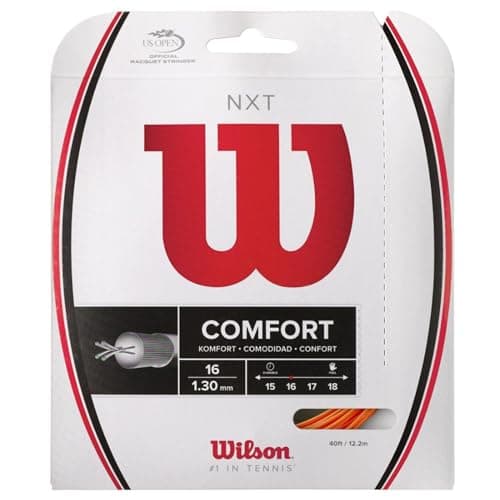 Wilson NXTTop pick | The default club string | 8.74 criteria | |
| 2 | 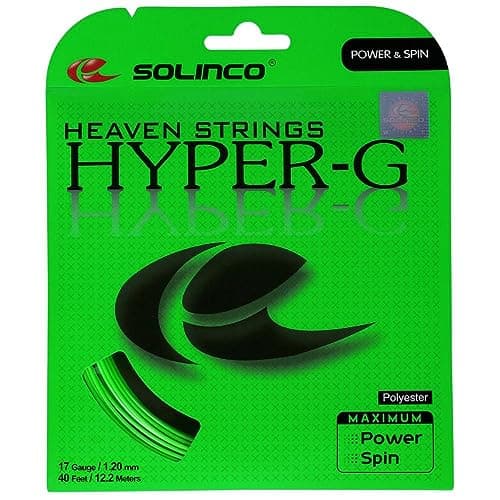 Solinco Hyper-GBest for string breakers | Players who break strings | 8.54 criteria | |
| 3 | 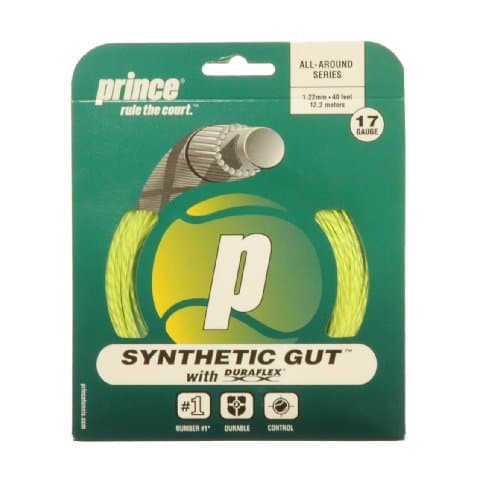 Prince Synthetic Gut DuraflexBest value | A first restring | 7.94 criteria | |
| 4 | 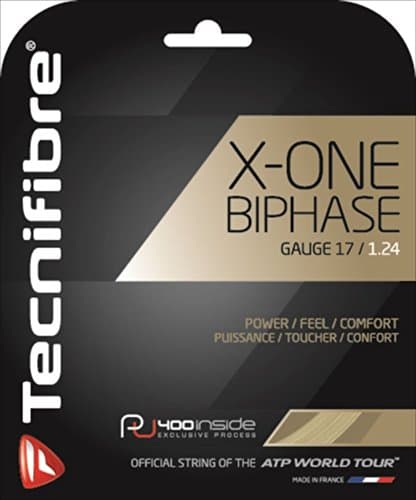 Tecnifibre X-One BiphaseBest for power | Comfort without losing pace | 8.34 criteria | |
| 5 | 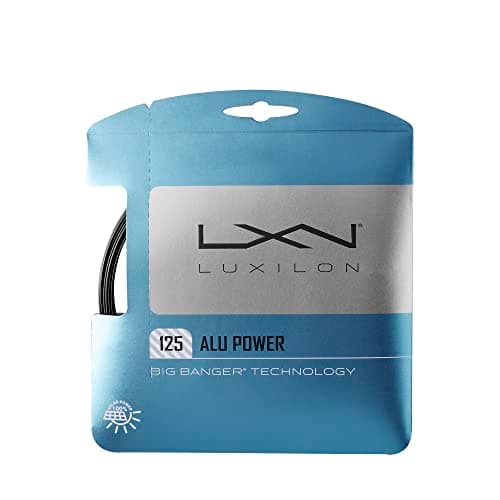 Luxilon ALU PowerThe reference polyester | Players who already know they want poly | 8.04 criteria |
The picks in detail
01Wilson NXT
Top pickBest for: The default club string
Tennis Warehouse name NXT their comfort winner in the string category, and the construction is why: over a thousand ultra-flexible fibers bonded together with polyurethane, so the bed stretches further under load and returns the ball with less shock travelling back up the frame. It is listed at $23.95 a set in gauges 16 and 17.
It is the pick for most people because most club players are not string breakers. If a set lasts you a month or more, you are paying nothing for the durability a polyester would give you and giving up the comfort and the free power a multifilament hands over. That trade only makes sense in one direction.
The honest cost is that it frays rather than snapping cleanly, and a frayed multifilament has already lost a good part of its stretch before it fails. Treat visible fraying as the restring signal rather than waiting for a break — [how often to restring a tennis racket](/guides/how-often-to-restring-a-tennis-racket) sets out the rest of the schedule.
Our score
- Performance
- 8.5
- Comfort
- 10.0
- Durability
- 7.0
- Value
- 7.5
- Overall
- 8.7
Verified specs
- Type
- Multifilament
- Gauges
- 16, 17
- TW award
- Comfort
- Construction
- 1,000+ fibers bonded with polyurethane
- Listed price
- $23.95 per set
Specs as published by Tennis Warehouse, checked September 2026.
Buy if
- A set currently lasts you a month or more
- Comfort matters more to you than durability
- You want one string that works across a wide tension range
Pass if
- You break strings inside two weeks
- You want maximum control above everything
- You restring often and want the lowest cost per set
02Solinco Hyper-G
Best for string breakersBest for: Players who break strings
Hyper-G is Tennis Warehouse's control polyester, listed at $13.99 a set, and it carries the widest gauge range of anything here — 15L right down to 20. That range is the reason to choose it over another poly: once you are breaking strings often enough to care, gauge becomes a real lever rather than a number on a packet.
Polyester is a monofilament, so it holds its shape under load instead of stretching. That is what produces the lower launch angle and the extra control, and it is also what lets the main strings slide sideways and snap back, which is where spin actually comes from.
The cost is comfort and tension life. Poly is stiff to begin with and loses a substantial fraction of its tension in the first hours of play, which is why it is the wrong answer for anyone with a history of arm trouble. String it several pounds below where you would set a multifilament.
Our score
- Performance
- 9.0
- Comfort
- 6.5
- Durability
- 9.0
- Value
- 9.0
- Overall
- 8.5
Verified specs
- Type
- Polyester
- Gauges
- 15L to 20
- TW award
- Control
- Listed price
- $13.99 per set
Specs as published by Tennis Warehouse, checked September 2026.
Buy if
- You break a set inside two weeks
- You want a lower launch angle and more control
- You want gauge options to experiment with
Pass if
- You have had tennis elbow
- Your sets already last a month
- You dislike restringing on a schedule
03Prince Synthetic Gut Duraflex
Best valueBest for: A first restring
Tennis Warehouse give this their All-Around Value award and list it at $4.76 a set in 16 and 17 gauge. Synthetic gut is nylon with a wear-resistant coating: nothing exotic, nothing to dislike, and about a fifth the price of the multifilament above it.
It is the right first restring precisely because it is unremarkable. A new player changing from factory string to synthetic gut will feel the racket improve without having introduced a variable they cannot interpret, which is more than can be said for dropping a stiff poly into a beginner frame.
What you give up is the top end. It is less comfortable than NXT and less controlled than Hyper-G, and it will not do anything special. At under five dollars a set, that is the deal on offer and it is a fair one.
Our score
- Performance
- 7.0
- Comfort
- 8.0
- Durability
- 7.5
- Value
- 10.0
- Overall
- 7.9
Verified specs
- Type
- Synthetic gut
- Gauges
- 16, 17
- TW award
- All-Around Value
- Listed price
- $4.76 per set
Specs as published by Tennis Warehouse, checked September 2026.
Buy if
- This is your first or second restring
- You want the lowest cost per set
- You are not sure yet how often you will play
Pass if
- Your elbow is the reason you are reading this
- You want a specific playing characteristic
- You break strings quickly
04Tecnifibre X-One Biphase
Best for powerBest for: Comfort without losing pace
X-One Biphase is the multifilament Tennis Warehouse rate for power rather than only for comfort, listed at $22.95 to $23.95 a set, and it is offered in the widest gauge spread of any multifilament here: 15L, 16, 17 and 18.
That matters for a specific player — someone whose arm wants a soft string but whose shots are landing short. A soft string that only absorbs energy makes that worse. This one is built to give some of it back, which is why it sits in the power slot rather than the comfort slot.
It is the least durable thing on this list and the most expensive per hour of play. If you are restringing monthly anyway it is a reasonable indulgence; if you break strings it is money set on fire.
Our score
- Performance
- 9.0
- Comfort
- 9.5
- Durability
- 6.5
- Value
- 6.5
- Overall
- 8.3
Verified specs
- Type
- Multifilament
- Gauges
- 15L, 16, 17, 18
- TW award
- Power
- Listed price
- $22.95-$23.95 per set
Specs as published by Tennis Warehouse, checked September 2026.
Buy if
- You want a soft string that still adds pace
- You restring on a schedule rather than on breakage
- You want to try a thinner gauge
Pass if
- Cost per set is a factor
- You break strings
- You want control above power
05Luxilon ALU Power
The reference polyesterBest for: Players who already know they want poly
ALU Power is the string the rest of the polyester category is measured against, listed at $21.50 a set in 16, 16L, 17L and 18. It is on this page for completeness and because people search for it by name, not because most readers should buy it.
If you are an advanced player with a full swing and a frame that supplies its own power, this is the control and the predictability you are paying for. It is the most demanding string here in the sense that it gives back exactly what you put in.
For everyone else it is the wrong choice and we would rather say so. It is stiff, it is expensive for a poly, and in a lighter frame swung at club pace it produces a dead, low-powered bed. Hyper-G does the same job for two thirds of the money with more forgiveness.
Our score
- Performance
- 9.5
- Comfort
- 5.5
- Durability
- 8.5
- Value
- 6.0
- Overall
- 8.0
Verified specs
- Type
- Polyester
- Gauges
- 16, 16L, 17L, 18
- TW category
- Reference polyester
- Listed price
- $21.50 per set
Specs as published by Tennis Warehouse, checked September 2026.
Buy if
- You are an advanced player with a full swing
- You already play polyester and want the benchmark
- Your frame supplies its own power
Pass if
- You are a beginner or improver
- You have any history of arm pain
- You want the best value poly — buy Hyper-G
The type decision comes before the brand decision
Almost every piece of bad string advice comes from skipping a step. People compare named strings against each other when the question that actually decides the outcome is which of three or four material types they belong to. Get the type right and any reputable string inside it will be fine; get the type wrong and the best string in the category will play badly.
There is one question that sets the type, and it is not your rating or your frame. It is how long a set currently survives. If your string lasts a month or more, you are not a breaker and you should be in a soft string. If it dies in under two weeks, no soft string will survive you and you need a polyester. Everything else is detail.
| Type | Who it is for | What it does | Our pick |
|---|---|---|---|
| Synthetic gut | First or second restring | Nylon, predictable, cheap | Prince Synthetic Gut Duraflex |
| Multifilament | Most club players | Soft, powerful, frays before it breaks | Wilson NXT |
| Polyester | Anyone breaking sets in under two weeks | Control, spin, low launch angle, stiff | Solinco Hyper-G |
| Premium multifilament | Soft string, short shots | Comfort plus pace, least durable | Tecnifibre X-One Biphase |
| Reference polyester | Advanced full swings | Maximum control, no forgiveness | Luxilon ALU Power |
Natural gut is the one type missing from this list. It is the best-playing string material there is and it is also the most expensive and the least weather-tolerant, and we do not currently carry a listing for it that we are confident in. Saying nothing is better than naming something we have not verified. Tennis string types covers how it compares in principle.
The five, side by side
Every figure below is from Tennis Warehouse's published listings and gear guide, retrieved during our research pass and cited at the foot of this page. The price column is what the retailer lists per set, which is a different number from what the same string costs on Amazon — the live figure is on each buy button.
| String | Type | Gauges | Retailer award | Listed price |
|---|---|---|---|---|
| Wilson NXT | Multifilament | 16, 17 | Comfort | $23.95 per set |
| Solinco Hyper-G | Polyester | 15L to 20 | Control | $13.99 per set |
| Prince Synthetic Gut Duraflex | Synthetic gut | 16, 17 | All-Around Value | $4.76 per set |
| Tecnifibre X-One Biphase | Multifilament | 15L, 16, 17, 18 | Power | $22.95-$23.95 per set |
| Luxilon ALU Power | Polyester | 16, 16L, 17L, 18 | Reference polyester | $21.50 per set |
Tension is the other half of the decision
Choosing the string is half of it. The number it goes in at is the other half, and the two are not independent: 55 lb of polyester and 55 lb of multifilament are not comparable string beds, because poly is far stiffer before any tension is applied. Dropping a poly into a frame at the tension you used for a multifilament is the single most common cause of a harsh, dead-feeling racket.
The rule of thumb that holds: start in the middle of the range printed inside your frame's hoop, then move in 2 lb steps. Lower gives more power, more comfort and a higher launch angle. Higher gives more control and a lower launch angle. A 4 to 6 lb change is clearly noticeable; 2 lb is subtle but real. If you are moving from multifilament to poly, come down several pounds as part of the switch.
Two guides carry this further. Tennis string tension covers how to pick a number and why a dead string bed plays worse than a broken one, and tennis string gauge explains the thickness trade — thinner for feel and spin, thicker for durability.
If you are shopping by level instead
This page sorts by string type, because type is what the decision actually turns on. If you would rather start from where your game is, the level pages narrow the field faster.
| If this is you | Go to | Why |
|---|---|---|
| First racket, first restring | Best strings for beginners | Four options and the one type to avoid early |
| Rallying consistently, generating pace | Best strings for intermediate players | Where hybrid setups start to make sense |
| Any history of elbow pain | Best strings for tennis elbow | Sorted by stiffness rather than by award |
| Not sure which band you are in | Racquet sports skill levels explained | Defined by what happens in your rallies, not a rating |
Those four pages are best tennis strings for beginners, best tennis strings for intermediate players, best tennis strings for tennis elbow and racquet sports skill levels explained.
How these picks were made
Racket & Rally does not run a test lab. Nothing on this page is written as though we had hit with, worn or measured anything ourselves, because we have not. What we do instead is read the published specification sheets and the third-party lab measurements cited at the foot of the page, set them against each other, and say which differences change something you will notice.
Every product here is already in our registry, which means it carries a cited retailer or review source and a verified listing. Our full selection criteria set out the method, and the editorial policy covers corrections and how often pages are revisited. Prices are never written into the page — the number on each buy button is the live one.
Common questions
What are the best tennis strings?
For most club players, Wilson NXT — a multifilament Tennis Warehouse rate as their comfort winner, listed at $23.95 a set. The exception is string breakers: if a set dies inside two weeks, no multifilament will survive you and Solinco Hyper-G polyester is the better answer.
What string type should a beginner use?
Synthetic gut or a multifilament. Prince Synthetic Gut Duraflex at $4.76 a set is the honest first restring. Avoid polyester early — it is stiff, it demands a full swing to work, and it is the string most likely to leave a new player with a sore arm.
Is polyester string better than multifilament?
Only for a specific player. Polyester gives control, spin potential and durability; multifilament gives comfort, power and a wider usable tension range. If you break strings often, poly is better for you. If a set lasts a month, poly is costing you comfort for a durability benefit you do not need.
How much does a tennis restring cost?
The string itself ranges from under $5 a set for synthetic gut to around $24 for a premium multifilament, going by Tennis Warehouse's listed prices. Labour is charged separately by whoever strings it and varies by shop, so we do not quote a total.
What is the best string for tennis elbow?
A soft multifilament, strung toward the lower end of your frame's range. Wilson NXT is the comfort pick here, and polyester of any brand is the type to avoid. Our strings for tennis elbow page sorts the whole category by stiffness.
Does string matter more than the racket?
For how the racket plays, often yes — and it costs a tenth as much. If your frame feels wrong and you have not restrung in a year, change the string first. The string bed is what touches the ball; the frame only decides how the bed is held.
Read next
Sources
- 01Tennis Warehouse — Best Tennis Strings gear guide
- 02Tennis Warehouse — Wilson Clash 100 v3 (tension range reference)
Every source above was retrieved while writing this page. Specifications are quoted from the listing or manufacturer page cited, not from memory.