Guide
Tennis string types explained
Four materials, each with a different trade. Choose the type correctly and any reputable string inside it works; choose it wrongly and the best string in the category plays badly.
By Janet H.Updated

The short answer
Tennis string comes in four materials. Synthetic gut is cheap nylon and the sensible default. Multifilament is soft and powerful and suits most club players. Polyester is stiff, controlled and durable, and is for players who break strings. Natural gut plays best and costs most. The type is set by how fast you break strings, not by your rating.
Disclosure — we earn a commission on qualifying purchases made through links on this page, at no extra cost to you. It never changes which product we rank first. How this site is funded.
The four materials
Everything sold as tennis string belongs to one of four material families, and the families differ far more from each other than the brands differ inside a family. Understanding the four takes about two minutes and saves most of the money people waste on string.
Synthetic gut
A solid nylon core with one or more wrapped outer layers, usually with a wear-resistant coating. It is the cheapest real string there is — Tennis Warehouse list Prince Synthetic Gut Duraflex at $4.76 a set — and it is deliberately unremarkable in every direction. Reasonable power, reasonable comfort, reasonable durability, no particular strength.
Multifilament
Hundreds or thousands of fine fibers bonded together, usually with polyurethane. Wilson NXT is built from over a thousand fibers and is Tennis Warehouse's comfort winner at $23.95. Because a bundle of fibers stretches further than a solid core, multifilament is the softest and most powerful of the synthetic types, and it frays rather than snapping cleanly.
Polyester
A single stiff monofilament, sometimes with a shaped or textured profile. Solinco Hyper-G at $13.99 and Luxilon ALU Power at $21.50 are both in this family. Poly holds its shape under load instead of stretching, which produces a lower launch angle, more control and much better durability — and it is the stiffest, least forgiving option by a wide margin.
Natural gut
Made from processed cow intestine, and still the best-playing string material available: the most comfortable, the most powerful and the best at holding tension. It is also the most expensive and the least tolerant of moisture. We do not currently carry a natural gut listing we are confident in, so there is no pick for it below — naming nothing is better than naming something unverified.
| Type | Power | Control | Comfort | Durability | Cost |
|---|---|---|---|---|---|
| Synthetic gut | Medium | Medium | Medium | Medium | Lowest |
| Multifilament | High | Medium | Highest of the synthetics | Low | Mid to high |
| Polyester | Low | Highest | Lowest | Highest | Mid |
| Natural gut | Highest | High | Highest | Low in damp conditions | Highest |
Hybrids: using two types at once
A hybrid is one material in the main strings and another in the crosses. It exists because the two directions do different jobs: the mains take most of the wear and do most of the work generating spin, while the crosses contribute more to the overall feel of the bed.
The common configuration is polyester mains with a multifilament or synthetic gut cross. That gives you the durability and the spin behaviour of poly where the wear happens, and some of the comfort of a soft string where it costs you least. It is a genuine middle path rather than a marketing construct.
Two honest caveats. A hybrid costs a set of each string rather than one set, so it is not cheap, and it is a harder setup to interpret — if the bed feels wrong you now have two variables to adjust rather than one. Most players are better off getting a single-material setup right first.
Gauge is a separate decision from type
Gauge is the thickness of the string, and it runs backwards: a higher number is thinner. Our registry spans 15L at the thick end to 20 at the thin end, with 16 and 17 covering most of what people actually buy.
- Thinner (higher number) — more feel, more spin potential, more power, and it breaks sooner. Thin strings also bite into the ball more, which is where the extra spin comes from.
- Thicker (lower number) — more durable, slightly more controlled, less feel. The right direction if you are breaking strings but do not want to leave a soft material.
Gauge interacts with type in one useful way. If a multifilament is nearly lasting long enough but not quite, going a gauge thicker can get you there without moving to polyester — which is a far bigger change in how the racket plays. Tennis string gauge covers the trade in full.
Choosing your type in one question
Everything above collapses into a single decision, and it is not about your rating, your frame or your favourite professional. It is about how long a set of string currently survives in your racket.
| How long a set lasts you | Your type | Why |
|---|---|---|
| Under two weeks | Polyester | Nothing softer will survive you; durability is the binding constraint |
| Two to four weeks | Polyester mains, soft cross (hybrid) | Durability where the wear is, comfort where it is not |
| A month or more | Multifilament | You are paying nothing for durability you do not need |
| You have never broken a string | Synthetic gut | Spend the least and change it on tension loss instead |
| Any history of arm pain | Multifilament or natural gut | Softest materials available; avoid poly entirely |
If you have never broken a string, the last row is important and it catches most club players out. Strings die of tension loss long before they break, and a bed that has gone dead plays worse than one that has snapped — because at least a snapped string tells you. How often to restring a tennis racket covers the schedule.
How this guide was put together
We do not run a test lab and nothing here is written as though we did. This guide is built from the published specification sheets and third-party lab measurements cited at the foot of the page, plus the physical reasoning that connects them. Where a figure is not published we say so rather than estimating it.
The picks below are drawn from our product registry, so every one carries a cited source and a verified listing. Our full selection criteria set out the method and the editorial policy covers corrections. No price is written into this page — the figure on each buy button is the live one.
Now pick yours
The specs above are only useful once they resolve into something you can buy. These are the products that match what this page has just explained.
Our picks
| # | Product | Best for | Score | Price |
|---|---|---|---|---|
| 1 | 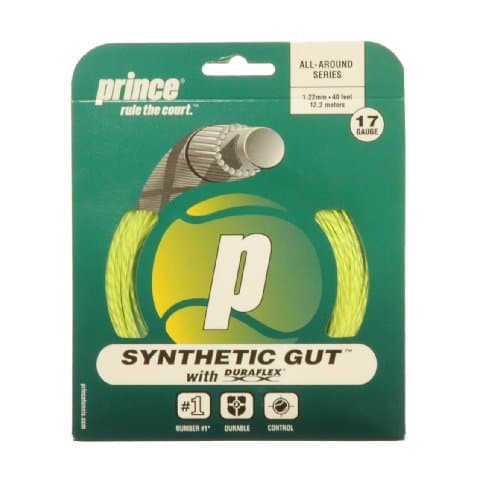 Prince Synthetic Gut DuraflexBest synthetic gut | The synthetic gut slot | 7.94 criteria | |
| 2 | 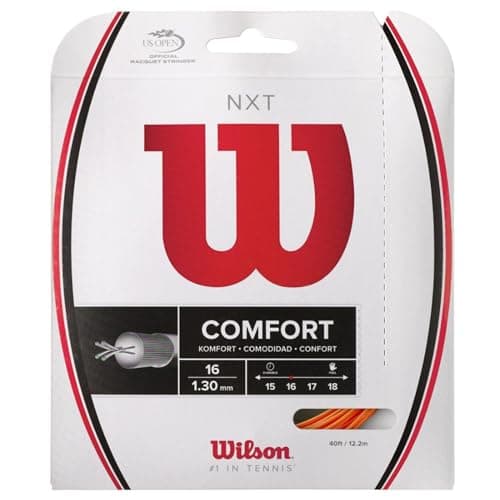 Wilson NXTBest multifilament | The multifilament slot | 8.74 criteria | |
| 3 | 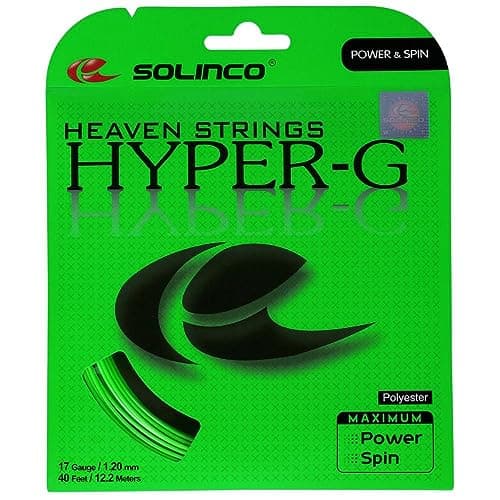 Solinco Hyper-GBest polyester | The polyester slot | 8.54 criteria | |
| 4 | 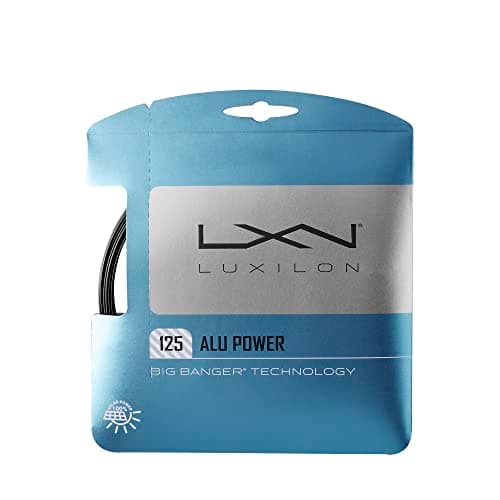 Luxilon ALU PowerThe reference poly | The polyester benchmark | 8.04 criteria |
01Prince Synthetic Gut Duraflex
Best synthetic gutBest for: The synthetic gut slot
Tennis Warehouse's All-Around Value award winner at $4.76 a set in 16 and 17 gauge. Nylon with a wear-resistant coating, and the honest representative of the whole synthetic gut family — nothing exotic, nothing to dislike.
This is the string to put in a racket when you want to remove string as a variable. If a frame plays badly with fresh synthetic gut in it, the problem is the frame.
It will not do anything special, and at under five dollars a set it is not pretending to. The ceiling is real and it is a long way above where a new player will meet it.
Our score
- Performance
- 7.0
- Comfort
- 8.0
- Durability
- 7.5
- Value
- 10.0
- Overall
- 7.9
Verified specs
- Type
- Synthetic gut
- Gauges
- 16, 17
- TW award
- All-Around Value
- Listed price
- $4.76 per set
Specs as published by Tennis Warehouse, checked September 2026.
Buy if
- This is your first or second restring
- You want the lowest cost per set
- You want a neutral baseline to judge the frame by
Pass if
- You want maximum comfort
- You want maximum control
- You break strings quickly
02Wilson NXT
Best multifilamentBest for: The multifilament slot
Tennis Warehouse's comfort winner, built from over a thousand ultra-flexible fibers bonded with polyurethane, at $23.95 a set in 16 and 17 gauge. It is the clearest example of what the multifilament construction buys you.
For the majority of club players this is the correct type and this is the correct string inside it. If a set lasts you a month or more, you have no durability problem to solve and no reason to accept the stiffness of a polyester.
It frays before it fails, which is a feature — you can see it going. A frayed multifilament has already lost much of its stretch, so treat visible fraying rather than breakage as the restring signal.
Our score
- Performance
- 8.5
- Comfort
- 10.0
- Durability
- 7.0
- Value
- 7.5
- Overall
- 8.7
Verified specs
- Type
- Multifilament
- Gauges
- 16, 17
- TW award
- Comfort
- Construction
- 1,000+ fibers bonded with polyurethane
- Listed price
- $23.95 per set
Specs as published by Tennis Warehouse, checked September 2026.
Buy if
- A set lasts you a month or more
- Comfort is a priority
- You want a wide usable tension range
Pass if
- You break strings inside two weeks
- You want the lowest cost per set
- You want maximum control
03Solinco Hyper-G
Best polyesterBest for: The polyester slot
Tennis Warehouse's control polyester at $13.99 a set, in the widest gauge range here — 15L through to 20. Once you are in the poly family, gauge becomes a real lever, and this is the string that gives you the most room to use it.
Monofilament construction is why poly behaves as it does: it holds its shape rather than stretching, which lowers the launch angle and lets the mains slide and snap back. That snap-back is where the spin actually comes from.
It loses tension fast in the first hours of play and it is stiff throughout. Anyone with a history of arm pain should stay in the multifilament family rather than trying to make a soft poly work.
Our score
- Performance
- 9.0
- Comfort
- 6.5
- Durability
- 9.0
- Value
- 9.0
- Overall
- 8.5
Verified specs
- Type
- Polyester
- Gauges
- 15L to 20
- TW award
- Control
- Listed price
- $13.99 per set
Specs as published by Tennis Warehouse, checked September 2026.
Buy if
- You break a set inside two weeks
- You want control and a lower launch angle
- You want gauge options
Pass if
- You have had tennis elbow
- Your sets already last a month
- You want maximum comfort
04Luxilon ALU Power
The reference polyBest for: The polyester benchmark
The string the rest of the polyester category is measured against, at $21.50 a set in 16, 16L, 17L and 18. It is here as the reference point for the family rather than as a recommendation for most readers.
For an advanced player with a full swing and a frame that supplies its own power, this is the predictability you are paying for — it gives back exactly what you put in, which is a virtue at that level.
In a lighter frame swung at club pace it produces a dead, low-powered bed, and it is more expensive than Hyper-G for no benefit most players will use. We would rather say that than let the name do the selling.
Our score
- Performance
- 9.5
- Comfort
- 5.5
- Durability
- 8.5
- Value
- 6.0
- Overall
- 8.0
Verified specs
- Type
- Polyester
- Gauges
- 16, 16L, 17L, 18
- TW category
- Reference polyester
- Listed price
- $21.50 per set
Specs as published by Tennis Warehouse, checked September 2026.
Buy if
- You are an advanced player with a full swing
- You want the category benchmark
- Your frame supplies its own power
Pass if
- You are a beginner or improver
- You have any history of arm pain
- You want the best value poly
Common questions
What are the different types of tennis string?
Four material families: synthetic gut (cheap nylon, neutral), multifilament (soft and powerful), polyester (stiff, controlled, durable) and natural gut (best playing, most expensive, moisture-sensitive). Hybrids combine two types, usually poly mains with a soft cross.
Which tennis string type is best for beginners?
Synthetic gut or multifilament. Both are soft enough to be comfortable and neither demands a full swing to work. Polyester is the type to avoid early — it is stiff and it is where most beginner arm trouble starts.
What is the difference between multifilament and polyester?
Construction, and it drives everything else. Multifilament is a bundle of fine fibers that stretches under load, giving comfort and power. Polyester is a single stiff monofilament that holds its shape, giving control, spin potential and durability at the cost of comfort.
What is a hybrid string setup?
One material in the main strings and another in the crosses, usually polyester mains with a multifilament or synthetic gut cross. It puts durability where the wear happens and comfort where it costs least. It needs a set of each string, so it is not a cheap option.
Is natural gut worth it?
It plays better than anything synthetic — more comfort, more power, better tension maintenance. It is also the most expensive and it degrades in damp conditions. We do not carry a listing for it we are confident in, so we name no specific product.
Can I use the same tension when I change string type?
No. Poly is much stiffer than multifilament before any tension is applied, so the same number produces a very different bed. Come down several pounds when moving from a soft string to polyester, and go up slightly when moving the other way.
Read next
Sources
Every source above was retrieved while writing this page. Specifications are quoted from the listing or manufacturer page cited, not from memory.