Guide
Are basketball shoes good for tennis?
This is a better question than the running-shoe version, because a basketball shoe really does have lateral structure. It fails on three other things instead - and one of them will cost you the shoes.
By Janet H.Updated
The short answer
No, though they are a better idea than running shoes. A basketball shoe has real lateral support, but it is built on a taller, softer stack for jump landings, its outsole compound and pattern are cut for clean indoor wood rather than abrasive hard court, and it has no toe guard for the front-foot drag that defines a tennis push-off. The stack and the outsole are the two that matter.
Disclosure — we earn a commission on qualifying purchases made through links on this page, at no extra cost to you. It never changes which product we rank first. How this site is funded.
Why the question deserves a real answer
Running shoes fail on court for one obvious reason: nothing about them resists a sideways force. Basketball shoes do not have that problem. Basketball is a lateral sport played on a hard indoor floor, with hard stops, crossover steps and defensive slides, and basketball shoes are built with reinforced uppers, substantial heel counters and often a midfoot shank or plate. If the only thing you needed was lateral structure, a basketball shoe would be a reasonable court shoe.
So the honest answer is not a flat no with a lecture about running shoes attached. It is that the two sports diverge on three specific things, and the divergences happen to be the three that decide how a court shoe performs and how long it lasts.
The three failures, in order of how much they matter
1. Stack height and midsole softness
Basketball's dominant loading pattern is jumping and landing from height. That demands a thick, compliant midsole, and modern basketball shoes carry tall foam and air or gel units in the heel to absorb it. Tennis's dominant pattern is low, wide, fast changes of direction, which demands the opposite: a low platform so there is minimal lever arm between the court and your ankle.
The court shoes we track run from 26.3 mm to 33.3 mm at the heel and from 14.4 mm to 22.0 mm at the forefoot. A cushioned basketball shoe typically stands considerably taller, and that extra height is working against you every time you load the outside edge of the shoe. A soft midsole makes it worse, because soft foam compresses asymmetrically under a sideways load and tips the platform further.
2. Outsole compound and pattern
A basketball outsole is tuned for a clean, dust-managed indoor hardwood floor. The compound is relatively soft for maximum grip, and the pattern is often a tight herringbone or a decorative variant optimized for that one surface. Put it on outdoor hard court and the soft compound wears rapidly - abrasive acrylic over concrete is far harsher than a sealed wood floor, which is why outdoor basketball shoes are sold as a separate, harder-compound category.
Grip is the other half of it. A tennis shoe is designed to grip and then release in a controlled slide, because a short slide is how you absorb and redirect momentum at the end of a wide chase. A basketball outsole on acrylic tends toward stick-then-skate rather than a predictable release, and unpredictable grip is harder on knees and ankles than either extreme.
3. No toe guard, and the toe drag
Nearly every court shoe has a reinforced panel across the outer and medial toe. It is there because a tennis push-off drags the front foot across the court, and many serves and wide forehands drag the toe hard. Basketball has no equivalent movement, so basketball shoes have no equivalent reinforcement - and the mesh or knit at the front of a basketball shoe will wear through from the inside in weeks. This is the failure that is guaranteed rather than probable.
Court shoes and basketball shoes side by side
| Feature | Tennis court shoe | Basketball shoe | Consequence on a tennis court |
|---|---|---|---|
| Heel stack | 26-33 mm on the models we track | Typically taller, built for jump landings | More height means more torque on the ankle under lateral load |
| Midsole | Firm, resists asymmetric compression | Softer, tuned for impact absorption | Soft foam tips further when you load an edge |
| Outsole compound | Hard and abrasion-resistant, e.g. 88-90 HC on ASICS models | Softer, tuned for indoor wood | Wears fast on outdoor acrylic and concrete |
| Slide behavior | Grips then releases predictably | Tends to stick then skate on acrylic | Unpredictable release is harder on knees and ankles |
| Toe guard | Reinforced panel, near-universal | Absent | Toe drag wears through the upper in weeks |
| Lateral upper support | TPU or synthetic overlays, stiff counter | Strong - this is basketball's strength | The one axis where the basketball shoe holds up |
If ankle support is why you were asking
Most people who ask this question are not asking about basketball. They are asking whether a high-collared shoe will protect an ankle that has gone over before, and basketball is where high-collared shoes live. It is a reasonable line of thinking and the answer is still no - but not because ankle support does not matter.
The support you want is at and below the ankle rather than above it: a stiff heel counter, high torsional rigidity and a low stack. Court shoes are measured on all three, and the best of them score 5/5 on the first two. A tall collar sits above the joint that fails and does little about the inversion motion that causes court sprains. The full argument, with the measurements, is on high-top vs low-top tennis shoes.
So the practical answer to the real question is: buy a court shoe that scores well on heel counter and torsional rigidity, stand as low as your joints will let you, and if you need more than that, take the brace question to a clinician. That path gets you more protection than a basketball shoe does, and your shoes survive the season.
How this guide was put together
We do not run a test lab and nothing here is written as though we did. This page is built from published specification sheets, from the independent measurements and governing-body rules cited at the foot of the article, and from the physical reasoning that connects them. Where a figure is not published anywhere we can cite, the page says so rather than filling the gap.
The picks are existing products from our own registry, so each one carries a source you can check. Our full selection criteria set out the method, and the editorial policy covers corrections and how often pages are revisited. We earn a commission if you buy through our links, which is disclosed on every page and never changes a ranking.
Now pick yours
The specs above are only useful once they resolve into something you can buy. These are the products that match what this page has just explained.
Our picks
| # | Product | Best for | Score | Price |
|---|---|---|---|---|
| 1 | 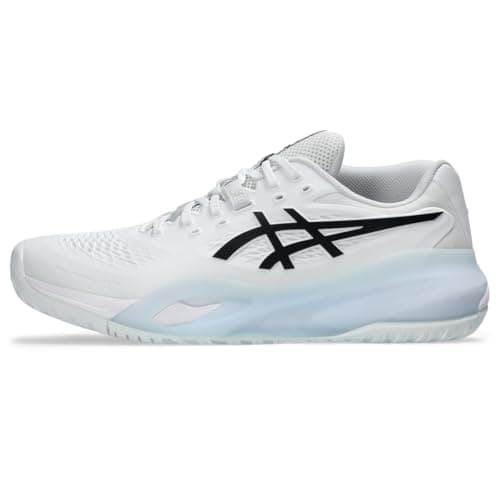 ASICS GEL-Resolution XTop pick | The lateral support you were looking for | 8.75 criteria | $139.95 · View on Amazon Price as of October 17, 2026 · was $164.95, 15% off |
| 2 | 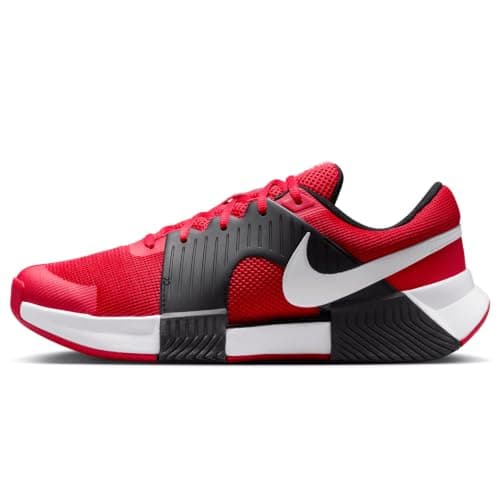 Nike Zoom GP Challenge 1Most energetic | Players who want a cushioned, rebounding ride | 8.35 criteria | |
| 3 | 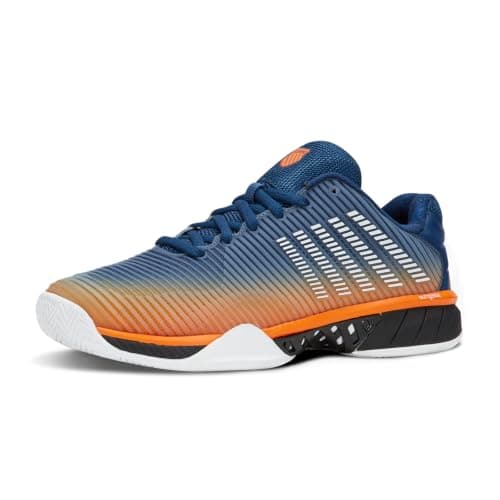 K-Swiss Hypercourt Express 2Best value | Not spending much to stop using the wrong shoes | 8.25 criteria |
01ASICS GEL-Resolution X
Top pickBest for: The lateral support you were looking for
If the appeal of a basketball shoe was structure, this is the court shoe that out-structures it where structure counts. RunRepeat scored both torsional rigidity and heel counter stiffness at a full 5/5, which no other shoe we track manages, on a low 30.8 mm heel and 21.9 mm forefoot with an 8.9 mm drop.
It also solves the problem that would have cost you a pair of basketball shoes: a 90.4 HC outsole that lost just 0.6 mm in the Dremel test, plus the toe guard and reinforced forefoot that a basketball shoe does not have. On outdoor hard court this is the most durable rubber we have a figure for.
The costs are weight and price - 14.7 oz / 417 g at the top of the category, and it is firm out of the box. A rigid shoe takes a week to feel normal. That is the trade for the structure, and it is the right trade if ankles are the reason you are here.
Our score
- Lateral stability
- 9.5
- Cushioning
- 8.5
- Outsole durability
- 9.5
- Fit accommodation
- 8.0
- Lightness
- 6.5
- Overall
- 8.7
Verified specs
- RunRepeat score
- 90 — Best Stability
- Weight
- 14.7 oz / 417 g (men's 9)
- Heel / forefoot stack
- 30.8 mm / 21.9 mm
- Drop
- 8.9 mm
- Torsional rigidity
- 5/5
- Heel counter stiffness
- 5/5
- Heel shock absorption
- 98 SA
- Outsole wear
- 0.6 mm depth, 90.4 HC
Specs as published by RunRepeat, checked September 2026.
Buy if
- You wanted a basketball shoe for its lateral support
- You play on outdoor hard court regularly
- You have rolled an ankle before
Pass if
- You want a light shoe
- You want a soft ride from day one
- Price is the deciding factor
Price as of October 17, 2026 · was $164.95, 15% off
02Nike Zoom GP Challenge 1
Most energeticBest for: Players who want a cushioned, rebounding ride
The pick for somebody who liked how a basketball shoe felt underfoot and does not want to give that up. RunRepeat give it their Best Energy Return award at an 88, built around a rebound-focused midsole, and score its torsional rigidity 5/5 with a 4/5 heel counter - so you get the springy feel without a chassis that twists.
It is also accommodating: RunRepeat list it in their wide-feet catalog, which matters if you have been wearing basketball shoes partly because court shoes felt tight. A court shoe that fits is a court shoe you will keep wearing.
The honest cost is weight: 14.71 oz / 417 g, the same ballpark as the GEL-Resolution X, and Nike publish no stack height for this model so we cannot tell you how low you are standing. If a low platform is your priority, the adidas Barricade 14 is the shoe on our [narrow feet page](/tennis-shoes/best-for-narrow-feet) with the lowest measured forefoot.
Our score
- Lateral stability
- 8.5
- Cushioning
- 8.5
- Outsole durability
- 8.5
- Fit accommodation
- 8.5
- Lightness
- 6.5
- Overall
- 8.3
Verified specs
- RunRepeat score
- 88 — Best Energy Return
- Weight
- 14.71 oz / 417 g
- Torsional rigidity
- 5/5
- Heel counter stiffness
- 4/5
- Width fit
- Listed in RunRepeat's wide-feet catalog
Specs as published by RunRepeat, checked September 2026.
Buy if
- You like a cushioned, rebounding feel underfoot
- You want a rigid chassis without a firm ride
- You have a broader foot
Pass if
- You want the lowest platform available
- You want a light shoe
- You want published stack figures
03K-Swiss Hypercourt Express 2
Best valueBest for: Not spending much to stop using the wrong shoes
RunRepeat score it 86 and name it their budget hard-court pick at a listed $110, 13 percent below category typical. If you have been playing in basketball shoes because court shoes seemed like an unnecessary expense, this is the price point that argument stops working at.
It is also cross-listed by Tennis Warehouse in their pickleball shoe catalog, so one pair covers both sports, and RunRepeat carry it in their wide-feet catalog. For a recreational player this is a complete answer rather than a compromise.
The honest cost is that it is a budget shoe: you do not get the measured 5/5 scores of the premium picks, and a heavy player playing four times a week will replace it sooner. It is the right shoe to switch into, not necessarily the one you will own in three years.
Our score
- Lateral stability
- 8.0
- Cushioning
- 7.5
- Outsole durability
- 8.5
- Fit accommodation
- 8.5
- Lightness
- 8.0
- Overall
- 8.2
Verified specs
- RunRepeat score
- 86 — Best Budget, hard court
- Price
- $110, 13% below category typical
- Weight
- Lighter than average
- Width fit
- Listed in RunRepeat's wide-feet catalog
Specs as published by RunRepeat, checked September 2026.
Buy if
- Cost was the reason you were using basketball shoes
- You play once or twice a week
- You play more than one court sport
Pass if
- You play four or more times a week
- You want maximum measured structure
- You want premium cushioning
Common questions
Are basketball shoes good for hard court tennis?
No. They have the lateral support running shoes lack, but they fail on three other things: a taller and softer stack built for jump landings, an outsole compound and pattern cut for indoor wood rather than abrasive acrylic, and no toe guard for the front-foot drag of a tennis push-off.
Will I wreck basketball shoes playing tennis?
Almost certainly, and quickly. The soft indoor-tuned outsole wears fast on abrasive outdoor hard court, and the unreinforced toe area wears through from the drag of a push-off - often within weeks for a regular player. That is the most predictable cost of the swap.
Are basketball shoes safer than running shoes for tennis?
Yes, on the lateral-support axis. A basketball shoe has a reinforced upper and a real heel counter, so it will not fold over its edge the way a soft running shoe does. It still stands taller and softer than a court shoe, which works against you under lateral load.
Can I use basketball shoes for indoor tennis?
It is the least bad version of the idea. A wood or cushioned indoor court removes the abrasion problem and most of the unpredictable-grip problem, leaving the stack height and the toe drag. For an occasional recreational player who already owns them, that is a very different risk from outdoor concrete twice a week.
Do basketball shoes prevent ankle sprains better than tennis shoes?
No. The structures that resist a court inversion sprain are the heel counter, torsional rigidity and a low stack - all measured in court shoes, and all better in a good court shoe than in a cushioned basketball shoe. A tall collar sits above the joint that fails. The measurements are on high-top vs low-top tennis shoes.
What about volleyball shoes for tennis?
Closer than basketball, because volleyball shoes are low, firm and built for lateral movement on a hard indoor floor. The remaining gaps are the same two: a gum or indoor-tuned outsole compound that wears on abrasive outdoor courts, and no toe guard for a tennis push-off drag.
Read next
Sources
- 01RunRepeat - ASICS GEL-Resolution X
- 02RunRepeat - best hard court tennis shoes
- 03RunRepeat - best tennis shoes
- 04RunRepeat - wide tennis shoes catalog
Every source above was retrieved while writing this page. Specifications are quoted from the listing or manufacturer page cited, not from memory.