Buying guide
Best tennis shoes for Achilles tendonitis in 2026
A higher heel does less asking of the tendon behind it. Here are the four court shoes whose measured drop and heel cushioning make the most sense for a sore Achilles - and the one caveat that changes the answer if your pain sits right on the heel bone.
By Janet H.Updated
The short answer
The Mizuno Wave Exceed Tour 7 AC is the best court shoe for Achilles tendonitis: at an 11.1 mm measured drop it has the highest heel-to-toe differential of any shoe we track, and a raised heel is what reduces strain on the tendon. If your pain sits directly on the heel bone rather than up the tendon, read the insertional caveat below before you buy anything.
Disclosure — we earn a commission on qualifying purchases made through links on this page, at no extra cost to you. It never changes which product we rank first. How this site is funded.
Our picks
| # | Product | Best for | Score | Price |
|---|---|---|---|---|
| 1 | 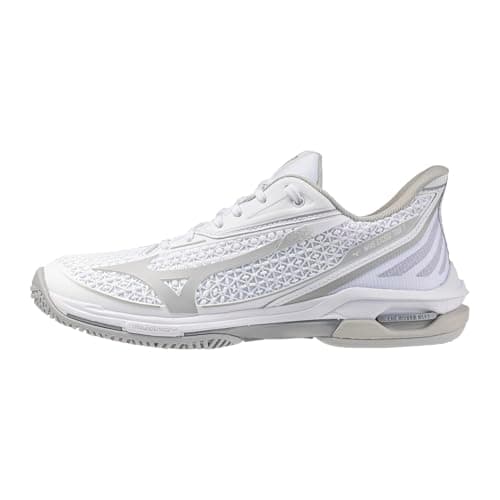 Mizuno Wave Exceed Tour 7 ACTop pick | Most Achilles pain, hard court | 8.85 criteria | |
| 2 | 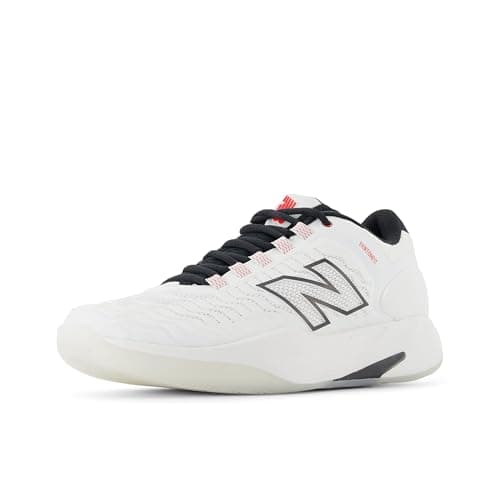 New Balance Fresh Foam X CT-Rally v2Best shock absorption | Impact that arrives at the heel | 8.65 criteria | |
| 3 | 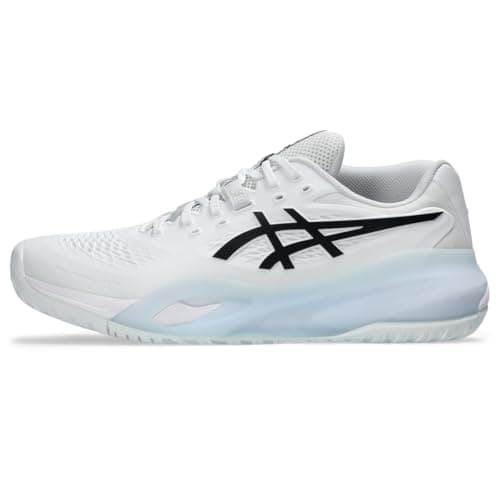 ASICS GEL-Resolution XMost supportive | A sore tendon plus a loose ankle | 8.55 criteria | $139.95 · View on Amazon Price as of October 17, 2026 · was $164.95, 15% off |
| 4 | 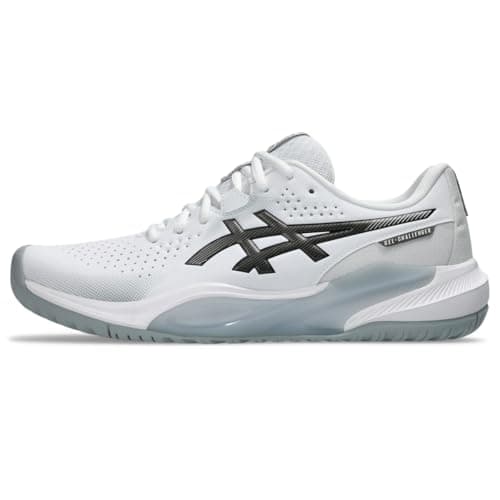 ASICS GEL-Challenger 15Best value | A first court shoe with a sore heel | 7.95 criteria |
The picks in detail
01Mizuno Wave Exceed Tour 7 AC
Top pickBest for: Most Achilles pain, hard court
Drop is the spec that matters here, and this shoe has the most of it: RunRepeat measured 11.1 mm between a 30.4 mm heel and a 19.3 mm forefoot. OrthoInfo, the American Academy of Orthopaedic Surgeons' patient-information site, lists heel lifts among the nonsurgical measures for Achilles tendinitis precisely because lifting the heel reduces strain on the tendon. A high-drop shoe is a built-in version of the same idea.
It backs that up where it counts. 100 SA of shock absorption at the heel, above-average energy return at both ends, a measured traction coefficient of 1.04, and only 0.7 mm of outsole wear in the Dremel test, with a six-month outsole warranty behind it. At 343 g it is also one of the lighter premium court shoes, which matters when you are deliberately not pushing off hard.
The honest costs are two. Torsional rigidity measured 12.9 Nm against a 18.1 Nm average, so this is a flexible shoe - a foot that needs the sole to refuse to twist is better served by the GEL-Resolution X below. And RunRepeat notes it is not for wide feet, which is good news on our [narrow feet page](/tennis-shoes/best-for-narrow-feet) and bad news if your foot is broad.
Our score
- Lateral stability
- 8.0
- Cushioning
- 9.0
- Outsole durability
- 8.5
- Fit accommodation
- 7.5
- Lightness
- 8.5
- Overall
- 8.8
Verified specs
- RunRepeat score
- 90
- Tested pair
- Men's — women's AC version sold separately
- Weight
- 12.1 oz / 343 g
- Heel / forefoot stack
- 30.4 mm / 19.3 mm
- Drop
- 11.1 mm
- Energy return
- 55.7% heel / 58.5% forefoot
- Shock absorption
- 100 SA heel / 67 SA forefoot
- Traction
- 1.04
- Torsional rigidity
- 12.9 Nm (average 18.1 Nm)
- Heel counter stiffness
- 4/5
- Outsole wear
- 0.7 mm
- Fit note
- RunRepeat: not for wide feet
- Outsole warranty
- 6 months
Specs as published by RunRepeat, checked September 2026.
Buy if
- Your pain runs up the tendon rather than sitting on the heel bone
- You want the highest heel-to-toe drop available in a court shoe
- Your foot is average width or slimmer
Pass if
- Your foot is wide
- You need maximum torsional rigidity
- Your pain is at the tendon's attachment to the heel bone
02New Balance Fresh Foam X CT-Rally v2
Best shock absorptionBest for: Impact that arrives at the heel
This is the most cushioned court shoe we track at the heel, and the figures are not close: 116 SA of heel shock absorption on a 33.3 mm heel stack, against 98 for the GEL-Resolution X and 89 for the Barricade 14. If the moment that hurts is the landing - the first step out of a split step, or simply the back of the heel after an hour - this is the shoe that takes the most of it away.
It manages that without going soft structurally. Torsional rigidity scored a full 5/5, so the tall heel stack is not sitting on a chassis that twists underneath it, and that combination is rarer than it sounds: cushioning and rigidity usually trade against each other. RunRepeat gave it a 92 and their Best Shock Absorption award.
Two things to know. The forefoot sits at 20.2 mm against that 33.3 mm heel, which is a large differential and good for you - but New Balance does not publish a drop figure for this model and we are not going to derive one and present it as published. And a tall, soft heel stack is more shoe to stand on than a low one, so a player who wants court feel will prefer the Barricade in our [narrow feet picks](/tennis-shoes/best-for-narrow-feet).
Our score
- Lateral stability
- 8.5
- Cushioning
- 9.5
- Outsole durability
- 7.5
- Fit accommodation
- 8.0
- Lightness
- 7.5
- Overall
- 8.6
Verified specs
- RunRepeat score
- 92 — Best Shock Absorption
- Heel stack
- 33.3 mm
- Forefoot stack
- 20.2 mm
- Heel shock absorption
- 116 SA
- Forefoot shock absorption
- 78 SA
- Torsional rigidity
- 5/5
Specs as published by RunRepeat, checked September 2026.
Buy if
- Heel impact is the part of a session that hurts
- You want cushioning without a chassis that twists
- You are a mid-price buyer rather than a premium one
Pass if
- You want a low, connected ride
- You play on abrasive concrete several times a week
- You want a published drop figure
03ASICS GEL-Resolution X
Most supportiveBest for: A sore tendon plus a loose ankle
The case for the stability shoe is that an Achilles problem rarely arrives alone. A foot that pronates through the stance phase drags the tendon's insertion inward on every step, and the structure that stops that is a rigid chassis plus a stiff heel counter. This shoe scores 5/5 on both torsional rigidity and heel counter stiffness - the only pick here to take full marks on either.
The supporting numbers are good too: an 8.9 mm measured drop, 98 SA at the heel, a 30.8 mm heel stack, and the hardest outsole we have a figure for at 90.4 HC with 0.6 mm of wear. For a player on outdoor hard court three or more times a week, it is also the pick least likely to need replacing mid-season.
The costs are weight and the heel counter itself. 14.7 oz / 417 g is heavy, and a heavy shoe asks more of the calf complex on every push-off, which is the opposite of what a sore tendon wants. More importantly, a 5/5 heel counter presses firmly on the back of the heel - excellent for a mid-tendon problem, potentially the wrong choice for insertional pain. Read the caveat section before you choose this one.
Our score
- Lateral stability
- 9.5
- Cushioning
- 8.5
- Outsole durability
- 9.5
- Fit accommodation
- 8.0
- Lightness
- 6.5
- Overall
- 8.5
Verified specs
- RunRepeat score
- 90 — Best Stability
- Weight
- 14.7 oz / 417 g (men's 9)
- Heel / forefoot stack
- 30.8 mm / 21.9 mm
- Drop
- 8.9 mm
- Torsional rigidity
- 5/5
- Heel counter stiffness
- 5/5
- Heel shock absorption
- 98 SA
- Outsole wear
- 0.6 mm depth, 90.4 HC
Specs as published by RunRepeat, checked September 2026.
Buy if
- You pronate and want the chassis to stop it
- Your pain is mid-tendon rather than at the heel bone
- You need an outsole that survives outdoor hard court
Pass if
- Your pain is right where the tendon meets the heel bone
- You want a light shoe
- You want a soft, forgiving ride
Price as of October 17, 2026 · was $164.95, 15% off
04ASICS GEL-Challenger 15
Best valueBest for: A first court shoe with a sore heel
RunRepeat's Best for Beginners pick at an 83, and the reason it belongs on this page is that it is structurally serious at an unserious price: 5/5 for both midsole stiffness and heel counter stiffness. If your Achilles started complaining while you were playing in trainers, the cheapest honest upgrade is a real court shoe, and this is it.
It is also listed in RunRepeat's wide-feet catalog, which makes it the accommodating option here - the Mizuno above is explicitly not for wide feet, and a broad-footed player with a sore tendon otherwise has very little to choose from. A shoe that fits is a shoe you will actually wear for the whole session.
Be clear about the trade. RunRepeat describes it as notably heavier than average and ASICS publishes no stack height or drop figure for it, so you are buying structure without the two measurements this page ranks on. It is the entry tier of the ASICS court range, so the outsole and midsole will not last like the GEL-Resolution's. Buy it as the sensible first step, not as the end of the search.
Our score
- Lateral stability
- 8.5
- Cushioning
- 7.5
- Outsole durability
- 7.5
- Fit accommodation
- 8.5
- Lightness
- 6.0
- Overall
- 7.9
Verified specs
- RunRepeat score
- 83 — Best for Beginners
- Midsole stiffness
- 5/5
- Heel counter stiffness
- 5/5
- Weight
- Notably heavier than average
- Width fit
- Listed in RunRepeat's wide-feet catalog
Specs as published by RunRepeat, checked September 2026.
Buy if
- You are moving from trainers to a real court shoe
- You have a wide foot and a sore Achilles
- You want structure at the lowest sensible price
Pass if
- You want published drop and stack figures
- You play four or more times a week
- You want the lightest shoe you can get
What Achilles tendonitis is, in two paragraphs
The Achilles is the tendon running down the back of your lower leg that connects the calf muscles to the heel bone. OrthoInfo describes Achilles tendinitis as irritation and inflammation of that tendon, almost always from overuse rather than from one identifiable injury - doing too much too quickly, a sudden jump in intensity or frequency, tight calf muscles, or a change of shoes. Racquet sports tick several of those boxes at once, because the split step and the recovery step load the tendon hundreds of times an hour.
The distinction that changes which shoe you should buy is where along the tendon it hurts. OrthoInfo splits the condition into noninsertional tendinitis, which affects the middle of the tendon above the heel and is more common in younger, active people, and insertional tendinitis, which affects the lower part where the tendon attaches to the heel bone and often comes with bone spurs on the back of the heel. Both hurt in the morning and both get worse with activity; only one of them is made worse by a firm heel counter pressing on the back of your heel.
The one spec that actually changes tendon load: drop
Heel-to-toe drop is the difference in stack height between the heel and the forefoot of a shoe. A 11.1 mm drop means your heel sits 11.1 mm higher than the ball of your foot; a 6.2 mm drop means it sits barely half that. The mechanical consequence is simple: the higher your heel sits, the less your ankle has to bend upward through the stance phase, and the less the Achilles is stretched under load.
That is the same logic behind the heel lifts OrthoInfo lists as a nonsurgical measure - a wedge under the heel reduces strain on the tendon. A high-drop court shoe builds the wedge into the midsole, which is tidier than stacking a lift inside a low-drop shoe and then finding your heel sits too high in the collar. It is also the reason we rank drop above cushioning on this page even though cushioning is the thing people shop for.
The catch is that almost nobody publishes it. Of the four shoes here, exactly one has a measured drop figure from an independent source, and two publish no stack height at all. That is why this page is four shoes rather than eight: we would rather rank the models we have real numbers for than pad the list with shoes whose drop we would have to guess. Where a figure is missing, the entry says so.
The numbers side by side
Drop and heel shock absorption are the two columns to read. Everything else is context.
| Shoe | Measured drop | Heel stack | Heel shock absorption | Heel counter stiffness |
|---|---|---|---|---|
| Mizuno Wave Exceed Tour 7 AC | 11.1 mm | 30.4 mm | 100 SA | 4/5 |
| New Balance Fresh Foam X CT-Rally v2 | Not published | 33.3 mm | 116 SA | Not published |
| ASICS GEL-Resolution X | 8.9 mm | 30.8 mm | 98 SA | 5/5 |
| ASICS GEL-Challenger 15 | Not published | Not published | Not published | 5/5 |
The table makes the ranking argument for you. The Mizuno wins on the axis that has the clearest mechanical link to the tendon. The CT-Rally v2 wins on the axis that has the clearest link to how a session feels. And the GEL-Resolution X wins on the axis that matters if your foot is also doing something it should not - which is why all three are here instead of one.
The insertional caveat: when a stiff heel is the problem
If your pain sits right where the tendon meets the heel bone, a well-built court shoe can be the thing making it worse. OrthoInfo's footwear note for insertional tendinitis is explicit: softer shoes, or shoes that are open at the back of the heel, reduce irritation at the insertion. A court shoe is the opposite of both. It has a firm heel counter by design, because that counter is what stops your heel lifting out of the shoe when you change direction.
So the ranking inverts for insertional pain. The ASICS pair's 5/5 heel counters go from being the reason to buy them to being the reason to think twice, and the Mizuno's 4/5 counter and the CT-Rally's soft, tall heel become the gentler options. Nothing on this page is open at the back of the heel, because a court shoe cannot be - which is a real limit of what footwear can do for you here, and worth saying out loud.
One more OrthoInfo detail with direct consequences on court: heel-drop exercises off a stair edge, the standard eccentric calf rehab, are for noninsertional tendinitis only, and the guidance says not to perform them if you have the insertional kind. That is a good reason to know which one you have before you build a routine around it - and a better reason to take the question to a clinician than to a gear page.
What else to change before you blame the shoes
Footwear is one line on a longer list, and the other lines are cheaper. These are the ones that overlap with the gear decisions this site covers.
- 01Check whether your current shoes are finished. A compressed midsole has lost the stack height that was protecting you, so the drop you bought is no longer the drop you are standing on. Our five replacement checks take two minutes.
- 02Cut the load, not the sport. OrthoInfo's first nonsurgical measure is activity modification - swapping high-impact work for cycling, elliptical or swimming while the tendon settles. On court, that reads as fewer sessions on hard court rather than none at all.
- 03Look at the surface. Clay absorbs more than hard court and allows a slide instead of a hard stop, which is less tendon load per change of direction. If you have a clay option, this is the season to use it.
- 04Check the calf, not just the heel. Tight calf muscles are on OrthoInfo's list of contributors, and a tight calf pulls on the tendon whatever shoe you are wearing.
- 05Then buy for drop. Once the above is handled, a higher-drop shoe is a durable change rather than a patch.
How these picks were made
Racket & Rally does not run a test lab. Nothing on this page is written as though we had played with, worn or measured anything ourselves, because we have not. What we do is read the published specification sheets, the independent measurements and the retailer listings cited at the foot of the page, set them against each other, and say which differences change something you will actually notice on court.
Every product here was confirmed on sale when its registry entry was built, and every claim traces to one of the sources listed at the bottom. Our full selection criteria set out the method, and the editorial policy covers corrections and how often pages are revisited. Where a brand does not publish a figure, we say that rather than filling the gap.
Common questions
What heel drop is best for Achilles tendonitis?
Higher is better, because a raised heel reduces how far the ankle bends upward under load and therefore how much the tendon is stretched. OrthoInfo lists heel lifts among its nonsurgical measures for exactly that reason. Of the court shoes we track, the Mizuno Wave Exceed Tour 7 AC has the highest measured drop at 11.1 mm.
Can I keep playing tennis with Achilles tendonitis?
That is a question for a clinician, not a gear site. What the published guidance says is that OrthoInfo's first nonsurgical measure is activity modification rather than complete rest, and that most cases improve without surgery but can take months. A sudden pop in the calf or heel is different - that may signal a tear and warrants immediate medical attention.
Are cushioned shoes or supportive shoes better for a sore Achilles?
It depends where it hurts. For mid-tendon pain, a supportive shoe with a firm heel counter controls the foot and limits the drag on the tendon's insertion. For pain right at the heel bone, OrthoInfo notes that softer shoes reduce irritation, so the firm counter works against you. Identify which type you have first.
Do heel lifts work in tennis shoes?
Heel lifts are on OrthoInfo's nonsurgical list, so the principle is sound. The practical problem in a court shoe is that lifting your heel inside a fixed collar can cause the heel to slip on lateral movement, which is its own injury risk. Buying a shoe with the drop built into the midsole avoids that trade.
Does a heavier tennis shoe make Achilles tendonitis worse?
Every gram has to be accelerated by the calf complex on each push-off, so a heavier shoe asks more of the same muscles and tendon. It is a secondary factor rather than the main one - drop and heel cushioning matter more - but it is why the 417 g GEL-Resolution X sits third here rather than first despite having the best structure.
Is this the same thing as plantar fasciitis?
No. Plantar fasciitis is the tissue along the sole of the foot; Achilles tendonitis is the tendon at the back of the heel and lower leg. They can feel adjacent and often coexist, and the shoe answers overlap but are not identical - plantar pain responds to arch support and forefoot cushioning, which our plantar fasciitis picks rank on.
Read next
Sources
- 01OrthoInfo (AAOS) - Achilles Tendinitis
- 02RunRepeat - Mizuno Wave Exceed Tour 7 AC
- 03RunRepeat - ASICS GEL-Resolution X
- 04RunRepeat - best hard court tennis shoes
- 05RunRepeat - wide tennis shoes catalog
Every source above was retrieved while writing this page. Specifications are quoted from the listing or manufacturer page cited, not from memory.