Guide
Hybrid tennis string setups explained
Two strings in one racket is not a compromise - it is the standard answer to wanting durability and comfort at the same time. Here is which way round they go, and why that order is not a matter of taste.
By Janet H.Updated
The short answer
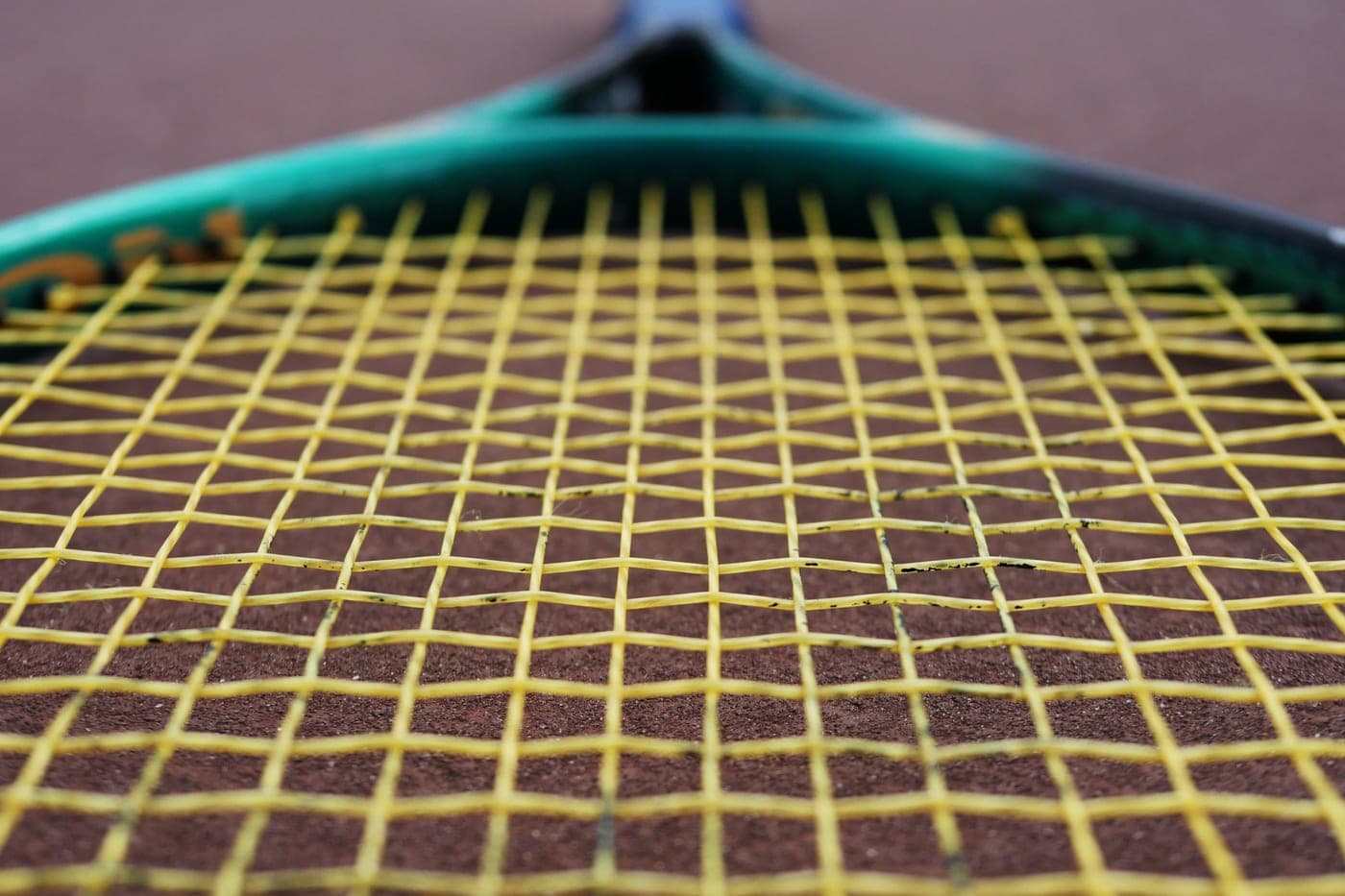
A hybrid uses one string type in the mains - the strings running along the racket's length - and another in the crosses. The standard setup is a stiff polyester in the mains for durability and spin, with a softer multifilament or synthetic gut in the crosses for comfort, strung a few pounds tighter than the mains. The mains do most of the work and most of the breaking, which is why they get the durable string.
Disclosure — we earn a commission on qualifying purchases made through links on this page, at no extra cost to you. It never changes which product we rank first. How this site is funded.
What a hybrid is, and why anybody bothers
A string bed is two sets of strings. The mains run from the handle end up through the hoop - the long ones - and the crosses weave across them. In a conventional job both sets are the same string from the same reel. In a hybrid they are not: you install one string as mains and a different one as crosses, which gives the bed two sets of properties at once.
The reason this exists is a real conflict. Polyester - the string most competitive players use - is durable, controlled and generates spin, and it is also stiff and hard on arms, and it loses tension faster than it looks. Multifilament and natural gut are soft, comfortable and powerful, and they fray and break quickly. You cannot get both from one string, so the hybrid splits the difference across the two axes of the bed.
It is not an exotic choice. A large proportion of tour setups are hybrids, and the reason is the same as yours: somebody wanted the control of a poly without the stiffness of a full poly bed. If you have been playing a full polyester and your elbow has started complaining, a hybrid is the step between that and giving up the string you like.
Which string goes where, and why it is not arbitrary
The mains do most of the work. They are longer, they deflect more on impact, they slide and snap back - which is the mechanism that generates spin - and they are what breaks. The crosses mostly hold the mains in place and modify the overall feel.
That gives you the standard rule: the durable, spin-generating string goes in the mains, and the softer, more comfortable string goes in the crosses. Poly mains with a multifilament or synthetic gut cross is the common setup, and it is common because it works - you get poly control and poly spin from the strings doing the hitting, and the softer crosses take some of the harshness out of the bed.
The reverse hybrid - soft mains, poly crosses - exists and has a narrower use. Natural gut or multifilament mains with poly crosses is softer and more powerful than the standard order, because the mains are the dominant strings and they are now the soft ones. The cost is durability: you have put the fragile string where the breaking happens. Players choose it when comfort or power outranks string life.
The combinations that do something
| Mains | Crosses | What you get | What you give up |
|---|---|---|---|
| Polyester | Multifilament | Poly control and spin with noticeably less harshness - the standard arm-friendly hybrid | Crosses fray before the mains break on some setups |
| Polyester | Synthetic gut | The cheapest way to soften a full poly bed | Less comfort than a multifilament cross |
| Multifilament | Polyester | A soft, powerful bed with more durability than a full multifilament | Mains are the fragile set, so string life is short |
| Polyester | Polyester, different gauge or type | Fine-tuning control and spin within the poly family | No comfort benefit - this is not an arm solution |
| Synthetic gut | Synthetic gut | Nothing - this is a conventional job in two colors | Not a hybrid in any useful sense |
Two things worth taking from that table. Poly-in-the-mains with something soft in the crosses is the setup that solves the most common problem, and it is the one to try first. And a poly-poly hybrid, which looks sophisticated, is a control adjustment and does nothing for an arm - if comfort is why you are here, one of the two strings has to be soft.
Is a hybrid right for you?
Four honest filters, in order.
- 01Are you breaking strings? If you break a full multifilament every two or three weeks, poly mains will roughly solve that, and a hybrid lets you do it without accepting a full poly bed. If you have never broken a string, durability is not your problem and a hybrid may be solving nothing.
- 02Is your arm complaining? If you play a full poly and have elbow or wrist symptoms, a hybrid is the standard first step and it is cheaper than a new racket. If that is not enough, the next step is a full multifilament, then a softer frame - in that order, cheapest first.
- 03Do you rely on spin? Poly mains are the spin mechanism, so a standard hybrid keeps your spin and softens the bed. A reverse hybrid will cost you some bite.
- 04Can your stringer do it? Any competent stringer can, and most will charge the same labor plus the two string costs. The thing to confirm is the tension differential they use, so your next restring is the same as this one.
One cost nobody mentions: a hybrid makes your restring economics messier. You are buying two strings and using half of each, so unless you buy reels you end up with partial sets accumulating. If you restring often enough to care, reels of the two strings you have settled on are the cheaper path - and that decision is covered on should you string your own racket.
How this guide was put together
We do not run a test lab and nothing here is written as though we did. This page is built from published specification sheets, from the independent measurements and governing-body rules cited at the foot of the article, and from the physical reasoning that connects them. Where a figure is not published anywhere we can cite, the page says so rather than filling the gap.
The picks are existing products from our own registry, so each one carries a source you can check. Our full selection criteria set out the method, and the editorial policy covers corrections and how often pages are revisited. We earn a commission if you buy through our links, which is disclosed on every page and never changes a ranking.
Now pick yours
The specs above are only useful once they resolve into something you can buy. These are the products that match what this page has just explained.
Our picks
| # | Product | Best for | Score | Price |
|---|---|---|---|---|
| 1 | 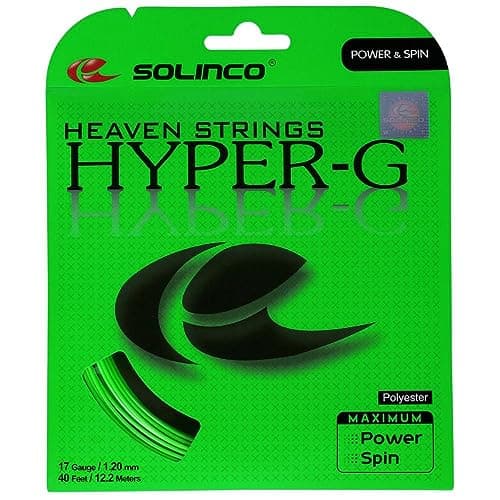 Solinco Hyper-GBest mains | The mains in a standard hybrid | 8.54 criteria | |
| 2 | 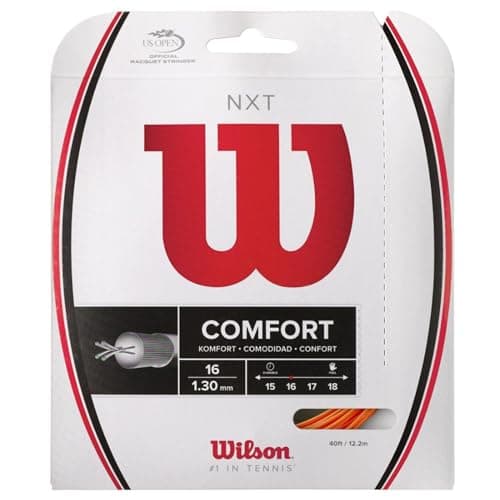 Wilson NXTBest crosses | The crosses in an arm-friendly hybrid | 8.44 criteria | |
| 3 | 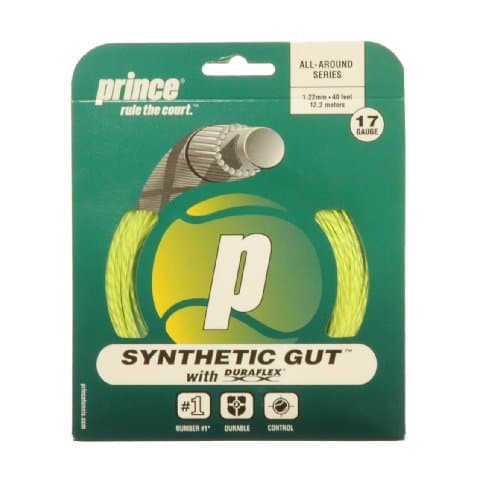 Prince Synthetic Gut DuraflexBest value crosses | The cheapest way to soften a poly bed | 8.04 criteria | |
| 4 | 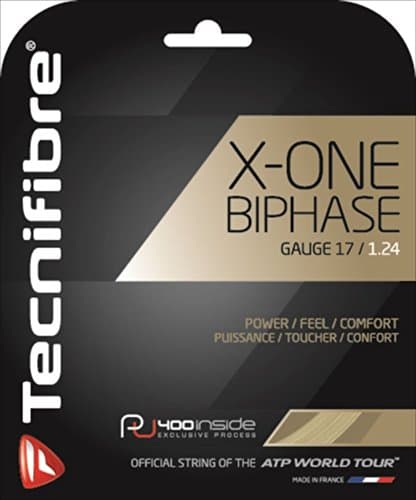 Tecnifibre X-One BiphaseBest soft mains | A reverse hybrid, or soft mains | 8.24 criteria |
01Solinco Hyper-G
Best mainsBest for: The mains in a standard hybrid
Tennis Warehouse's control polyester, and the one in our registry with the widest gauge range - 15L through 20. Gauge range matters more in a hybrid than in a conventional job, because you are choosing a main-string thickness independently of the crosses and can tune durability against bite without changing string.
As a mains string it does what poly mains are for: control, spin from the snap-back, and enough durability to outlast the crosses. At a listed $13.99 per set it is also the cheapest poly in our registry, which matters when you are buying two strings per restring.
The honest cost is stiffness. A polyester is a stiff string and this is a control-oriented one, which is precisely why it belongs in a hybrid rather than in a full bed if your arm is sensitive. Poly also loses tension faster than it feels like it does - if you play weekly, this bed needs restringing more often than you will want to.
Our score
- Performance
- 9.0
- Comfort
- 6.5
- Durability
- 9.0
- Value
- 8.5
- Overall
- 8.5
Verified specs
- Type
- Polyester
- Gauges
- 15L to 20
- TW award
- Control
- Listed price
- $13.99 per set
Specs as published by Tennis Warehouse, checked September 2026.
Buy if
- You want control and spin from the mains
- You break strings and want durability where it counts
- You want gauge options to tune main-string thickness
Pass if
- You want a soft full bed
- You restring rarely and want tension to hold
- You are not sure a poly is right for your arm
02Wilson NXT
Best crossesBest for: The crosses in an arm-friendly hybrid
Tennis Warehouse's Comfort award winner, built from over a thousand fibers bonded with polyurethane, in 16 and 17 gauge at a listed $23.95 per set. As the cross string in a poly hybrid it is the most effective single change available for taking harshness out of a bed you otherwise like.
The combination is the standard recommendation for a reason: poly mains keep the control and the spin you bought the poly for, and a multifilament cross softens the impact your arm feels. If you have been told to come off a full poly bed and do not want to, this is the compromise that works.
The honest cost is durability. A multifilament frays, and in a hybrid it will often be the crosses that go first rather than the mains - which feels wrong and is normal. If you break strings every couple of weeks you will notice the running cost of the pairing.
Our score
- Performance
- 8.0
- Comfort
- 9.5
- Durability
- 6.5
- Value
- 8.0
- Overall
- 8.4
Verified specs
- Type
- Multifilament
- Gauges
- 16, 17
- TW award
- Comfort
- Construction
- 1,000+ fibers bonded with polyurethane
- Listed price
- $23.95 per set
Specs as published by Tennis Warehouse, checked September 2026.
Buy if
- You play a full polyester and your arm has started complaining
- You want the softest common cross string
- You want to keep poly control and spin
Pass if
- You break strings every week or two
- You want the cheapest possible cross string
- You want maximum control from the whole bed
03Prince Synthetic Gut Duraflex
Best value crossesBest for: The cheapest way to soften a poly bed
Tennis Warehouse's All-Around Value string at a listed $4.76 per set, in 16 and 17 gauge. As a cross string it does most of what a multifilament does for roughly a fifth of the money, which makes the economics of a hybrid much easier to live with.
It is the pick for somebody experimenting. If you are not sure whether a hybrid is going to solve your problem, pairing a poly main with a synthetic gut cross costs very little more than a conventional restring and tells you most of what you need to know. Upgrade the crosses to a multifilament if the direction is right but the effect is not enough.
The honest cost is that it is not as soft or as lively as a multifilament - nylon is a step down from a bonded multifilament on both comfort and feel. It is the sensible first experiment rather than the best version of the setup.
Our score
- Performance
- 7.0
- Comfort
- 8.0
- Durability
- 7.5
- Value
- 9.5
- Overall
- 8.0
Verified specs
- Type
- Synthetic gut
- Gauges
- 16, 17
- TW award
- All-Around Value
- Listed price
- $4.76 per set
Specs as published by Tennis Warehouse, checked September 2026.
Buy if
- You are trying a hybrid for the first time
- You restring often and the per-set cost matters
- You want a predictable, neutral cross string
Pass if
- Arm comfort is the whole reason you are here
- You want the liveliest possible bed
- You already know a multifilament cross is what you need
04Tecnifibre X-One Biphase
Best soft mainsBest for: A reverse hybrid, or soft mains
The multifilament Tennis Warehouse rate for power rather than for comfort, which is the useful distinction for a reverse hybrid: as the mains, this is a soft string that adds pace instead of only absorbing it. It comes in 15L, 16, 17 and 18 gauge, which is the widest range of any multifilament in our registry.
The reverse setup - soft mains, poly crosses - is the one to reach for when comfort and power both matter more to you than string life. Putting this in the mains means the dominant strings are the soft ones, so the bed is markedly gentler than a standard hybrid while a poly cross set adds some durability and bite back.
The honest cost is string life, and it is a big one: you have deliberately put the fragile string where the breaking happens. If you are a string breaker, this is the wrong direction and you want it in the crosses instead. It is also the more expensive of the two multifilaments here at a listed $22.95 to $23.95 per set.
Our score
- Performance
- 8.5
- Comfort
- 9.5
- Durability
- 6.0
- Value
- 7.0
- Overall
- 8.2
Verified specs
- Type
- Multifilament
- Gauges
- 15L, 16, 17, 18
- TW award
- Power
- Listed price
- $22.95-$23.95 per set
Specs as published by Tennis Warehouse, checked September 2026.
Buy if
- Comfort and power matter more than string life
- You rarely break strings
- You want gauge options to fine-tune the mains
Pass if
- You break strings regularly
- Control is your priority
- Per-restring cost is the deciding factor
Common questions
What is a hybrid tennis string setup?
One string type in the mains - the long strings running the length of the racket - and a different string in the crosses. It lets you get two sets of properties from one string bed, most often polyester durability and spin in the mains with a softer, more comfortable string in the crosses.
Which string goes in the mains?
The durable, spin-generating one, usually a polyester. The mains deflect more, slide and snap back, and are what breaks, so the string that needs to survive and generate spin belongs there. The softer string goes in the crosses, where it modifies the feel of the bed.
What is a reverse hybrid?
A soft string - natural gut or a multifilament - in the mains with a polyester in the crosses. It is softer and more powerful than the standard order because the mains dominate the bed's behavior, and much less durable, because the fragile string is now where the breaking happens.
Should the crosses be tighter or looser than the mains?
The usual convention is to string the crosses a few pounds tighter, because the mains stretch and settle more over time. Ask your stringer for the differential they normally use rather than picking one yourself - repeatability between restrings matters more than the exact figure.
Will a hybrid help my tennis elbow?
It is the standard first step if you currently play a full polyester bed, and it is far cheaper than a new racket - poly mains with a multifilament cross keeps your control and softens the impact. If that is not enough, the order of further steps is a full multifilament, then a lower tension, then a softer frame.
Does a hybrid cost more to string?
Usually a little, because you are buying two strings and using roughly half of each. Labor is normally the same. If you settle on a combination and restring often, buying reels of both strings removes the waste - which is one of the arguments for learning to string your own.
Read next
Sources
Every source above was retrieved while writing this page. Specifications are quoted from the listing or manufacturer page cited, not from memory.