Guide
Should you string your own tennis racket?
It is a real skill with a real learning curve, and the money only works out above a certain volume. Here is how to tell which side of that line you are on.
By Janet H.Updated
The short answer
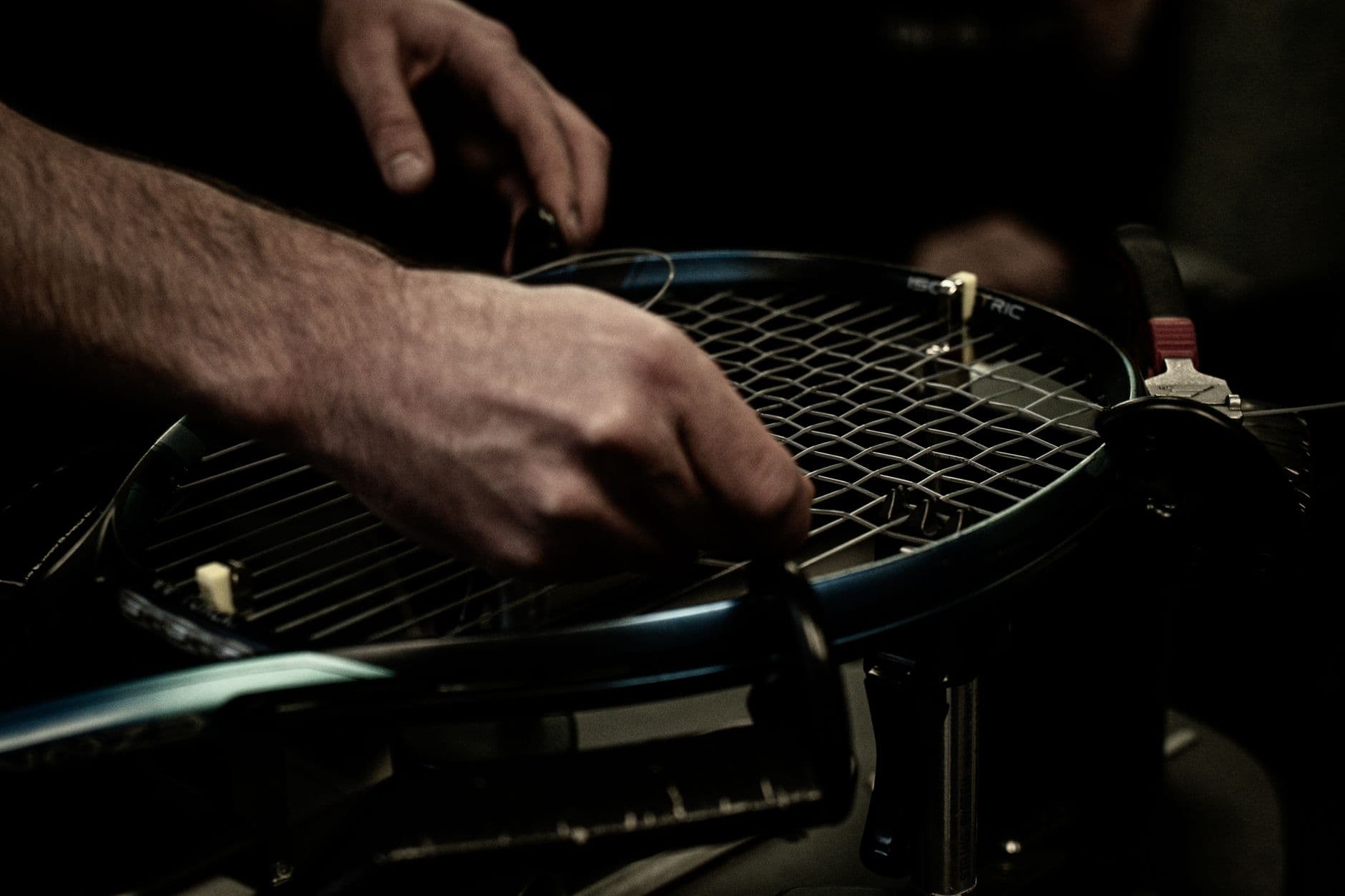
String your own racket if you restring often, play with more than one frame, or want to experiment with string and tension systematically. For a club player who restrings two or three times a year, paying a stringer is better value and the result will be more consistent. The learning curve is real and a badly strung bed plays worse than an old one.
Disclosure — we earn a commission on qualifying purchases made through links on this page, at no extra cost to you. It never changes which product we rank first. How this site is funded.
The three costs you are actually comparing
Most discussions of this question compare the price of a machine against the price of a restring and stop there. That misses two of the three costs, and the two it misses are the ones that decide the answer for most people.
1. The string itself
This cost is identical either way, and it is smaller than people expect. At Tennis Warehouse's listed prices, a set runs from $4.76 for a synthetic gut up to around $24 for a premium multifilament. Whoever pulls the strings, you are buying the set.
2. The labor
This is what you are replacing with your own time. Labor is charged separately by whoever does the work and it varies by shop, so we are not going to quote a figure - what we will say is that it is typically a larger share of a restring than the string, which is why the question gets asked at all.
3. Your time and the learning curve
This is the cost people leave out. A first restring takes most people well over an hour and the result is usually poor. Getting to a consistent, confident job takes repetitions, and during those repetitions you are playing with string beds you have strung badly. That is a real cost paid in the quality of your tennis, not just in minutes.
When it is clearly worth it
Three situations make the case on their own, and they have more to do with volume and curiosity than with money.
- You break strings. If a set lasts you under two weeks, you are restringing twenty or more times a year. At that volume the labor saving is substantial and the repetitions needed to get good arrive naturally.
- You play more than one frame. Matched rackets need matched string beds, and a stringer working to the nearest pound across two or three visits will not give you that as reliably as doing them yourself in one session.
- You want to experiment. Trying three tensions or a hybrid setup is expensive and slow when each attempt is a trip to a shop. Doing it yourself turns tuning from a project into an afternoon.
If you break strings, our best tennis strings page covers the polyester options that survive you, and how often to restring a tennis racket sets out the schedule rules.
When to pay someone
For most club players, paying a stringer is the better answer, and it is worth being direct about why rather than treating it as the lazy option.
If you restring two or three times a year, the labor you would save in a year is small, and you will never do enough repetitions to get consistent. Inconsistency is the real problem: the whole point of choosing a tension is that the number means something, and a bed strung with uneven tension across the mains does not deliver the tension you selected.
There is also a specific technical risk worth knowing about. Clamping and pulling strings puts significant load on the frame, and a frame that is not supported correctly in the mounting system can be distorted. A bad restring can cost you the racket, not just the set of string.
What to know before you commit
Three things that are not obvious from the outside, and that we can state without quoting equipment prices we have not verified.
- 01Tension loss starts immediately. Every string bed begins losing tension from the moment it comes off the machine, and polyester loses a substantial fraction in the first hours of play. That is a property of the string, not of who strung it.
- 02String pattern dictates difficulty. An 18x20 frame has more strings to weave in less space than a 16x19. Dense patterns are slower and fiddlier, and a one-piece pattern with a shared hole is where most beginners get stuck.
- 03Grommets wear. The plastic grommet strip protects the string from the frame's edges. Restringing repeatedly wears it, and a worn grommet will cut a new set of strings prematurely - a detail a good stringer notices and an inexperienced self-stringer does not.
We do not stock stringing machines, and we are not going to recommend one we have not researched to the standard we apply to everything else on this site. What we can point you at is the string itself - the three sets below are where we would start, whoever pulls them.
How this guide was put together
We do not run a test lab and nothing here is written as though we did. This guide is built from the published specification sheets and retailer listings cited at the foot of the page, plus the physical reasoning that connects them. Where a figure is not published we say so rather than estimating it.
The picks below are drawn from our product registry, so every one carries a cited source and a verified listing. Our full selection criteria set out the method and the editorial policy covers corrections. No price is written into this page as a recommendation - the figure on each buy button is the live one.
Now pick yours
The specs above are only useful once they resolve into something you can buy. These are the products that match what this page has just explained.
Our picks
| # | Product | Best for | Score | Price |
|---|---|---|---|---|
| 1 | 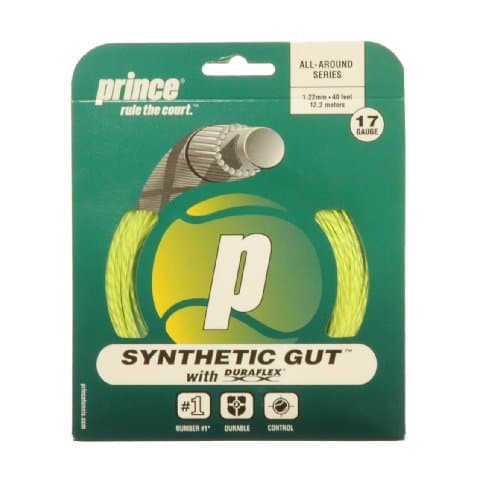 Prince Synthetic Gut DuraflexTop pick to practice with | Learning on | 8.04 criteria | |
| 2 | 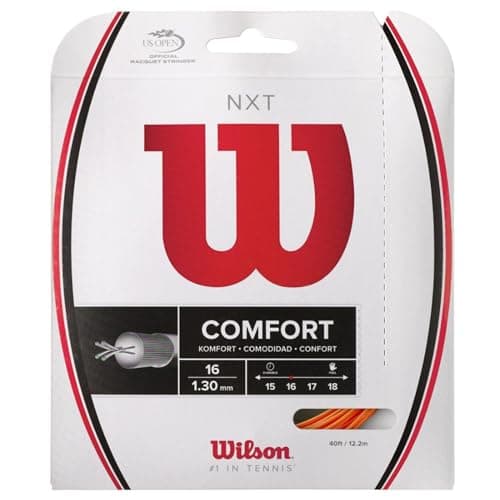 Wilson NXTBest for most players | The string most club players should be in | 8.74 criteria | |
| 3 | 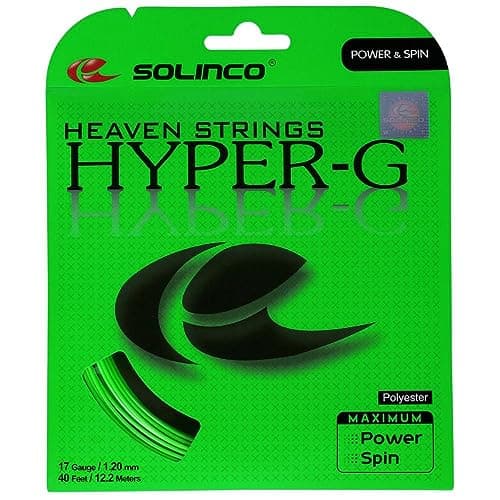 Solinco Hyper-GBest for high volume | String breakers, who are the ones who should self-string | 8.54 criteria |
01Prince Synthetic Gut Duraflex
Top pick to practice withBest for: Learning on
Tennis Warehouse give this their all-around value award and list it at $4.76 a set in 16 and 17 gauge. At that price you can afford to string badly a few times, which is exactly what learning requires.
It is also the easiest string to work with. Synthetic gut is nylon with a wear-resistant coating - it is forgiving to weave, it does not kink the way a stiff poly does, and it does not fray under the clamps the way a soft multifilament can.
What it will not do is anything special. It is less comfortable than a multifilament and less controlled than a poly, and it will not reward a careful job with a noticeable improvement. That is fine for the first ten rackets.
Our score
- Performance
- 7.0
- Comfort
- 8.0
- Durability
- 7.5
- Value
- 10.0
- Overall
- 8.0
Verified specs
- Type
- Synthetic gut
- Gauges
- 16, 17
- TW award
- All-Around Value
- Listed price
- $4.76 per set
Specs as published by Tennis Warehouse, checked September 2026.
Buy if
- You are learning to string
- You want the lowest cost per set
- You want a forgiving string to weave
Pass if
- Your elbow is the reason you are reading this
- You want a specific playing characteristic
- You break strings quickly
02Wilson NXT
Best for most playersBest for: The string most club players should be in
NXT is Tennis Warehouse's comfort winner in the string category, listed at $23.95 a set in 16 and 17 gauge. Over a thousand ultra-flexible fibers bonded with polyurethane, so the bed stretches further under load and returns the ball with less shock.
It is the right default if a set currently lasts you a month or more, because at that rate you are paying nothing for the durability a polyester would give you and giving up real comfort and free power for it.
It is the fussiest of the three to string by hand. A multifilament frays if the clamps bite it, and a frayed string has lost part of its stretch before you have hit a ball. If your technique is not reliable yet, this is the set to pay someone to pull.
Our score
- Performance
- 8.5
- Comfort
- 10.0
- Durability
- 7.0
- Value
- 7.5
- Overall
- 8.7
Verified specs
- Type
- Multifilament
- Gauges
- 16, 17
- TW award
- Comfort
- Construction
- 1,000+ fibers bonded with polyurethane
- Listed price
- $23.95 per set
Specs as published by Tennis Warehouse, checked September 2026.
Buy if
- A set lasts you a month or more
- Comfort matters more than durability
- You want one string that works at many tensions
Pass if
- You break strings inside two weeks
- You are on your first few restrings
- You want maximum control
03Solinco Hyper-G
Best for high volumeBest for: String breakers, who are the ones who should self-string
Hyper-G is Tennis Warehouse's control polyester, listed at $13.99 a set, and it carries the widest gauge range of anything we list - 15L down to 20. If you break strings often enough to be considering a machine, this is the category you are in.
Polyester is a monofilament, so it holds its shape under load rather than stretching. That produces the lower launch angle and the extra control, and it is also what lets the mains slide and snap back, which is where spin comes from.
It is stiff and it loses tension quickly, which is why it is the wrong answer for anyone with a history of arm trouble. String it several pounds below where you would set a multifilament - an advantage of doing your own, since you can adjust freely between sessions.
Our score
- Performance
- 9.0
- Comfort
- 6.5
- Durability
- 9.0
- Value
- 9.0
- Overall
- 8.5
Verified specs
- Type
- Polyester
- Gauges
- 15L to 20
- TW award
- Control
- Listed price
- $13.99 per set
Specs as published by Tennis Warehouse, checked September 2026.
Buy if
- You break a set inside two weeks
- You want control and a lower launch angle
- You want to experiment with gauge
Pass if
- You have had tennis elbow
- Your sets already last a month
- You restring rarely
Common questions
Is it worth stringing your own tennis racket?
It is worth it if you restring often, play with matched frames, or want to experiment with tension and string systematically. For a club player restringing two or three times a year, paying a stringer costs little and gives a more consistent result.
How hard is it to learn to string a tennis racket?
Harder than it looks. A first attempt takes most people well over an hour and the result is usually uneven, and getting to a confident, consistent job takes repetitions. During those repetitions you are playing with beds you strung badly.
Can a badly strung racket be worse than an old one?
Yes. Uneven tension across the mains means the bed does not deliver the tension you selected, and a frame mounted incorrectly in a machine can be distorted under load. A bad restring can cost you the racket, not just the string.
How much does a restring cost?
The string itself runs from about $4.76 a set for synthetic gut to around $24 for a premium multifilament, going by Tennis Warehouse's listed prices. Labor is charged separately by whoever does the work and varies by shop, so we do not quote a total.
Which string is easiest to learn on?
A synthetic gut. It is forgiving to weave, it does not kink the way a stiff polyester does, and it does not fray under the clamps the way a soft multifilament can - and at under five dollars a set, a wasted one costs almost nothing.
How many rackets a year make a stringing machine worthwhile?
There is no universal number because labor rates vary by shop, so we will not invent one. The honest test is different: if you are restringing often enough to get good at it, you are restringing often enough for it to pay.
Read next
Sources
Every source above was retrieved while writing this page. Specifications are quoted from the listing or manufacturer page cited, not from memory.