Buying guide
Best pickleball balls in 2026
Nobody chooses a ball for fun - you choose one because the last batch cracked, or flew, or died in the wind. The useful ranking is not by brand but by where you play, how cold it gets and how many games you need out of a pack.
By Janet H.Updated
The short answer
The Franklin X-40 Outdoor is the best pickleball ball for most players: 40 drilled holes, a seamless one-piece shell, USA Pickleball approval and roughly 20 to 30 games of life in Pickleheads' use. Play indoors and buy the Franklin X-26 instead - 26 holes, not 40. Play in the cold and buy the Selkirk Pro S1, which carries a one-year no-crack warranty.
Disclosure — we earn a commission on qualifying purchases made through links on this page, at no extra cost to you. It never changes which product we rank first. How this site is funded.
Our picks
| # | Product | Best for | Score | Price |
|---|---|---|---|---|
| 1 | 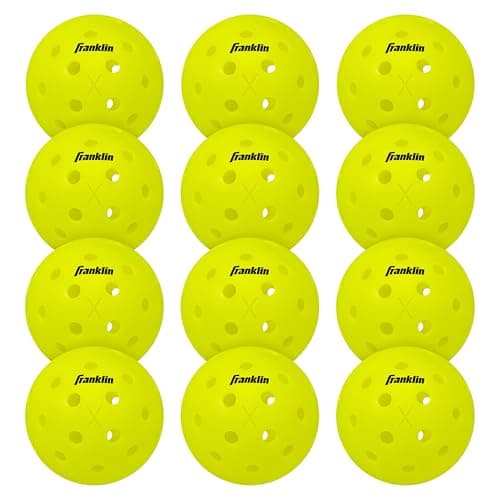 Franklin X-40 OutdoorTop pick | Most outdoor play, any level | 9.04 criteria | $29.04 · View on Amazon Price as of October 22, 2026 · was $39.99, 27% off |
| 2 | 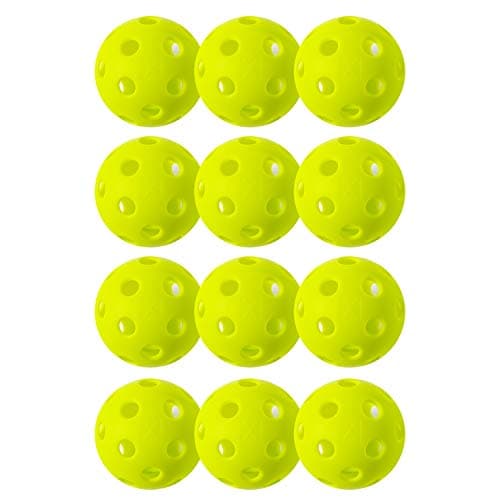 Franklin X-26 IndoorBest indoor ball | Indoor courts and gym floors | 8.84 criteria | $21.99 · View on Amazon Price as of October 22, 2026 · was $34.99, 37% off |
| 3 | 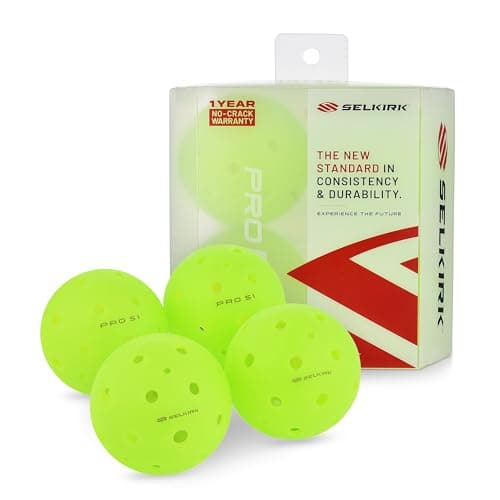 Selkirk Pro S1Most durable | Cold weather and long-life packs | 8.74 criteria | |
| 4 | 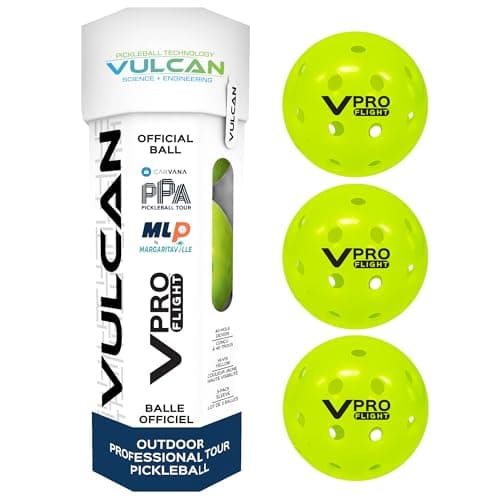 Vulcan VPRO FlightBest speed and spin balance | Fast outdoor play with spin | 8.44 criteria | |
| 5 | 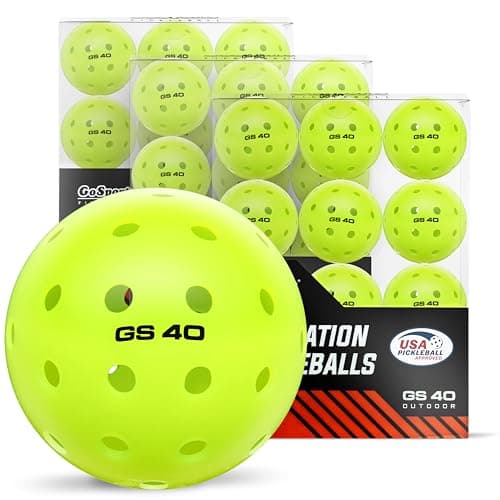 GoSports GS40Best value | Big packs, drills and casual outdoor games | 8.04 criteria |
The picks in detail
01Franklin X-40 Outdoor
Top pickBest for: Most outdoor play, any level
This is the ball the rest of the category gets measured against, and the measurements are the reason. Pickleball Union weighed it at 0.92 oz against a published 0.92 oz - a ball that matches its own spec sheet, which is not universal in this category - at 2.9 in across, with 40 precision-drilled holes and a one-piece, seamless, rotationally molded shell. It is USA Pickleball approved and they watched it pass the USAP bounce test.
Seamless construction is the single spec worth paying for in an outdoor ball. A two-piece ball is glued along an equator, and that glue line is where a cold ball splits. The X-40 has no seam to split, and Pickleball Union reported insignificant wear and no cracks after a month of use - with the interesting note that the abrasive surface wear that showed up after about four hours actually added to its spin rather than taking anything away.
The honest cost is pace. Pickleheads rank it second overall rather than first specifically because it is slower than the fastest balls in the category, and an advanced player who wants the ball to come off the paddle quickly may find it limiting. They also note it is the wrong ball below about 40 degrees, where the Selkirk is the better call. If you play hard, fast, flat pickleball with players who hit through the ball, read the Vulcan entry below before you commit.
Our score
- Performance
- 9.0
- Comfort
- 9.0
- Durability
- 9.0
- Value
- 9.0
- Overall
- 9.0
Verified specs
- Holes
- 40, precision drilled
- Diameter
- 2.9 in
- Weight
- 0.92 oz published, 0.92 oz as tested
- Material
- Polyethylene
- Construction
- One-piece, seamless, rotationally molded
- USA Pickleball approved
- Yes
- Surface
- Outdoor
Specs as published by Pickleball Union, checked September 2026.
Buy if
- You play outdoors and want one ball you never think about again
- You play in leagues or tournaments that specify a USAP-approved ball
- You buy in bulk and care about games per pack
Pass if
- You play indoors on a gym floor
- You play regularly in the cold
- You want the fastest ball available
Price as of October 22, 2026 · was $39.99, 27% off
02Franklin X-26 Indoor
Best indoor ballBest for: Indoor courts and gym floors
If you play on a wood or sport-court floor, this - not the X-40 - is the ball you want, and the difference is printed on the box. The X-26 has 26 precision-molded, beveled holes rather than 40 drilled ones, which is the regulation convention for indoor balls: fewer, larger holes, because indoors there is no wind to punch through and a lighter, softer flight is what keeps a rally alive on a fast floor.
Pickleball Union gave it the same five out of five as the X-40 and measured it at 2.9 in and 0.90 oz against a published 0.92 oz, in polyethylene like its outdoor sibling. They rated its spin, control and pop as excellent with particularly good serve and drive speeds, and singled out the smooth beveled holes - a detail that matters more than it sounds, because a ball with rough drilled holes chews up an indoor floor and your paddle face with it.
Two real costs. It is a two-piece, seamed ball, so it has the glue line the X-40 does not, and a seam is where an indoor ball eventually goes. And it takes adjusting to: Pickleball Union's players needed about five minutes to settle into its feel, bounce and pop, and noted it runs slightly lighter than some rival indoor balls. Taking it outside is the mistake to avoid - 26 holes in any wind at all is a ball that will not go where you aimed it.
Our score
- Performance
- 9.0
- Comfort
- 9.0
- Durability
- 8.5
- Value
- 9.0
- Overall
- 8.8
Verified specs
- Holes
- 26, precision molded and beveled
- Diameter
- 2.9 in
- Weight
- 0.92 oz published, 0.90 oz as tested
- Material
- Polyethylene
- Construction
- Two-piece, seamed
- USA Pickleball approved
- Yes
- Surface
- Indoor
Specs as published by Pickleball Union, checked September 2026.
Buy if
- You play in a gym, a rec center or on an indoor sport court
- You want the indoor ball with the most measured data behind it
- You already like the X-40 and want its indoor equivalent
Pass if
- You play outdoors at all regularly
- You want a seamless shell
- You want maximum durability over feel
Price as of October 22, 2026 · was $34.99, 37% off
03Selkirk Pro S1
Most durableBest for: Cold weather and long-life packs
This is the ball for anybody who plays through a real winter. Pickleheads give it the highest durability score of the five balls they rank and specifically note it performs in cold play below 40 degrees, which is the condition that cracks everything else in this category. Selkirk backs that with a one-year no-crack warranty - the only stated warranty on this page, and a company putting its own money behind the claim rather than a reviewer's impression.
It is also not a slow, dead, durability-first ball, which is the usual trade. Pickleheads describe it as faster and bouncier than the Franklin X-40, so a group that has outgrown the X-40's pace can move here without giving up ball life. In 100-packs it is the best value per ball they list, which is the arithmetic that matters for a club or a group that opens a new sleeve every week.
Three honest costs. It carries less spin than the Vulcan or the Franklin, so if your game is built on a heavy topspin drive you will feel the shortfall. Pickleheads report it can warp - resting or rolling the ball may bring it back, but a ball that needs managing is a ball that needs managing. And it is poppy and fast for a genuine beginner, which is exactly the wrong characteristic while you are still learning where the kitchen line is.
Our score
- Performance
- 8.5
- Comfort
- 8.0
- Durability
- 9.5
- Value
- 9.0
- Overall
- 8.7
Verified specs
- Surface
- Outdoor
- Warranty
- One-year no-crack warranty
- Durability
- Highest durability score of the five balls Pickleheads scored
- Cold weather
- Rated by Pickleheads as performing in cold play below 40F
- Flight
- Faster and bouncier than the Franklin X-40
- Holes
- 38, per Selkirk's own retail listing
- Diameter and weight
- Not published by the source we used
Specs as published by Pickleheads, checked September 2026.
Buy if
- You play outdoors below about 40 degrees
- You want the longest ball life and a warranty behind it
- You buy in 100-packs for a group
Pass if
- You are brand new to the sport
- Your game depends on spin
- You want the ball used in your local league
04Vulcan VPRO Flight
Best speed and spin balanceBest for: Fast outdoor play with spin
This is the performance ball on the page. Pickleheads rate the second-generation VPRO Flight as the best balance of speed and spin in their set with a reliable bounce, and it is the official ball of Major League Pickleball - so if you want the ball a professional league chose for televised play, this is the one that is actually sold to the public.
The reason a spin-and-speed ball matters is what it does to a third shot. A ball that holds spin lets a drop land short and die; a ball that comes off the paddle quickly lets a drive get through a soft defense before the opponent resets. The VPRO Flight is the only ball here that Pickleheads credit with both at once, and that combination is why it is on a page where the top pick is a slower ball.
The honest cost is life expectancy, and it is a big one. Pickleheads got about 10 to 20 games out of these, against roughly 20 to 30 from the Franklin X-40 - call it half the ball life for the performance. They also flag it as too fast for beginners, and note the Life Time ball is faster still. If you are buying for a mixed-level group, buy the X-40 and keep a sleeve of these for the competitive games.
Our score
- Performance
- 9.5
- Comfort
- 8.0
- Durability
- 7.0
- Value
- 8.5
- Overall
- 8.4
Verified specs
- Surface
- Outdoor
- Tour status
- Official ball of Major League Pickleball
- Durability
- About 10-20 games in Pickleheads' use
- Flight
- Balance of speed and spin with a reliable bounce
- Diameter and weight
- Not published by the source we used
Specs as published by Pickleheads, checked September 2026.
Buy if
- You play competitive outdoor pickleball
- You want spin and pace from the same ball
- You do not mind replacing balls more often
Pass if
- You are a beginner or buying for beginners
- You want the most games per dollar
- You play indoors
05GoSports GS40
Best valueBest for: Big packs, drills and casual outdoor games
This is Pickleheads' budget pick and the cheapest ball here per ball in a large pack, and it earns the slot on more than price: they recorded no cracking at all in their testing, rate it fast and highly visible, and put it third overall in a ranking where the two balls above it cost meaningfully more per ball. For a basket of drill balls or a group that loses balls over the fence, this is the straightforward answer.
Visibility is the underrated spec on that list. A ball you can track against a dark fence line, a tree line or a blue court is a ball you hit cleanly, and it is the one property that matters identically to a beginner and an advanced player. Nothing else on this page was called out for it.
Two real costs, both about feel. Pickleheads describe it as hard and pingy off the paddle with limited spin shaping - so if you are learning to roll a drive or drop a ball short, this is the ball that will make that hardest. They also report it can go out of round after extended play, and that it plays too fast in cold weather or at elevation, where the Selkirk above is the better choice. A ball that is durable and out of round is still a ball you replace.
Our score
- Performance
- 7.5
- Comfort
- 6.5
- Durability
- 8.5
- Value
- 9.5
- Overall
- 8.0
Verified specs
- Surface
- Outdoor
- Durability
- No cracking observed in Pickleheads' testing
- Feel
- Hard and pingy off the paddle
- Visibility
- Rated highly visible by Pickleheads
- Diameter and weight
- Not published by the source we used
Specs as published by Pickleheads, checked September 2026.
Buy if
- You need a large quantity of balls for drills or open play
- You want the lowest cost per ball
- You lose balls more often than you wear them out
Pass if
- You want a soft, spin-friendly feel
- You play at altitude or in the cold
- You are working on touch shots
Indoor or outdoor is the only decision that really matters
Every other question about pickleball balls is secondary to this one, and the whole thing comes down to hole count. Pickleheads put the convention plainly: outdoor balls usually have 40 holes and indoor balls usually have 26. That is not branding. It is the one design variable that decides whether a ball behaves on the court you actually stand on.
An outdoor ball is harder, heavier-feeling and drilled with more, smaller holes so that wind has less to push against and the ball holds the line you hit it on. An indoor ball has fewer, larger holes and a softer shell, because indoors there is no wind to defeat and the priority is a ball that comes off a fast gym floor at a playable height instead of skidding away. Use an indoor ball outside on a breezy day and it will curve off your intended line within a few feet. Use an outdoor ball in a gym and it plays hard, loud and quick in a way that shortens every rally.
If you play both, buy both. It is the cheapest piece of equipment in the sport and the only one where using the wrong version actively teaches you the wrong shot. If you only ever play one, start with the 40-hole outdoor ball - it is where the great majority of recreational pickleball is played, and where the shoes we recommend are aimed too.
The four criteria we ranked on
Every ball here is scored on the same four axes this site uses for gear, so a score means the same thing on every page. These are our editorial judgments drawn from published specs and from the measured and reported figures in the sources cited below - they are not user ratings and we do not present them as our own test results.
- Performance - speed, spin and bounce consistency, which together decide whether the ball rewards the shot you were trying to play. The gap between the Vulcan and the GoSports on this axis is the largest on the page.
- Comfort - read here as feel off the paddle face. A hard, pingy ball transmits more through the handle and gives you less information about contact; a softer ball lets you shape a drop. Nothing about this axis is a medical claim.
- Durability - cracking resistance and games per ball, from the figures the sources report: roughly 20 to 30 games for the Franklin X-40, about 10 to 20 for the Vulcan, no cracking at all observed in GoSports' testing window, and the highest durability score in Pickleheads' set for the Selkirk.
- Value - cost per ball weighed against how long the ball lasts, not the sticker price of a three-pack. A cheap ball that goes out of round in a month is not the value pick, which is why the GoSports and the Selkirk both score high here for different reasons.
Visibility is the fifth property that matters and the one we could not score consistently, because only one ball in the set - the GoSports GS40 - was explicitly assessed for it by a source. Where it was called out, we said so in the pick.
The specs side by side
Read this across rather than down. The blank cells are real: two of these balls have measured diameter and weight figures published by a reviewer who weighed them, and three do not, and we are not going to borrow a number from a retailer listing and present it as a measurement.
| Ball | Surface | Holes | Diameter / weight | Construction | Reported life |
|---|---|---|---|---|---|
| Franklin X-40 Outdoor | Outdoor | 40, drilled | 2.9 in / 0.92 oz measured | One-piece, seamless, roto-molded | About 20-30 games |
| Franklin X-26 Indoor | Indoor | 26, molded and beveled | 2.9 in / 0.90 oz measured | Two-piece, seamed | Barely noticeable wear over four weeks |
| Selkirk Pro S1 | Outdoor | 38, per Selkirk's listing | Not published by our source | Not published by our source | Highest durability score in the set; 1-year no-crack warranty |
| Vulcan VPRO Flight (Gen 2) | Outdoor | Not published by our source | Not published by our source | Not published by our source | About 10-20 games |
| GoSports GS40 | Outdoor | Not published by our source | Not published by our source | Not published by our source | No cracking observed in testing |
Two things fall out of that table. The first is how little hard data exists in this category: a $2 ball does not get the lab treatment a $200 paddle does, so most of what you will read about pickleball balls online is impression rather than measurement - which is why the two balls somebody actually weighed are the two we rank first and second. The second is that construction, not brand, predicts cold-weather cracking. The seamless ball is the one with no glue line to split.
Why balls crack, and what you can do about it
A pickleball is a thin plastic shell with holes drilled through it, hit at speed by a rigid composite face. It fails in two ways and they are not the same failure, so it is worth knowing which one you are seeing before you blame the ball.
- 01It cracks. A clean split, usually through or between holes, usually in the cold. Plastic stiffens as the temperature drops, a stiffer shell flexes less on impact, and the energy goes into a crack instead. This is the failure a seamless shell and a cold-rated ball are designed to resist, and it is why the Selkirk's warranty exists at all.
- 02It goes soft or out of round. No visible damage, but the ball sits lower, dies off the paddle and curves oddly. The shell has fatigued and lost its shape. Pickleheads flag this specifically for the GoSports GS40 after extended play, and it is the failure mode that ends most balls that do not crack first.
Three habits make a real difference. Do not leave balls in a car through a cold night and then play with them straight out of the trunk - let them come up to air temperature first, because a cold ball is a brittle ball. Retire a ball the moment it loses its round rather than when it splits, since an out-of-round ball teaches your hands the wrong feedback about your own contact. And keep your outdoor and indoor balls in separate bags, because the only way to end up playing a 26-hole ball in the wind is to not know which sleeve you grabbed.
Two famous balls we did not pick, and why
Transparency on omissions is more useful than a longer list. Two balls you will see everywhere are missing from the ranking above, and in both cases the reason is the same: we could not source a verdict we would stand behind.
The ONIX Dura Fast 40 is the most recognizable outdoor ball in the sport and is mentioned on the Pickleheads guide we used - but that guide does not review or rank it, so we have no sourced assessment of its current generation's speed, spin or durability to put next to the five balls above. Writing one from reputation would be exactly the fabrication this site does not do. If your local league specifies it, play it; it is a legitimate ball with a long history.
The Life Time Pro 48 is Pickleheads' number-one ball overall - they report it is the fastest ball they reviewed, has a consistent bounce, lasts about 20 to 25 games and is the official PPA Tour ball. It is left off this ranking for one specific reason: the retail listings for it describe a 48-hole, two-piece ball, and 48 holes sits outside the 26-to-40-hole range the same Pickleheads guide publishes as the regulation specification. We are not going to rank a ball first on a page whose opening criterion is that the ball is legal for the play you are buying it for, without being able to reconcile those two facts. If your club or tour supplies it, Pickleheads' verdict is worth knowing, with the caveats they attach: too fast for beginners, less spin because it leaves the paddle quickly, and it bounces high and hangs in the air.
How to narrow it to one
Work in this order and you will land on a single ball without reading another page.
- 01Play indoors on a gym or sport-court floor? Buy the Franklin X-26 Indoor and stop here. It is a 26-hole ball and nothing on this page substitutes for it.
- 02Play outdoors and want one ball to stop thinking about? Buy the Franklin X-40 Outdoor. It is the league default, it is seamless, and it is the ball with real measurements behind it.
- 03Play outdoors in genuinely cold weather? Buy the Selkirk Pro S1 for the cold rating and the no-crack warranty, and accept a little less spin.
- 04Playing competitively and want the ball to move? Buy the Vulcan VPRO Flight and budget for replacing it twice as often.
- 05Filling a drill basket or feeding a big open-play group? Buy the GoSports GS40 in the biggest pack you can find, and retire them when they go out of round rather than when they crack.
Two things to sort out while you are here, because a ball is the cheapest part of the kit and rarely the real problem. If your drives are flying long, the ball is probably innocent and paddle weight is the variable to look at. And if you came to pickleball from tennis and the ball still feels alien, tennis vs pickleball covers what actually changes between the two.
How these picks were made
Racket & Rally does not run a test lab. Nothing on this page is written as though we had played with, hit or measured anything ourselves, because we have not. What we do is read the published specifications, the independent measurements and the retailer listings cited at the foot of the page, set them against each other, and say which differences change something you will actually notice on court.
Every product here was confirmed on sale when its registry entry was built, and every claim traces to one of the sources listed at the bottom. Our full selection criteria set out the method, and the editorial policy covers corrections and how often pages are revisited. Where a brand or a reviewer does not publish a figure, we say that rather than filling the gap.
Common questions
What is the difference between indoor and outdoor pickleballs?
Hole count and shell hardness. Outdoor balls usually have 40 smaller holes and a harder shell so wind has less to push against; indoor balls usually have 26 larger holes and a softer shell, because indoors there is no wind and the priority is a playable bounce off a fast floor. Using the wrong one is the most common equipment mistake in the sport.
How many holes does a pickleball have?
Between 26 and 40, and that range is in the regulation specification. The convention is 40 for outdoor balls and 26 for indoor ones. The Franklin X-40 has 40 precision-drilled holes; the Franklin X-26 has 26 precision-molded, beveled ones.
How long does a pickleball last?
It depends more on the ball than on you. Pickleheads got roughly 20 to 30 games out of the Franklin X-40 and about 10 to 20 from the Vulcan VPRO Flight, saw no cracking at all from the GoSports GS40 in their testing window, and gave the Selkirk Pro S1 the highest durability score in their set. Cold weather shortens all of those figures.
Why do pickleballs crack in cold weather?
Plastic stiffens as it gets colder, a stiffer shell flexes less on impact, and the impact energy goes into a crack instead of into deformation. A seamless one-piece ball has no glue line to split, which is why construction predicts cold-weather cracking better than brand does. Letting balls reach air temperature before you play with them genuinely helps.
Are all pickleballs USA Pickleball approved?
No. Approval is a separate process and only matters for sanctioned play, though it is a reasonable proxy for consistency either way. Both Franklin balls on this page are USA Pickleball approved. For anything else, check the USA Pickleball Approved Ball List before a tournament rather than trusting packaging.
Does the ball matter as much as the paddle?
Not as much, but more than most players assume - a dead or out-of-round ball will make a good paddle feel wrong, and it is the cheaper variable to fix first. If you are chasing a feel problem, replace the ball before you replace the paddle. Our paddle roundups cover the other half of the question.
Can I use a pickleball for other paddle sports?
No. A padel ball is a pressurized ball closer to a tennis ball, and a platform tennis ball is different again - a perforated plastic pickleball behaves like none of them. Padel racket vs pickleball paddle covers how far the crossover goes on the equipment side.
Read next
Sources
- 01Pickleball Union - Franklin X-40 and X-26 review (measured specs)
- 02Pickleheads - best pickleball balls
- 03Pickleheads - pickleball shoes (criteria reference)
Every source above was retrieved while writing this page. Specifications are quoted from the listing or manufacturer page cited, not from memory.