Buying guide
Best pickleball paddles for women in 2026
There is no women's pickleball paddle in any rulebook, and the brands that sell one are usually selling a color. What does vary is grip, handle length and weight - so those are the three specs this page ranks on.
By Janet H.Updated
The short answer
The Engage Pursuit MX 6.0 is the best pickleball paddle for most women: its published handle of 4.0 to 4.125 inches is the smallest we track, and a grip that is too large is the most common fit problem for a smaller hand. If you want the lightest paddle instead, take the Paddletek Bantam EX-L at a published 7.2 to 7.8 oz.
Disclosure — we earn a commission on qualifying purchases made through links on this page, at no extra cost to you. It never changes which product we rank first. How this site is funded.
Our picks
| # | Product | Best for | Score | Price |
|---|---|---|---|---|
| 1 |  Engage Pursuit MX 6.0Top pick | Smaller hands | 8.55 criteria | |
| 2 | 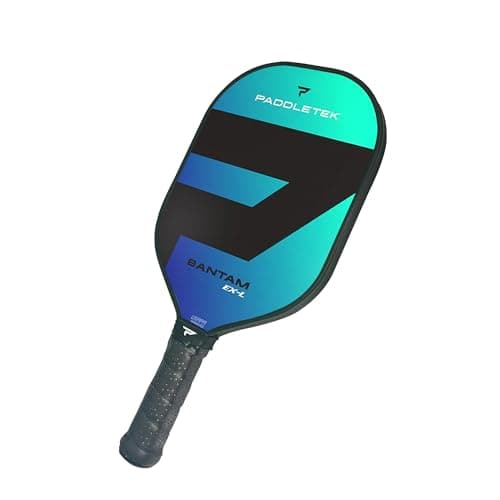 Paddletek Bantam EX-LLightest | The lightest paddle available | 8.35 criteria | |
| 3 |  Ronbus Quanta ProBest for two hands | A two-handed backhand | 8.65 criteria | |
| 4 | Selkirk SLK Evo Hybrid MaxMost forgiving | A one-handed player who wants pop | 8.25 criteria |
The picks in detail
01Engage Pursuit MX 6.0
Top pickBest for: Smaller hands
The published handle figure here - 4.0 to 4.125 inches - is the smallest in our registry, and grip is the fit variable that actually separates paddles for a smaller hand. A grip that is too big forces you to squeeze harder to stop the paddle turning in your hand, and squeezing harder is how forearms get sore and how soft hands at the kitchen line stop being soft.
It is not a compromise paddle in any other respect. PickleballUS name it their pick for beginners chasing spin, built on an Engage ControlPro core with a textured fiberglass face, and that texture is the reason: a gritty face holds the ball long enough to actually impart topspin on a dink, which is the shot that wins points once you are past simply returning the ball.
Two honest costs. Fiberglass is poppier and less damped than raw carbon, so it is livelier in hand than a control paddle - good for drives, slightly harder to reset with. And a short handle means no two-handed backhand, a genuine loss if you came from tennis with a two-handed stroke; the Ronbus below is the pick in that case. Engage publish no core thickness figure we can cite.
Our score
- Control
- 8.5
- Power
- 7.5
- Spin
- 9.0
- Sweet spot
- 8.0
- Value
- 8.5
- Overall
- 8.5
Verified specs
- PickleballUS award
- Best for Beginners Chasing Spin
- Weight
- 7.6-8.1 oz
- Core
- Engage ControlPro
- Face
- Fiberglass with skin texture
- Handle
- 4.0-4.125 in
Specs as published by PickleballUS, checked September 2026.
Buy if
- Your hand is small and paddles tend to turn in it
- You want spin from a textured face
- You play one-handed on both wings
Pass if
- You want a two-handed backhand
- You want a damped, control-first face
- You want a published core thickness
02Paddletek Bantam EX-L
LightestBest for: The lightest paddle available
At a published 7.2 to 7.8 oz this is the lightest paddle we track, and weight is the second fit variable that matters more than anything gendered. A lighter head is quicker to the ball at the net and less tiring over three hours of round-robin, and it asks less of the forearm on every stop and start.
It is built as a control paddle rather than a light power paddle, which is the right combination: PickleballUS name it their control-first beginner pick, on a Paddletek polymer core with a graphite face. Light and soft is a coherent paddle; light and poppy is a paddle that sends everything long.
The cost is power, stated plainly. If you drive the ball and like to finish points from mid-court, you will find yourself swinging harder for the same depth, and swinging harder is the opposite of why you bought a light paddle. Paddletek also publish the core as a material rather than a thickness, and no handle length - so two of the three specs this page ranks on are simply unavailable for it.
Our score
- Control
- 9.0
- Power
- 6.5
- Spin
- 7.0
- Sweet spot
- 8.5
- Value
- 8.0
- Overall
- 8.3
Verified specs
- PickleballUS award
- Best for Control-First Beginners
- Weight
- 7.2-7.8 oz
- Core
- Paddletek polymer
- Face
- Graphite
- Shape
- Standard
Specs as published by PickleballUS, checked September 2026.
Buy if
- You want the lightest paddle on the market
- Your game is dinks, resets and placement
- You play long sessions and fatigue is a factor
Pass if
- You are a power player
- You need a published handle length before buying
- You want a spin-oriented face
03Ronbus Quanta Pro
Best for two handsBest for: A two-handed backhand
7.9 oz with a 5.5-inch handle, which is the combination for anybody who arrived from tennis with a two-handed backhand and does not want to give it up. A 5.5-inch grip has room for a second hand, and a two-handed backhand is both a stronger shot for a smaller frame and a kinder one for a single forearm.
The spec sheet is strong for the money: a 16 mm core for shock absorption and a NanoBond raw carbon face for grit, at a price Pickleheads list as $99.99 with their Best Under $100 award. Of the four paddles here it also has the fewest gaps in its published figures.
The costs are weight and grit life. 7.9 oz is heavier than the Paddletek, and a 5.5-inch handle on a standard-length paddle means a slightly shorter face, so the sweet spot sits marginally lower than on a short-handled paddle. Raw carbon faces also lose surface texture with use - a property of the material, not a fault.
Our score
- Control
- 8.5
- Power
- 7.5
- Spin
- 8.5
- Sweet spot
- 8.0
- Value
- 9.5
- Overall
- 8.6
Verified specs
- Pickleheads award
- Best Under $100
- Weight
- 7.9 oz
- Core
- 16 mm
- Face
- NanoBond raw carbon
- Handle
- 5.5 in
- Price
- $99.99 as listed by Pickleheads
Specs as published by Pickleheads, checked September 2026.
Buy if
- You hit, or want to hit, a two-handed backhand
- You want a 16 mm core and raw carbon at a sub-$100 listed price
- You want the best-documented paddle on this page
Pass if
- You play strictly one-handed and want a small grip
- You want the lightest option
- You want a face whose grit does not change
04Selkirk SLK Evo Hybrid Max
Most forgivingBest for: A one-handed player who wants pop
A 4.25-inch handle and a published 7.8 to 8.2 oz on a 16 mm core, with a hybrid fiberglass-and-carbon face. The short handle is deliberate - it buys a longer hitting surface, which is why this is the most forgiving paddle on the page - and it suits a player who has never wanted a second hand on the paddle.
The hybrid face is the other reason to pick it. Fiberglass adds pop and carbon adds control, and blending them gives a paddle that puts a drive away without feeling like a plank on a reset. PickleballUS name it their pick for brand reliability, which is a real consideration in a category where paddle brands appear and vanish inside a season.
The honest costs: it is the heaviest paddle here at the top of its range, and the 4.25-inch handle rules out a two-handed backhand entirely. A hybrid face also spins less than a raw carbon one, so if topspin dinks are the shot you are building your game around, the Engage or the Ronbus will serve you better.
Our score
- Control
- 8.0
- Power
- 8.5
- Spin
- 7.5
- Sweet spot
- 9.0
- Value
- 8.0
- Overall
- 8.2
Verified specs
- PickleballUS award
- Best for Brand Reliability
- Weight
- 7.8-8.2 oz
- Core
- 16 mm
- Face
- Hybrid fiberglass / carbon
- Handle
- 4.25 in
Specs as published by PickleballUS, checked September 2026.
Buy if
- You play one-handed and want the largest hitting surface
- You want some pop rather than pure control
- You want an established brand
Pass if
- You want a two-handed backhand
- Weight is your limiting factor
- Maximum spin is the priority
What actually differs, and what does not
There is no women's category in pickleball equipment. Paddles are not sized or certified by gender, and a paddle marketed as a women's paddle is almost always a standard paddle in a different colorway, sometimes at the same price and sometimes not. That is worth knowing before you shop, because it means the useful search is not for a women's paddle - it is for the specs that differ between hands and bodies.
Three of those specs do real work. Grip circumference, because a handle that is too thick for your hand has to be gripped harder, and a hard grip costs you touch at the net and loads the forearm. Handle length, because a handle under about 5 inches has no room for a second hand, and a two-handed backhand is a genuinely stronger shot for a player with less reach and less arm mass. And weight, because every ounce is accelerated and stopped by your forearm hundreds of times a session.
Two things that do not matter: color, obviously, and shape, mostly. An elongated paddle buys reach at the cost of a smaller sweet spot, and that trade is about your game rather than your build. Face material changes spin and pop and nothing else. Our how to choose a pickleball paddle guide walks the whole decision in order.
The three specs side by side
| Paddle | Published handle | Published weight | Core | Face |
|---|---|---|---|---|
| Engage Pursuit MX 6.0 | 4.0-4.125 in | 7.6-8.1 oz | Engage ControlPro, no thickness published | Textured fiberglass |
| Paddletek Bantam EX-L | Not published | 7.2-7.8 oz | Paddletek polymer, no thickness published | Graphite |
| Ronbus Quanta Pro | 5.5 in | 7.9 oz | 16 mm | NanoBond raw carbon |
| Selkirk SLK Evo Hybrid Max | 4.25 in | 7.8-8.2 oz | 16 mm | Hybrid fiberglass / carbon |
The gap in that table is the point. Not one of these brands publishes grip circumference, the single most useful number for a smaller hand - they publish handle length instead, which tells you whether a second hand fits but not whether the first one does. Until that changes, the practical approach is to buy slightly small and build up with an overgrip.
One hand or two: the decision that sets the paddle
This is the fork in the road and it comes before weight, price or face material. If you hit a two-handed backhand - or came from tennis and would like to - you need a handle around 5.5 inches, which immediately rules out two of the four paddles above and most short-handled paddles on the market. If you are a committed one-hander, a shorter handle buys you a longer face and a bigger sweet spot, which is free forgiveness.
The case for two hands is not only that it is a stronger shot. It distributes the deceleration of a hard-driven ball across two arms, which is why it appears in our paddles for tennis elbow picks as well. For a player with less upper-body mass to brace with, that is a genuine mechanical advantage rather than a stylistic preference.
The case against is reach and simplicity. Two hands on the paddle shortens your effective reach at the kitchen line, where the game is often decided by a few inches, and it is one more thing to coordinate while you are learning. If you have never played a two-handed shot in any sport, start one-handed with the Engage or the Selkirk and revisit it later.
How to narrow it to one
- 01Decide on one hand or two. Two hands means the Ronbus Quanta Pro and its 5.5-inch handle. One hand means the other three.
- 02If paddles turn in your hand, take the Engage Pursuit MX 6.0 - the 4.0 to 4.125-inch handle is the smallest published figure here.
- 03If you fade in long sessions or your forearm aches afterwards, take the Paddletek Bantam EX-L for its 7.2 to 7.8 oz.
- 04If you want to put drives away and value a big sweet spot over spin, take the Selkirk SLK Evo Hybrid Max.
- 05Whichever you pick, add an overgrip before your second session. It is the cheapest fit adjustment in the sport and the only way to tune a grip that is slightly too small.
How these picks were made
Racket & Rally does not run a test lab. Nothing on this page is written as though we had played with or measured anything ourselves, because we have not. What we do is read the published specification sheets and the independent guides cited at the foot of the page, set them against each other, and say which differences change something you will actually notice on court.
Every paddle here was confirmed on sale when its registry entry was built, and every claim traces to one of the sources listed at the bottom. Our full selection criteria set out the method, and the editorial policy covers corrections and how often pages are revisited. Paddle brands publish weights as ranges rather than measurements, and several publish no core thickness or grip circumference at all - where a figure is missing, we say so rather than estimating it.
Common questions
Are there women's pickleball paddles?
Not as an equipment category. Paddles are not sized or certified by gender, and most paddles sold as women's paddles are standard paddles in a different colorway. The specs that genuinely differ between players are grip circumference, handle length and weight, which is what this page ranks on.
What paddle weight should a woman use?
The same question everybody should ask: light enough that you are not fighting it at the net, heavy enough that you are not swinging harder to get depth. The lightest paddle we track is 7.2 to 7.8 oz and the heaviest here is 8.2 oz. If you fatigue late in a session or have any forearm history, start at the lighter end.
How do I know my pickleball grip size?
Measure from the middle crease of your palm to the tip of your ring finger with a ruler; that figure in inches is a sensible starting circumference. If you are between sizes, buy the smaller and add an overgrip - adding material is easy and removing it is not.
Is a two-handed backhand worth it in pickleball?
It is a stronger shot and it shares the load across both arms, which helps if a single forearm is the limiting factor. It costs you a little reach at the kitchen line and needs a handle around 5.5 inches, so it is a decision to make before you buy rather than after.
Should a beginner buy a thick or thin core?
Thick, in almost every case. A 16 mm core deflects more on impact, which absorbs shock and makes resets easier; a thin core is poppier and less forgiving. Our paddle weight guide covers how core thickness and weight interact.
Do I need a different paddle if I come from tennis?
Not a different category, but a different pick within it. A tennis player benefits from a longer handle for a two-handed backhand and from a face that rewards a swing rather than absorbing it - a different emphasis from the grip-first logic on this page. Our paddles for tennis players roundup covers that case.
Read next
Sources
- 01PickleballUS - paddles for beginners
- 02Pickleheads - pickleball paddles guide
- 03Tennis Warehouse - best overgrips
Every source above was retrieved while writing this page. Specifications are quoted from the listing or manufacturer page cited, not from memory.