Buying guide
Best pickleball paddles for advanced players in 2026
Once you can reset a drive and dink with topspin, the paddle stops being a crutch and becomes a constraint. These four are the ones worth playing at 4.0 and up - and two of them cost a third of what the other two do.
By Janet H.Updated
The short answer
The Six Zero Coral is the best pickleball paddle for advanced players: a 16 mm core under a damped Diamond Tough carbon face, with a 5.5 or 5.75-inch handle and Pickleheads' Best Control award behind it. If you want reach and leverage instead of maximum touch, take the JOOLA Ben Johns Hyperion CFS 16.
Disclosure — we earn a commission on qualifying purchases made through links on this page, at no extra cost to you. It never changes which product we rank first. How this site is funded.
Our picks
| # | Product | Best for | Score | Price |
|---|---|---|---|---|
| 1 | 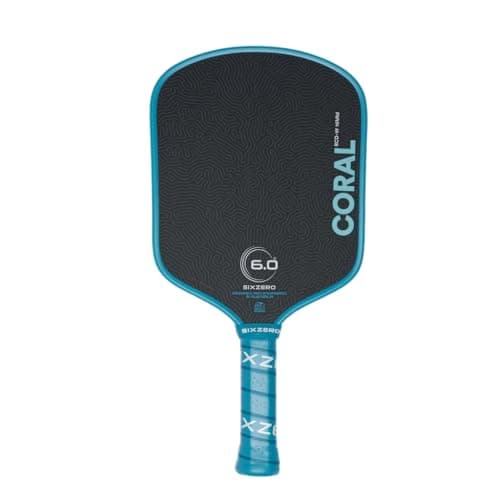 Six Zero CoralTop pick | Control at the kitchen line | 8.95 criteria | |
| 2 |  JOOLA Ben Johns Hyperion CFS 16Best elongated | Reach and leverage | 8.75 criteria | |
| 3 |  Vatic Pro V-SOL ProBest value | An advanced spec sheet at a mid-tier price | 8.65 criteria | |
| 4 | Ronbus Quanta ProLightest | Hand speed at the net | 8.55 criteria |
The picks in detail
01Six Zero Coral
Top pickBest for: Control at the kitchen line
Advanced pickleball is a soft game played at speed. The point is usually won by whoever can take a hard drive out of the air and drop it dead into the kitchen, and that is a damping problem rather than a power problem. Pickleheads give this paddle their Best Control award, and the construction is why: a thick 16 mm core under a Diamond Tough carbon face tuned to absorb rather than return.
The handle is the other reason it leads. Six Zero publish it in 5.5 and 5.75 inches, and at this level a two-handed backhand is close to standard - it is stronger, more stable against a ball driven at your body, and it takes load off a single forearm over a long tournament day. A 5.75-inch option is unusually generous and worth having.
The honest cost is price and put-away power. Pickleheads list it at $180, roughly double the two value picks below, and a damped face by definition gives back less on a drive than a poppy one - a banger will find it slow. At 8 to 8.3 oz it is also not the lightest option here. Buy it because resets decide your matches, not because it is the most expensive paddle on the page.
Our score
- Control
- 9.5
- Power
- 8.0
- Spin
- 8.5
- Sweet spot
- 9.0
- Value
- 7.0
- Overall
- 8.9
Verified specs
- Pickleheads award
- Best Control
- Weight
- 8-8.3 oz
- Core
- 16 mm
- Face
- Diamond Tough carbon
- Handle
- 5.5 / 5.75 in
- Price
- $180 as listed by Pickleheads
Specs as published by Pickleheads, checked September 2026.
Buy if
- Your matches are decided at the kitchen line
- You hit a two-handed backhand and want a long handle option
- You want maximum damping on resets
Pass if
- You win points by driving the ball
- Budget is a real constraint
- You want the lightest paddle available
02JOOLA Ben Johns Hyperion CFS 16
Best elongatedBest for: Reach and leverage
An elongated shape on a 16 mm core with a Carbon Friction face and a 5.5-inch handle, at a published 8.0 to 8.4 oz. Elongated is the shape advanced singles players and aggressive right-side doubles players converge on, because the extra length is reach at the stretch volley and leverage on the drive - the same physics that makes the tip of a longer lever travel faster for the same hand speed.
The Carbon Friction face is a genuine spin surface rather than a smooth one, and spin matters more as the level rises: a topspin dink that dips at the net forces an error from a 4.0 opponent who would simply block a flat one. PickleballUS position this as their overall pick for players moving up, which is the right description - it stops being too much paddle at about the level this page is written for.
Two costs, both inherent to the shape. An elongated paddle moves mass away from your hand, so swingweight is higher and the sweet spot is narrower and sits further up the face - you will feel off-center contact more than on a standard shape. And JOOLA publish no grip circumference figure, so handle length is the only fit number available.
Our score
- Control
- 8.5
- Power
- 9.0
- Spin
- 8.5
- Sweet spot
- 7.5
- Value
- 7.5
- Overall
- 8.7
Verified specs
- PickleballUS award
- Best Overall for beginners moving up
- Weight
- 8.0-8.4 oz
- Core
- 16 mm
- Face
- Carbon Friction
- Handle
- 5.5 in
- Shape
- Elongated
Specs as published by PickleballUS, checked September 2026.
Buy if
- You play singles or the right side in doubles
- You want reach at the stretch volley
- You generate spin and want a face that holds the ball
Pass if
- You want the largest possible sweet spot
- Hand speed at the net is your main weapon
- You find high-swingweight paddles tiring
03Vatic Pro V-SOL Pro
Best valueBest for: An advanced spec sheet at a mid-tier price
A T700 raw carbon face on a 16 mm core with a 5.3 to 5.6-inch handle, at a price Pickleheads list as $99.99 with their Best Budget award. Read that spec line again without the price: thick polymer core, raw carbon face, long handle. That is the same recipe as the two premium paddles above, which is the real story of this category in 2026.
T700 is a specific carbon fiber grade rather than a marketing word, and a raw - unpainted - carbon face generates spin by friction rather than by a sprayed grit layer that wears off in a month. For a 4.0 player who replaces paddles on a cycle, buying the spin surface at a third of the price is a defensible strategy rather than a compromise.
The honest costs are tolerance and documentation. Smaller brands publish less, and Vatic Pro publish no core material detail or grip circumference we can cite; a published weight range of 8 to 8.5 oz is also wide, so two paddles from the same run can feel different in hand. And raw carbon loses surface grit with use at any price point - that is the material, not the brand.
Our score
- Control
- 8.5
- Power
- 8.0
- Spin
- 9.0
- Sweet spot
- 8.0
- Value
- 9.5
- Overall
- 8.6
Verified specs
- Pickleheads award
- Best Budget
- Weight
- 8-8.5 oz
- Core
- 16 mm
- Face
- T700 raw carbon
- Handle
- 5.3-5.6 in
- Price
- $99.99 as listed by Pickleheads
Specs as published by Pickleheads, checked September 2026.
Buy if
- You want the advanced spec recipe without the premium price
- You replace paddles on a regular cycle
- Spin from a raw carbon face is the priority
Pass if
- You want tight weight tolerances
- You want a documented grip circumference
- You prefer a damped premium face for resets
04Ronbus Quanta Pro
LightestBest for: Hand speed at the net
7.9 oz is the lightest published weight among these four, and at 4.0 and above the fastest exchange in the game is the hands battle at the net - four players a couple of feet apart, trading volleys at chest height. Paddle speed wins those, and paddle speed is a function of mass. A 5.5-inch handle keeps the two-handed backhand available.
The 16 mm core and NanoBond raw carbon face put it in the same construction class as everything else on this page, and Pickleheads award it Best Under $100 at a listed $99.99. Of the four paddles here it also has the fewest unpublished specs - a small thing, but it means you are buying figures rather than adjectives.
The costs are power and grit life. A light paddle gives less free pace on a drive, so you have to supply it, and a player who finishes points from mid-court will feel that. Raw carbon faces lose texture over a season of regular play. And at 7.9 oz some advanced players will find it too light to stay stable against a hard-driven ball - if you get pushed around at the net, the Six Zero's extra ounce is doing something for you.
Our score
- Control
- 8.5
- Power
- 7.5
- Spin
- 8.5
- Sweet spot
- 8.0
- Value
- 9.5
- Overall
- 8.5
Verified specs
- Pickleheads award
- Best Under $100
- Weight
- 7.9 oz
- Core
- 16 mm
- Face
- NanoBond raw carbon
- Handle
- 5.5 in
- Price
- $99.99 as listed by Pickleheads
Specs as published by Pickleheads, checked September 2026.
Buy if
- You win hands battles and want the quickest paddle here
- You want a two-handed backhand and a 16 mm core at a sub-$100 listed price
- You value published specs over brand prestige
Pass if
- You get overpowered at the net and want more mass
- You finish points from mid-court with drives
- You want a damped face for resets
What changes at 4.0 and above
A beginner's paddle is doing work for them. A thick core and a wide sweet spot keep a mis-hit in play, a forgiving face turns a panicked swing into a returnable ball, and that is exactly right at 3.0. By 4.0 the paddle has stopped supplying forgiveness you need and started limiting shots you can play - and the limits show up in four specific places.
- The reset. Taking a hard drive out of the air and dropping it into the kitchen is a damping task: the paddle has to absorb pace rather than return it. A poppy face sends that ball long, and no amount of soft hands fixes a lively face.
- The topspin dink. Below 4.0 a flat dink is fine because nobody will attack it. Above it, they will - so you need a face with enough friction to make the ball dip, which is why raw carbon has taken over the top of the market.
- The hands battle. Four players a couple of feet apart at the net, trading volleys. This is a pure speed contest, decided by how quickly you get the face to the ball, which is a weight-and-balance question.
- The two-handed backhand. Not universal, but close to standard at the top levels, and it needs a handle of roughly 5.5 inches. A short-handled paddle quietly removes the option.
Notice what is not on that list: power. The sport's power ceiling is set by the ball and the court rather than by the paddle, and the players who win at 4.5 are not the ones hitting hardest. Every paddle on this page is a control-oriented build for that reason, including the elongated one. Our intermediate roundup is the page below this one on the same ladder.
The four side by side
Shape and handle are the two columns that decide the pick. Core thickness is effectively a constant at this level: all four are 16 mm, and that is not an accident.
| Paddle | Shape | Core | Handle | Published weight | Listed price |
|---|---|---|---|---|---|
| Six Zero Coral | Standard | 16 mm | 5.5 / 5.75 in | 8-8.3 oz | $180 (Pickleheads) |
| JOOLA Ben Johns Hyperion CFS 16 | Elongated | 16 mm | 5.5 in | 8.0-8.4 oz | Not published |
| Vatic Pro V-SOL Pro | Elongated | 16 mm | 5.3-5.6 in | 8-8.5 oz | $99.99 (Pickleheads) |
| Ronbus Quanta Pro | Standard | 16 mm | 5.5 in | 7.9 oz | $99.99 (Pickleheads) |
The interesting line in that table is the last column. Two paddles with the same core thickness, the same face material class and the same handle length, at $180 and $99.99 as listed. The premium pair buy you tighter tolerances, more published engineering and a damped face profile a budget brand will not tune for; they do not buy you a different construction. That gap has narrowed every year since raw carbon became standard, and anybody telling you a sub-$100 paddle cannot be an advanced paddle has not read a spec sheet recently.
Elongated or standard: pick this first
Shape is the only axis on this page where the two options are genuinely different paddles rather than different grades of the same one. An elongated paddle is longer and narrower within the same perimeter limit; a standard shape is shorter and wider.
Elongated gives you reach - the stretch volley you get to, the dig at your feet - and leverage, because the tip of a longer paddle travels faster for the same hand speed. That makes it the singles shape and the right-side doubles shape. The price is a narrower, higher sweet spot and more swingweight, so off-center contact punishes you and long sessions tire you faster.
Standard gives you the opposite: a wider, lower sweet spot, less swingweight, quicker hands. It is the left-side doubles shape and the shape for anybody whose game lives at the net. If you are not sure which you are, you are probably a standard-shape player - the elongated advantage is specific, and most players who buy it are buying reach they never use.
How to narrow it to one
- 01Pick your shape. Singles or right-side doubles with a drive game: elongated, so the JOOLA or the Vatic Pro. Net-focused doubles: standard, so the Six Zero or the Ronbus.
- 02Then pick your budget band. The two Pickleheads list at $99.99 give you the same core and face class as the premium pair; the premium pair give you tighter tolerances and a tuned damping profile.
- 03If your matches are decided by resets, take the Six Zero Coral and its damped face. It is the most complete paddle on this page.
- 04If you lose hands battles at the net, take the Ronbus Quanta Pro at 7.9 oz and get your paddle there first.
- 05Whichever you buy, check the handle against how you play. If you hit a two-handed backhand, 5.5 inches is the floor - and our paddles for tennis elbow page explains why that handle is worth having even if you do not.
How these picks were made
Racket & Rally does not run a test lab. Nothing on this page is written as though we had played with or measured anything ourselves, because we have not. What we do is read the published specification sheets and the independent guides cited at the foot of the page, set them against each other, and say which differences change something you will actually notice on court.
Every paddle here was confirmed on sale when its registry entry was built, and every claim traces to one of the sources listed at the bottom. Our full selection criteria set out the method, and the editorial policy covers corrections and how often pages are revisited. Paddle brands publish weights as ranges rather than measurements, and several publish no core thickness or grip circumference at all - where a figure is missing, we say so rather than estimating it.
Common questions
What makes a paddle an advanced paddle?
Not power. A thick 16 mm core for damping on resets, a raw carbon face with enough friction to generate topspin, and a handle long enough for a two-handed backhand. Every paddle on this page has all three, which is why they are here and why several beginner-marketed paddles are not.
Is a 16 mm core better than a 14 mm core for advanced play?
For the control-oriented game that wins at 4.0 and above, generally yes: a thicker core deflects more on impact and absorbs more pace, which is what a reset needs. A thinner core is poppier and gives more free power, which is the trade a driving player might choose. All four picks here are 16 mm.
Do I need to spend $200 on a paddle at 4.0?
No, and the table above is the evidence. Two of these four are listed at $99.99 by Pickleheads with the same 16 mm core and raw carbon face class as the premium pair. What more money buys is tighter manufacturing tolerances, more published engineering and a tuned damping profile - real things, but not a different category of paddle.
Elongated or standard shape for advanced players?
Elongated for reach and leverage, which suits singles and the right side in doubles; standard for a wider sweet spot and faster hands, which suits net-focused doubles. If you are unsure, standard is the safer default - the elongated advantage is specific and often unused.
How long does a raw carbon paddle face last?
The face does not fail, but its grit fades with use, and that is a property of raw carbon rather than a defect in any particular paddle. Players who rely on spin tend to replace paddles on a cycle rather than when something breaks, which is part of the argument for the two sub-$100 picks here.
Should I add lead tape to my paddle?
It is the standard way to tune a paddle you already own: tape at the top of the face raises swingweight and power, tape at the throat adds stability without much swingweight. It is also the honest answer to published weight ranges, since you can measure what you actually have and adjust from there.
Read next
Sources
Every source above was retrieved while writing this page. Specifications are quoted from the listing or manufacturer page cited, not from memory.