Comparison
Tennis racket vs squash racket
They look like relatives and they are not interchangeable in either direction. A squash racket caps at 255 g and 500 square centimeters of string; a tennis racket runs to 360 g strung over a head two to three times that area - and those numbers explain every difference in how the two are swung.
By Janet H.Updated
The short answer
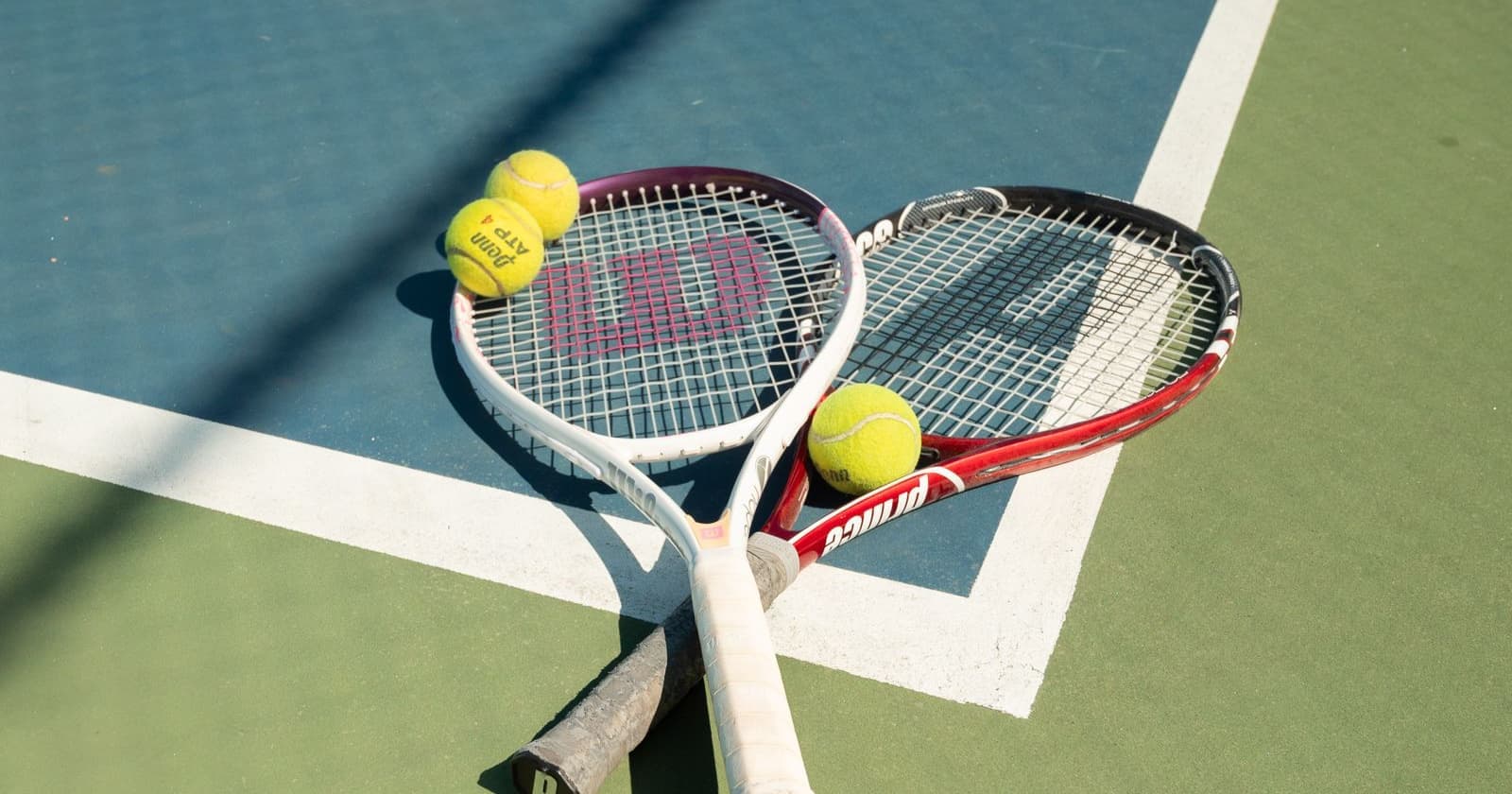
A squash racket has published maximum dimensions of 686 mm long and 215 mm wide with a maximum strung area of 500 square centimeters and a maximum weight of 255 g, and most weigh 90 to 150 g. A standard tennis racket is around 27 in with a head of 95 to 115 square inches and weighs 200 g unstrung to 360 g strung. You cannot substitute either for the other: the squash frame is too light and too small-faced to handle a tennis ball, and a tennis racket is both illegal and unwieldy in a squash court.
Disclosure — we earn a commission on qualifying purchases made through links on this page, at no extra cost to you. It never changes which product we rank first. How this site is funded.
Our picks
| # | Product | Best for | Score | Price |
|---|---|---|---|---|
| 1 | 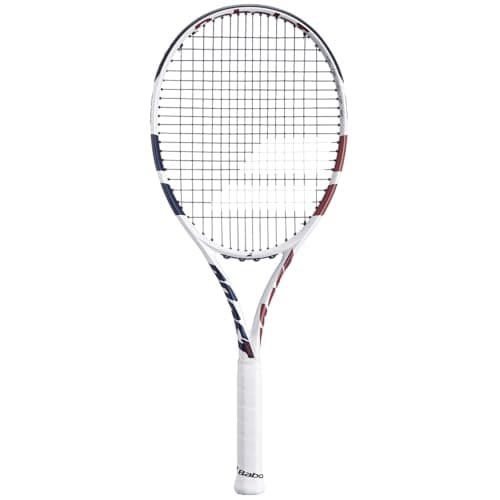 Babolat Boost DriveBest first tennis racket | A squash player's first tennis racket | 8.45 criteria | |
| 2 | 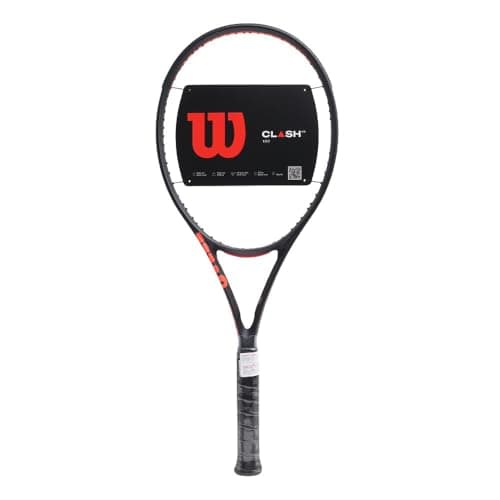 Wilson Clash 100 v3Best for a squash-trained arm | A wristy squash swing applied to tennis | 8.75 criteria | $224.25 · View on Amazon Price as of October 22, 2026 · was $299.00, 25% off |
| 3 | 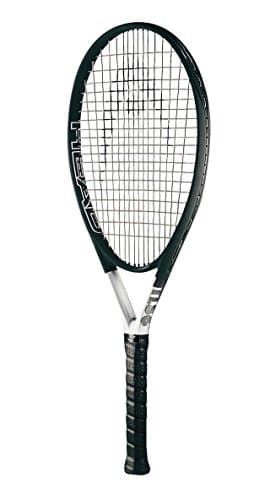 HEAD Titanium Ti.S6Lightest option | The shortest possible swing | 8.05 criteria |
The picks in detail
01Babolat Boost Drive
Best first tennis racketBest for: A squash player's first tennis racket
If you are coming to tennis from squash, the two things you have and the two things you lack are predictable. You have fast hands and a strong wrist; you lack a long shoulder-driven swing and the habit of hitting a ball that weighs several times what you are used to. This frame is built for exactly that profile: a 105 sq in head with a 16x19 open pattern at 9.7 oz / 275 g strung, which is light enough to swing with squash timing and large enough to forgive the contact point you have not learned yet.
The geometry is Pure Drive geometry in a beginner package, 3 points head heavy on a 312 swingweight with a 65 RA stiffness - so the mass that produces depth sits out in front of your hand rather than asking you to generate pace from the shoulder. For a player used to a 130 g racket, that head-heavy feel is also the most direct cue that the swing has to come from further back.
The honest cost is the ceiling. A 65 RA frame at 275 g is a stiff, light racket, which is a combination that gives you free power now and less feel later; and the open 16x19 pattern that helps you brush up on the ball also shortens string life. If your squash background means you already swing hard and cleanly, read the Clash below instead. Either way, [how to choose a tennis racket](/guides/how-to-choose-a-tennis-racket) is worth ten minutes before you buy.
Our score
- Power
- 8.5
- Control
- 7.0
- Forgiveness
- 9.0
- Arm comfort
- 8.0
- Maneuverability
- 8.5
- Overall
- 8.4
Verified specs
- Head size
- 105 sq in
- Strung weight
- 9.7 oz / 275 g
- Balance
- 3 pts head heavy
- Swingweight
- 312
- Stiffness (RA)
- 65
- Beam
- 23 / 26 / 23 mm
- String pattern
- 16x19
- Length
- 27 in
Specs as published by Tennis Warehouse, checked September 2026.
Buy if
- You are picking up tennis and have never owned a tennis racket
- You want the lightest standard-length frame that still has a big face
- You want free depth while you learn the swing
Pass if
- You already play tennis at club level
- You want maximum feel and control
- You have a history of arm pain
02Wilson Clash 100 v3
Best for a squash-trained armBest for: A wristy squash swing applied to tennis
A squash player's forearm and wrist do work a tennis player's do not, and that habit arrives in tennis as a very fast, very late racket head. The Clash exists for players who want the frame to bend with that: 54 RA is the softest stiffness rating on any mainstream 100 sq in racket, in a 24.5 mm uniform beam at 11 oz / 312 g strung and 7 points head light.
The practical consequence is comfort. A flexible frame deforms on impact rather than transferring the shock straight into your arm, which matters most in exactly the first season when your contact point is inconsistent and you are catching balls off-center. A 308 swingweight with a head-light balance also keeps the racket turning quickly, which is the feel a squash player will recognize.
The honest cost is pace and price. A 54 RA frame returns less of your energy than a stiff one, so if you want the ball to leave quickly without a full swing, the Boost Drive above or a [power frame](/tennis-rackets/best-for-power-and-spin) will do more for you. It is also a premium racket, which is a lot to spend before you know whether tennis will stick.
Our score
- Power
- 7.5
- Control
- 8.5
- Forgiveness
- 8.5
- Arm comfort
- 9.5
- Maneuverability
- 8.0
- Overall
- 8.7
Verified specs
- Head size
- 100 sq in
- Strung weight
- 11 oz / 312 g
- Balance
- 7 pts head light
- Swingweight
- 308
- Stiffness (RA)
- 54
- Beam
- 24.5 mm uniform
- String pattern
- 16x19
- Length
- 27 in
Specs as published by Tennis Warehouse, checked September 2026.
Buy if
- You generate racket head speed from your wrist and forearm
- You want the softest mainstream frame for arm comfort
- You intend to play regularly rather than occasionally
Pass if
- You want free power from a short swing
- You are not yet sure you will keep playing
- You want the lightest possible racket
Price as of October 22, 2026 · was $299.00, 25% off
03HEAD Titanium Ti.S6
Lightest optionBest for: The shortest possible swing
This is the frame that comes closest to a squash racket's hand feel in the tennis aisle, and the numbers say why: 8.6 oz / 244 g strung, which is the lightest racket in common circulation and only around 100 g heavier than a typical squash frame, under a 115 sq in head. If the physical weight of a tennis racket is the thing stopping you, this is the answer to that specific problem.
It is also the most forgiving racket on this page by a wide margin. A 115 sq in head with a 309 swingweight and 7 points head heavy balance produces depth almost regardless of swing length - which is genuinely useful for a player whose instinct is a compact wrist flick rather than a full shoulder turn. It arrives strung, and at 27.75 in it is slightly longer than standard, which adds reach.
The honest cost is control and comfort, and it is substantial. A 71 RA frame on a 27 / 28 / 27 mm beam is a stiff racket, and stiff plus light plus a huge head is the combination that gives you the least feedback and the most arm load per shot - which is why a player with elbow history should look at our [tennis elbow picks](/tennis-rackets/best-for-tennis-elbow) instead. You will also outgrow it: control-oriented players find a 115 sq in head overpowers them within a season.
Our score
- Power
- 9.5
- Control
- 5.5
- Forgiveness
- 9.5
- Arm comfort
- 7.5
- Maneuverability
- 9.5
- Overall
- 8.0
Verified specs
- Head size
- 115 sq in
- Strung weight
- 8.6 oz / 244 g
- Balance
- 7 pts head heavy
- Swingweight
- 309
- Stiffness (RA)
- 71
- Beam
- 27 / 28 / 27 mm
- String pattern
- 16x19
- Length
- 27.75 in
Specs as published by Tennis Warehouse, checked September 2026.
Buy if
- The weight of a tennis racket is your main obstacle
- You want depth from a short, wristy swing
- You want a strung racket for the lowest outlay
Pass if
- You want to place the ball rather than hit through it
- You have any history of elbow pain
- You expect to improve quickly
The published specifications side by side
Start with the numbers, because every behavioral difference between the two rackets falls out of them. Squash's governing specification is unusually tidy: a squash racket has published maximum dimensions of 686 mm long and 215 mm wide, a maximum strung area of 500 square centimeters, and a permitted maximum weight of 255 g - and most squash rackets weigh between 90 and 150 g, which is to say well under half the legal ceiling.
Tennis is described differently. The reference we used gives 69 cm (27 in) as the length stronger players typically use, with some models running 70 to 74 cm (27.5 to 29 in), and notes that a 81 cm (32 in) frame is no longer legal at that length - but it does not state a current maximum length figure, and we are not going to supply one. Head sizes in current use run 610 to 740 square centimeters (95 to 115 square inches), most professionals use 630 to 700 square centimeters, and anything above 880 square centimeters (137 square inches) is not legal. Weights run from 200 g unstrung to 360 g strung.
| Tennis racket | Squash racket | |
|---|---|---|
| Typical length | 69 cm / 27 in; some models 70-74 cm (27.5-29 in) | Maximum 686 mm (27.0 in) |
| Maximum length | Not stated by the source we used | 686 mm (27.0 in) |
| Maximum width | Not stated by the source we used | 215 mm (8.5 in) |
| String area in use | 610-740 cm2 (95-115 sq in); pros 630-700 cm2 | Maximum 500 cm2 (77.5 sq in) |
| String area limit | Above 880 cm2 (137 sq in) is not legal | 500 cm2 (77.5 sq in) |
| Weight | 200 g (7 oz) unstrung to 360 g (12.6 oz) strung | Maximum 255 g (9.0 oz); most 90-150 g |
| Ball struck | 56.0-59.4 g pressurized felt ball, 6.54-6.86 cm across | 23-25 g hollow rubber ball, 39.5-40.5 mm |
| String material in common use | Polyester is the string of choice today | Synthetic strings, having replaced natural gut |
Two gaps in that table do the explaining. The first is weight: a typical squash racket at 90 to 150 g against a tennis racket at 300 g or more strung is a two-to-three-times difference in the mass your hand is accelerating. The second is string area: 500 square centimeters is the squash ceiling, and the smallest head in current tennis use is 610 square centimeters - so even the most control-oriented tennis frame is strung over more area than any legal squash racket.
Why the frames diverged: it is the ball
Equipment follows the projectile. A squash ball is a hollow rubber sphere of 39.5 to 40.5 mm weighing 23 to 25 g, made from two rubber compound pieces glued into a shell, and the competition version barely bounces at all until it has been warmed up by hitting. A tennis ball, under the ITF ranges, is a pressurized felt-covered ball of 56.0 to 59.4 g measuring 6.54 to 6.86 cm across, and it bounces high and leaves the strings fast. One of those is well over twice the mass of the other.
A light ball that does not bounce needs a light racket you can swing very fast and place very precisely, because the game is about getting the ball into a corner it cannot come out of. A heavy ball that bounces hard needs mass behind it, because the racket has to survive the collision and redirect real momentum - and a 130 g frame simply gets pushed backwards by a tennis ball struck with any pace.
Everything else follows from that. Squash's small 500 square centimeter face is enough because the ball is small and the swing is precise; tennis needs a bigger face because the ball arrives faster over a longer distance with more spin on it. Squash rackets are strung at low tensions in thin synthetic strings for feel; tennis has moved to polyester for durability and spin, which is covered in tennis string types. And the swings are different in kind, not degree: squash is wrist and forearm inside a confined court, tennis is a shoulder-driven rotation with room to run.
Can you use a tennis racket for squash?
On the published numbers, usually not legally, and never well. A squash racket's maximum length is 686 mm - about 27.0 inches - which is exactly the length of a standard tennis racket, so a standard 27 in tennis frame sits right at the limit and any extended-length model from 27.5 to 29 in is over it. The width limit is tighter still: 215 mm, about 8.5 inches, against a tennis head that is routinely wider than that. And the strung-area ceiling of 500 square centimeters rules out every tennis head in current use, the smallest of which is 610 square centimeters.
Set the rules aside and it still does not work. A squash court is a confined box where the ball is dug out of back corners and the nick, and a 300 g frame with a wide head is both slow to turn in your hand and physically awkward against a side wall. You would also be hitting a 24 g ball with a racket built to survive a ball more than twice that mass, which gives you no feel for a shot whose entire point is touch.
The reverse direction is simply impossible rather than merely ill-advised. A 130 g squash racket against a tennis ball struck at club pace gets pushed back on contact: you will lose depth, the frame will twist in your hand on anything off-center, and the 500 square centimeter face gives you very little margin on a ball with topspin. Squash rackets are also built for a far lower stringing load, and stringing one up to a tennis tension is a good way to end up with a broken frame.
What transfers if you switch sports
The equipment does not transfer; a surprising amount of the player does. If you are moving between these two sports, it is worth knowing which of your existing habits is an asset and which is going to fight you for a season.
Squash to tennis
- What helps: racket head speed, wrist strength, reading an opponent's body, and comfort with long attritional rallies. Squash players also tend to have excellent footwork for short recovery steps.
- What fights you: the swing length. A squash forehand is generated close to the body with a late wrist; a tennis forehand needs a shoulder turn and a longer path, and a wristy tennis swing sprays the ball and loads the elbow. Expect to deliberately unlearn it.
- What to buy first: a light, forgiving frame rather than a player's racket, and court shoes that are not your squash shoes - indoor squash shoes have gum outsoles that are wrong on an outdoor hard court. What are court shoes covers the difference.
Tennis to squash
- What helps: hand-eye coordination, timing, and an existing sense of how to open up a court. Tennis players usually hit a clean ball from the first session.
- What fights you: the dead ball and the tin. A squash ball has to be warmed up before it behaves, and the bottom half-meter of the front wall is a penalty area, so the flat, hard, low shot that wins tennis points is the shot that ends your rally in a squash court.
- What to buy first: a cheap squash racket - not your tennis one - and a blue-dot ball, which is graded fast with very high bounce and is sold for beginners precisely because it keeps a rally alive while you learn.
If the choice is still open and you are only going to pick up one racket this year, our skill levels explained page is a more useful starting point than any spec comparison - it sets out what each sport asks of a genuine beginner before you spend anything.
Buying your first tennis racket as a squash player
The three frames above are the shortlist, and they map onto three different versions of the same decision. Work through it in this order.
- 01If the physical weight of a tennis racket is what is putting you off, take the HEAD Titanium Ti.S6 at 244 g strung - the lightest frame in common circulation - and accept that it is stiff, powerful and something you will outgrow.
- 02If you want the normal recommendation, take the Babolat Boost Drive. A 105 sq in head at 275 g with Pure Drive geometry is the standard answer for a new tennis player, and nothing about a squash background changes that.
- 03If you already swing hard and you are going to play weekly, take the Wilson Clash 100 v3. A 54 RA frame is the softest mainstream racket available and the best answer to a squash-trained arm that is about to start hitting a much heavier ball.
- 04Then sort out the grip size before anything else. It is the one specification that genuinely carries over from your squash racket, and getting it wrong costs you more than any frame choice - tennis racket grip size has the measurement.
One thing not to do: do not buy a heavy control frame because it looks like what good players use. A 320 g player's racket asks for a swing you do not have yet, and the result is a late contact point and a sore elbow. Head size and racket weight both explain the trade in more detail, and both say the same thing - start lighter and larger than your ego suggests.
How this comparison was put together
We do not run a test lab, and nothing here is written as though we had played both sports competitively. Every dimension, weight and strung-area figure on this page was read from the reference entry or retailer specification sheet cited at the foot of the article, all retrieved on 2026-10-22. Where a source does not publish a figure, this page says so rather than converting or estimating one.
Our full selection criteria set out the method, and the editorial policy covers corrections and how often pages are revisited. We earn a commission if you buy through our links, which is disclosed on every page and never changes what we recommend.
Common questions
What is the difference between a tennis racket and a squash racket?
Size, weight and string area. A squash racket has published maximums of 686 mm long, 215 mm wide, 500 square centimeters of strung area and 255 g of weight, with most weighing 90 to 150 g. A tennis racket is around 27 in long with a head of 610 to 740 square centimeters and weighs 200 g unstrung to 360 g strung - so it is heavier, wider and strung over more area than any legal squash racket.
Can I use a tennis racket for squash?
Not legally, in most cases, and not well in any case. A squash racket is capped at 686 mm long, 215 mm wide and 500 square centimeters of strung area; a standard tennis racket sits right at that length limit, an extended-length model exceeds it, and every tennis head in current use exceeds the strung-area limit. It would also be slow and awkward in a confined court against a ball that weighs under half a tennis ball.
Can I use a squash racket for tennis?
No. At 90 to 150 g a squash racket is far too light to redirect a 56 to 59 g tennis ball struck with pace - it gets pushed back on contact and twists on off-center hits - and a 500 square centimeter face gives you almost no margin on a spinning ball. Squash frames are also built for much lower string tensions than tennis uses.
Is a squash racket lighter than a tennis racket?
Much lighter. Most squash rackets weigh 90 to 150 g against 200 g unstrung to 360 g strung for a tennis racket, and the squash legal maximum of 255 g is below what a typical adult tennis racket weighs strung. That single difference is why the two swings are so unalike.
Are squash and tennis grips the same size?
They are close enough that your hand size preference carries over, and overgrips are entirely interchangeable - the same roll will wrap either racket. Strings, tensions and head shapes do not cross over.
Which is harder on your arm, tennis or squash?
The impact loads are higher in tennis, because the ball is more than twice the mass and arrives faster, which is why tennis elbow is named after tennis rather than squash. Squash asks more of the wrist and shoulder through sheer repetition in a confined space. Neither observation is medical advice - if you have pain, see a professional, and read tennis elbow vs golfer's elbow for what the two injuries actually are.
Does my tennis racket's string tension apply to a squash racket?
No, and do not try it. Squash frames are built for a far lower stringing load than tennis frames, and pulling tennis tensions through one risks distorting or breaking the head. Our string tension guide is tennis-specific for exactly that reason.
Read next
Sources
- 01Wikipedia - Racket (sports equipment): tennis and squash dimensions
- 02Wikipedia - Squash: racket limits and ball specification
- 03Wikipedia - Tennis ball: ITF mass and diameter
- 04Tennis Warehouse - Babolat Boost Drive
- 05Tennis Warehouse - Wilson Clash 100 v3
- 06Tennis Warehouse - HEAD Titanium Ti.S6
Every source above was retrieved while writing this page. Specifications are quoted from the listing or manufacturer page cited, not from memory.