Guide
Pickleball paddle grip size explained
The one spec you can fix after you buy, and the one most players never check. Too small and you squeeze; too large and you fight for control - and both roads end at a sore forearm.
By Janet H.Updated
The short answer
Pickleball paddle grips run from 4 to 5 inches in circumference. To find yours, open your dominant hand and measure from the middle of the three palm creases to the tip of your ring finger - the figure in inches, usually between 4 and 5, is your circumference. When you are between sizes, buy the smaller paddle: an overgrip adds circumference, and nothing removes it.
Disclosure — we earn a commission on qualifying purchases made through links on this page, at no extra cost to you. It never changes which product we rank first. How this site is funded.
What grip size actually means
Grip size on a pickleball paddle is a circumference: the distance around the handle, measured in inches. Selkirk's guide puts the range plainly - pickleball paddle grips start at 4 inches and go up to 5 inches in circumference - and notes that in practice sizes vary within about an inch of each other.
That is a narrower range than it sounds, and it is why the spec gets ignored. An inch of circumference across the whole category means the difference between a small grip and a large one is a few millimeters of handle diameter - small enough that it is easy to pick up a paddle, decide it feels fine, and never think about it again. It is also small enough that a single overgrip moves you a meaningful part of the way across the range, which is the useful half of this page.
Grip size is not the same thing as handle length, and the two get confused constantly because both are printed in inches. Circumference is how thick the handle is; length is how far it extends from the paddle face, and Selkirk note that handles are usually around 4.5 inches long with a maximum of about 6 inches for players who hit some shots two-handed. Circumference is a fit question for one hand. Length is a technique question about whether a second hand will fit on there at all.
How to measure your grip size in thirty seconds
There is one method worth using and one worth knowing about as a fallback. Selkirk's guide sets out both.
The ruler test, which is the accurate one
- 01Open your dominant hand, palm up, fingers extended.
- 02Find the creases in your palm. There are two lateral creases running across the hand and one arc-shaped crease running toward your wrist - three in total.
- 03Measure from the bottom lateral crease, which is the middle of the three, straight up to the tip of your ring finger.
- 04Read the figure in inches. Selkirk say it will land somewhere between 4 and 5 inches, and that number is your grip circumference.
The height chart, which is the fallback
| Your height | Suggested circumference |
|---|---|
| Below 5 ft 3 in (160 cm) | 4 in |
| 5 ft 3 in to 5 ft 8 in (160-173 cm) | 4.25 in |
| Above 5 ft 8 in (173 cm) | 4.5 in |
Use the ruler test if you can. Height correlates with hand size loosely and nothing more; two people the same height can be a full size apart. One thing specifically not to do: Selkirk note that the tennis index-finger test - sliding your index finger into the gap between fingertips and palm - does not apply to pickleball grip sizing. If you have come from tennis, that is the habit to drop. Our tennis racket grip size guide covers the tennis method, and it is a different method for a reason.
What goes wrong at each end
Both errors end in the same place, which is the useful thing to understand about this spec. Selkirk describe it directly: if the grip is too small you tend to hold the paddle more tightly than necessary, and if the grip is too big you have to strain more to get the control you need over your shots. They link either problem to muscle fatigue, which they say can eventually lead to pickleball elbow.
Too small
A thin handle gives your fingers nothing to close around, so you grip harder to stop the paddle twisting. Squeezing is a continuous low-level contraction of the forearm flexors, held for the length of a session, and it is the most direct route to a tired and then sore forearm. The paddle also rotates more on off-center contact, because a smaller handle gives your hand less leverage against the twist.
Too large
A thick handle is the opposite failure. Your fingers cannot wrap far enough around to control the face, so you lose the fine wrist movement that shapes a dink or rolls a drive, and you compensate with more arm. Selkirk describe this as having to strain more for the control you need. It also restricts the full range of motion they identify as the mark of a correctly sized grip: large enough to play comfortably while still allowing the hand to move.
If either of those sounds like your experience, grip size is worth checking before anything else in your kit, because it is the cheapest variable in the sport to change. And if you already have elbow pain, read it as a signal rather than a verdict - our pickleball paddles for tennis elbow picks cover the equipment side, and tennis elbow vs golfer's elbow covers what the injuries actually are. Neither is medical advice.
The rule that makes this easy: buy small, build up
Here is the asymmetry that settles almost every grip-size question. Selkirk put it in one line: you can always add an overgrip, or two, to your paddle to increase the circumference. There is no equivalent move in the other direction - a handle that is too thick cannot be made thinner without taking the factory grip off and rebuilding it, which is a job most players will not do.
So when you are between two sizes, buy the smaller paddle. An overgrip adds a wrap of material around the handle and moves you a fraction of an inch up the range; two overgrips move you further. You get to tune the fit after you own the paddle, in five minutes, for the price of a coffee - and if you get it wrong you unwrap it and try again.
There is a second reason to own overgrips regardless of size. Selkirk note that grips can change size over time as they wear away or swell up with moisture, and that they should be checked regularly. A factory grip that has compressed over a season is a grip that has got smaller without you noticing, which is how a correctly fitted paddle quietly becomes a slightly-too-small one. Replacing the overgrip resets it.
Handle length is the other half of the decision
Circumference decides whether the paddle fits your hand. Length decides whether it fits your stroke, and for one group of players it is the more consequential spec of the two.
Selkirk put typical handle length at around 4.5 inches, with a maximum of about 6 inches for players who hit some shots two-handed. That upper band is the whole story: if you hit a two-handed backhand, you need somewhere for the second hand to go, and below about 5 inches there is simply no room for it. Registry paddles cluster around that threshold - the Vatic Pro V-SOL Pro publishes a 5.3 to 5.6 inch handle, the Six Zero Coral is sold in 5.5 and 5.75 inch handles, and the JOOLA Ben Johns Hyperion CFS 16 and Ronbus Quanta Pro both publish 5.5 inches.
The trade is that handle length comes out of the face. A paddle is capped on combined length plus width, so every extra inch of handle is an inch the hitting surface does not get - which is why elongated paddles with long handles have narrower faces and smaller sweet spots. If you hit one-handed, a shorter handle and a bigger face is the better deal, and nothing about a long handle will help you.
One honest limit on this page: several paddles publish a single handle figure and nothing about circumference, and a couple publish a figure in the 4 to 4.25 inch range that could be either a short handle or a grip circumference. We have not guessed which. Where a paddle's circumference is not published, measure your hand, buy the paddle on its other merits and tune the grip with an overgrip - which is the advice this whole page converges on anyway. Pickleball paddle weight covers the spec that does change how a paddle plays, and how to choose a pickleball paddle covers the full decision.
What to do, in order
- 01Measure from the middle palm crease to your ring fingertip. That figure in inches is your circumference, and it will be between 4 and 5.
- 02If you cannot measure, use the height chart - 4 inches below 5 ft 3 in, 4.25 inches to 5 ft 8 in, 4.5 inches above that - and treat it as a rough guide rather than an answer.
- 03Decide on handle length separately. Two-handed backhand means 5.5 inches or more; one-handed means take the bigger face instead.
- 04When you are between circumferences, buy the smaller paddle. Always.
- 05Add an overgrip to bring it up to your measurement, and keep a spare. Replace it when it compresses or stops feeling dry - the fit changes as it wears.
The three overgrips below are the ones we would actually buy for this job, and they split along one line: whether you want tack or a dry feel in your hand.
How this guide was put together
We did not measure any hands or any paddles. Racket & Rally does not run a test lab, and nothing on this page is written as though we had. Every circumference figure, measuring step and height band is quoted from the guide cited at the foot of the page, retrieved on 2026-11-05; handle-length figures are the published specifications for those paddles.
Our full selection criteria set out the method, and the editorial policy covers corrections and how often pages are revisited. We earn a commission if you buy through our links, which is disclosed on every page and never changes what we recommend.
Now pick yours
The specs above are only useful once they resolve into something you can buy. These are the products that match what this page has just explained.
Our picks
| # | Product | Best for | Score | Price |
|---|---|---|---|---|
| 1 | 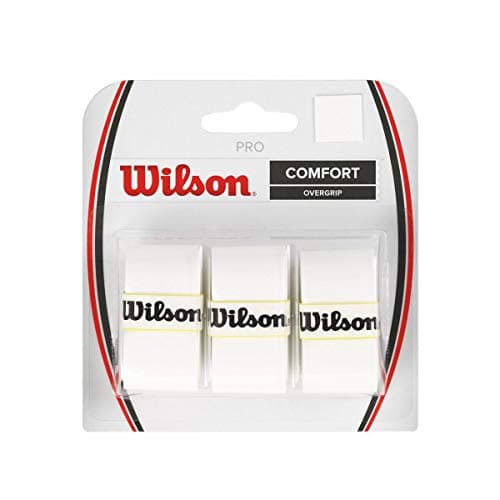 Wilson Pro OvergripBest for fine tuning | Adding the least circumference per wrap | 8.64 criteria | |
| 2 | 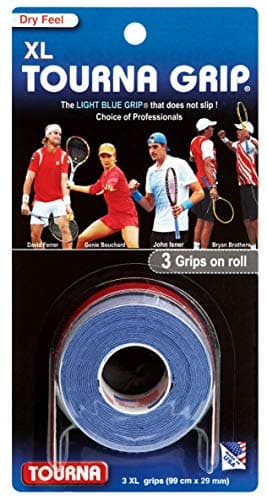 Tourna Grip OriginalBest dry feel | Hands that sweat | 8.54 criteria | |
| 3 | 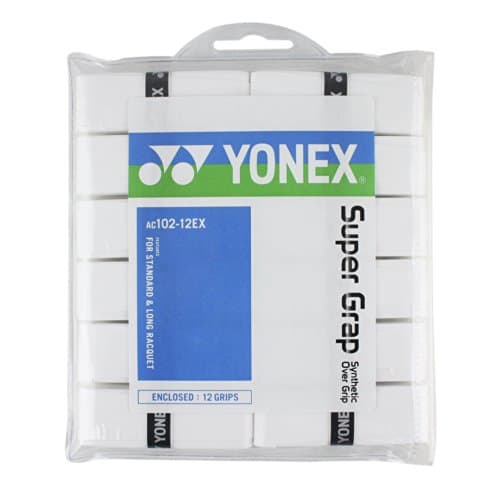 Yonex Super GrapBest for adding size | Building up a handle that is genuinely too thin | 8.54 criteria |
01Wilson Pro Overgrip
Best for fine tuningBest for: Adding the least circumference per wrap
This is the one to buy if your measurement says you are only slightly under your paddle's handle. Tennis Warehouse list it as a thin overgrip that keeps grip size minimal, which is exactly the property you want when you are tuning rather than rebuilding - one wrap moves you a small, controllable amount up the range instead of overshooting.
It is also the category's default tacky grip and a Tennis Warehouse best seller, sold in multipacks, which matters because an overgrip is a consumable. Selkirk's point about grips changing size as they wear or swell with moisture only has a cheap answer if you own more than one.
The honest cost is what tack does in sweat. A tacky surface is grippy dry and slicker than a dry-feel grip once it is wet, so if your hands sweat heavily this is the wrong family - take the Tourna Grip below instead. Being thin also cuts both ways: if you need to add a lot of circumference you will be stacking two or three wraps, at which point a thicker grip is tidier.
Our score
- Performance
- 8.5
- Comfort
- 8.5
- Durability
- 7.5
- Value
- 9.0
- Overall
- 8.6
Verified specs
- Type
- Tacky
- TW status
- Best Seller
- Profile
- Thin — keeps grip size minimal
- Listed price
- $9.00 for 3
Specs as published by Tennis Warehouse, checked September 2026.
Buy if
- You are a fraction under your measured circumference
- You want the most controllable increment per wrap
- Your hands stay reasonably dry
Pass if
- Your hands sweat heavily
- You need to add a lot of circumference at once
- You want a cushioned feel
02Tourna Grip Original
Best dry feelBest for: Hands that sweat
If you are squeezing the paddle because it is slipping rather than because it is too thin, grip size is not your problem and this is the fix. Tourna Grip is the dry-feel reference in racquet sports: it absorbs sweat rather than relying on tack, and it gets grippier as it takes on moisture instead of slicker.
That distinction matters for the specific failure this page is about. A wet tacky grip makes you grip harder, which produces exactly the forearm fatigue Selkirk attribute to a badly sized grip - so a player with sweaty hands can have a perfectly measured handle and still get the symptoms. Changing the surface is cheaper than changing the paddle.
Two honest costs. It has a distinctly dry, slightly abrasive feel that players either prefer immediately or dislike immediately, and there is no middle ground to grow into. And it is the least durable family here - a dry grip that is doing its job is a grip that is absorbing, and absorbed sweat is what ends it. Buy it on a roll. [Best overgrips for sweaty hands](/gear/best-overgrips-for-sweaty-hands) goes through the whole category.
Our score
- Performance
- 9.0
- Comfort
- 7.5
- Durability
- 7.0
- Value
- 9.0
- Overall
- 8.5
Verified specs
- Type
- Dry / absorbent
- Strength
- Sweat absorption
- Listed price
- From $6.75
Specs as published by Tennis Warehouse, checked September 2026.
Buy if
- Your hands sweat and the paddle slips
- You prefer a dry feel to a tacky one
- You play in heat or humidity
Pass if
- You want a tacky surface
- You want the longest-lasting wrap
- You want cushioning as well as grip
03Yonex Super Grap
Best for adding sizeBest for: Building up a handle that is genuinely too thin
When your measurement says you are well under your paddle's handle, this is the sensible wrap. It is a tacky grip with more cushioning than the thin Wilson above, which means a single wrap adds more circumference and more padding at the same time - the combination you want when the handle is genuinely small in your hand rather than marginally so.
Cushioning does a second job worth naming. Part of what a too-small grip costs you is the paddle twisting on off-center contact, and part of what you feel from that is transmitted through a thin, hard handle. A softer wrap takes some of that out, which is the same argument our [paddles for tennis elbow](/pickleball/best-paddles-for-tennis-elbow) page makes about the whole handle assembly.
The honest cost is the same tack problem as the Wilson, plus one more: a thicker, more cushioned wrap gives you less feedback about where on the face you made contact. If you are working on touch shots at the kitchen line, that is a real trade. It is also a tacky grip, so heavy sweaters should still be looking at the Tourna above.
Our score
- Performance
- 8.5
- Comfort
- 9.0
- Durability
- 7.5
- Value
- 8.5
- Overall
- 8.5
Verified specs
- Type
- Tacky
- TW status
- Best Seller
- Listed price
- $8.00 single, $23.00 for 12
Specs as published by Tennis Warehouse, checked September 2026.
Buy if
- Your measurement is well above your paddle's handle
- You want cushioning as well as circumference
- You want a tacky surface
Pass if
- You only need a fraction more circumference
- You want maximum feedback on touch shots
- Your hands sweat heavily
Common questions
How do I measure my pickleball paddle grip size?
Open your dominant hand palm up with the fingers extended, find the three creases in your palm, and measure from the bottom lateral crease - the middle of the three - to the tip of your ring finger. That figure in inches is your grip circumference, and Selkirk say it will land somewhere between 4 and 5 inches.
What grip sizes do pickleball paddles come in?
Circumferences run from 4 inches to 5 inches, and in practice most of the category sits within about an inch of itself - so the gap between a small grip and a large one is only a few millimeters of handle diameter. That is also why a single overgrip makes a meaningful difference.
Should I size up or down if I am between grip sizes?
Down, every time. You can add an overgrip - or two - to increase the circumference, and there is no equivalent move to make a too-thick handle thinner without stripping and rebuilding the grip. Buying small and building up means you tune the fit after you own the paddle.
What happens if my pickleball grip is too small?
You hold the paddle more tightly than necessary, which is a continuous forearm contraction held for the whole session, and the paddle twists more on off-center contact. Selkirk link that kind of muscle fatigue to pickleball elbow. The cheap fix is an overgrip, not a new paddle.
What happens if my pickleball grip is too big?
Your fingers cannot wrap far enough around the handle to control the face, so you strain for the control you want and lose the wrist movement that shapes a dink or a roll. Selkirk describe a correctly sized grip as large enough to play comfortably while still allowing a full range of motion.
Is pickleball grip size the same as tennis grip size?
The ranges are similar but the method is not. Selkirk note specifically that the tennis index-finger test does not apply to pickleball grip sizing - use the palm-crease-to-ring-finger measurement instead. Our tennis racket grip size guide covers the tennis approach.
Does grip size change over time?
Yes, and it is worth rechecking. Selkirk note that grips can change size as they wear away or swell up with moisture, so a correctly fitted paddle can quietly become slightly too small over a season of compression. Replacing the overgrip resets both the size and the surface.
How long should a pickleball paddle handle be?
Around 4.5 inches is typical, with up to about 6 inches for players who hit some shots two-handed. If you hit a two-handed backhand, 5.5 inches or more is the practical floor - below about 5 inches there is no room for the second hand. If you hit one-handed, take the shorter handle and the bigger face instead.
Read next
Sources
- 01Selkirk Sport - how do I know my pickleball grip size
- 02Tennis Warehouse - best overgrips
- 03Pickleheads - pickleball paddles (published handle specifications)
Every source above was retrieved while writing this page. Specifications are quoted from the listing or manufacturer page cited, not from memory.